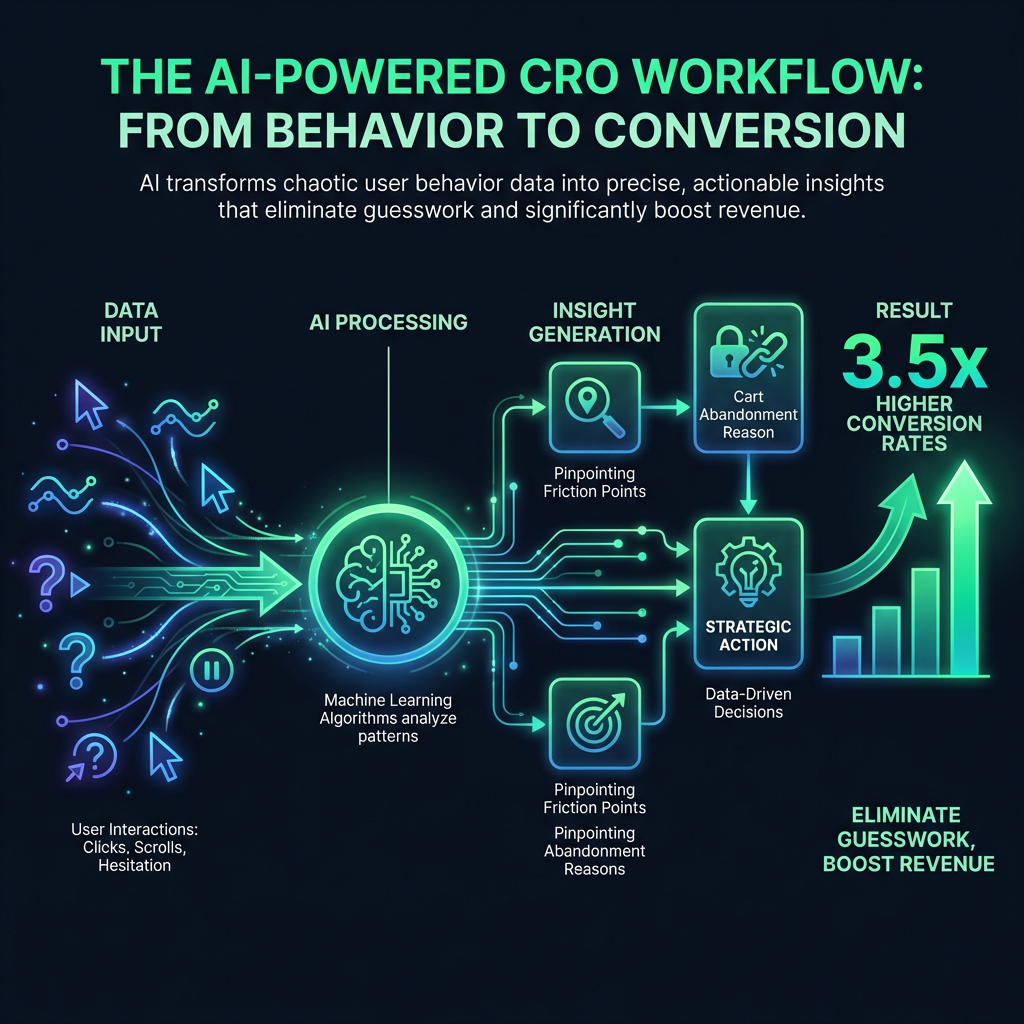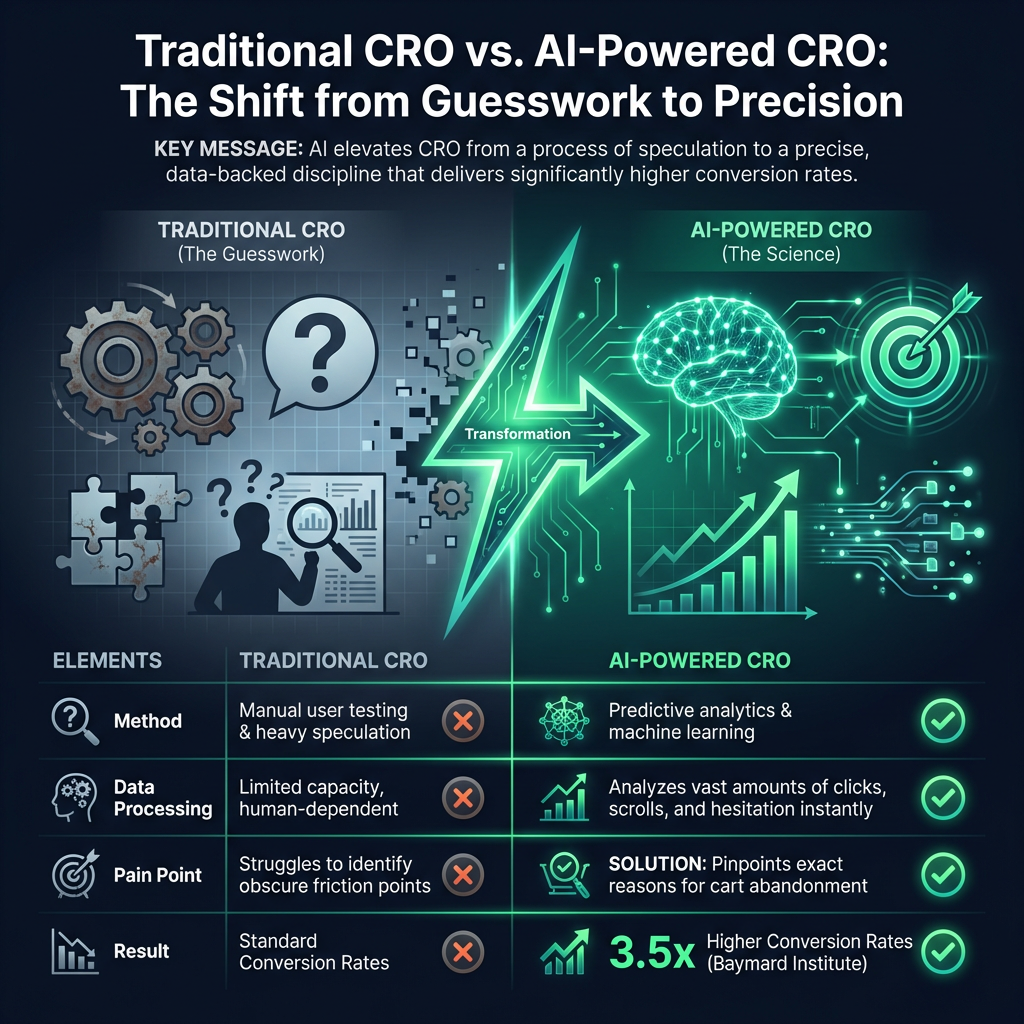

AI conversion rate optimization (AI CRO) is the use of machine learning and large language models to speed up the parts of conversion work that used to be slow and manual: auditing pages, predicting where visitors will look, drafting test variants, reading thousands of survey answers and reviews, and personalising what each visitor sees. AI does not replace the CRO process. It shortens the research and production steps, while people still choose hypotheses, approve changes and judge test results.
What is AI conversion rate optimization (AI CRO)?
Classic CRO is a loop: research what stops visitors from converting, turn findings into hypotheses, prioritise them, test the best ones, learn, repeat. AI CRO keeps exactly the same loop. What changes is the cost of each step:
| CRO step | Without AI | With AI | Who still decides |
|---|---|---|---|
| Research | Manual page reviews, reading feedback by hand | Automated audits, attention prediction, clustering of qualitative data | Analyst checks every finding against real data |
| Hypotheses | Workshop, spreadsheet | Draft hypotheses generated from findings | CRO lead picks and rewrites |
| Variants | Copywriter and designer from scratch | Many drafts in minutes, filtered by guardrails | Brand owner approves |
| Testing | A/B test | A/B test (AI can help monitor and summarise) | Statistics, not the model |
| Learning | Test reports | Searchable summaries of past tests | Team |
The practical rule: use AI to produce more and better inputs to decisions, never to skip the evidence that a change works.
Where does AI help with conversion optimization today?
Six use cases hold up in real programs. For each: how it works, what to watch out for, and a workflow.
1. AI page audits and heuristic review
How it works. A model loads a page (often as a screenshot plus the HTML), compares it with known usability and persuasion principles, and returns a list of issues: a weak value proposition, a CTA below the fold on mobile, missing trust signals near the buy button, a form asking for too much. Good tools rank findings by impact and propose fixes. It is a faster version of the heuristic evaluation method built on Jakob Nielsen's ten usability heuristics (Nielsen Norman Group).
Watch out for. Models can state a finding confidently that is not true on the live page, for example "there is no shipping information" when it sits in a tab the screenshot did not capture.
Workflow.
- Pick your three highest-traffic conversion pages.
- Run an AI audit on desktop and mobile separately. A tool such as an AI CRO audit that ranks findings by impact does this from a URL.
- Verify each finding by opening the page yourself on both devices. Delete anything you cannot reproduce.
- Cross-check surviving findings against analytics (does the "weak CTA" page also show low click-through?).
- Move confirmed findings into your backlog with a short evidence note.
If you want to compare the AI output with your own judgement, run a manual pass first using a DIY heuristic evaluation, then see what the model found that you missed and vice versa.
2. Predictive attention heatmaps
How it works. A model trained on eye-tracking data predicts where people are likely to look in the first seconds on a design. Because it works from an image, it needs no tracking script and no traffic, so you can check a mockup before it ships. EyeCaptain's AI attention heatmaps work this way.
Watch out for. Predicted attention is not behaviour. It tells you whether the headline and CTA are likely to be seen early, not whether people click, scroll or buy.
Workflow. Generate a heatmap for the current page and for each design candidate. Use one decision rule: if the primary CTA and the core value proposition are not among the strongest attention areas above the fold, fix the visual hierarchy before running a test.
3. Copy and variant generation with guardrails
How it works. Language models draft headlines, CTA labels, product descriptions, form microcopy and error messages. The value is volume: 30 angles on a headline in a minute.
Watch out for. Generic output, invented claims ("trusted by 10,000 teams" when you have no such number), off-brand tone and legal risk in regulated categories.
Workflow with guardrails.
- Give the model a brief: audience, the objection you are addressing, the evidence you have (real numbers, real reviews), your voice rules, and banned words.
- Ask for variants grouped by angle (risk reversal, speed, social proof, specificity), not 30 near-identical lines.
- Filter every draft through a checklist: Is every claim true and provable? Does it match the ad or email that sent the visitor? Is it in our voice? Does it fit on mobile?
- Pick one challenger per test. Testing five AI headlines at once splits your traffic five ways and makes the test much slower.
4. Analysing qualitative data at scale
How it works. This is where AI saves the most time. Paste or upload survey answers, product reviews, support tickets, chat logs or sales call notes, and ask the model to cluster them into themes, count mentions per theme, and pull representative quotes.
Watch out for. Models can merge distinct themes, invent quotes, or overweight vivid but rare complaints. Always ask for verbatim quotes with an ID you can look up, and spot-check counts on a sample.
Workflow. Export 200 to 1,000 recent responses, remove names, emails and order numbers, run the clustering prompt from the prompt section below, then read 20 random rows yourself to see whether the themes hold. Turn the top three objections into page changes or test ideas.
5. Personalisation and recommendation
How it works. Models decide which product, offer, message or layout to show each visitor based on signals such as traffic source, location, device, browsing history or cart contents. This includes product recommendations, search ranking and multi-armed bandits.
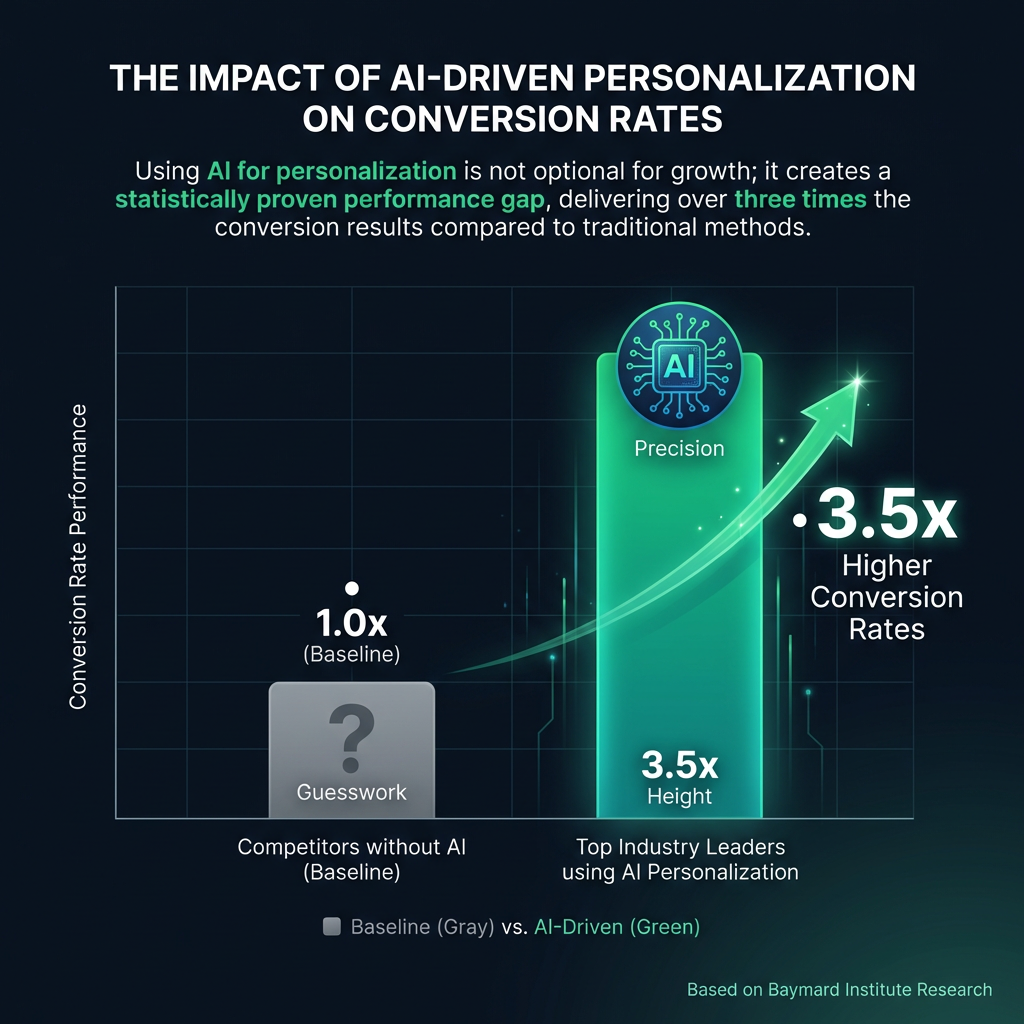
Watch out for. Personalisation needs volume; with small traffic the model has little to learn from. It is also hard to measure: without a holdout group that sees the non-personalised experience, you cannot know whether it helped. And it depends on data you may only use with consent.
Workflow. Start with one rule-based segment that has an obvious reason to differ (for example, paid search visitors landing on a page whose headline matches their ad). Keep 10% to 20% of traffic as a holdout. Only move to model-driven personalisation once simple segments have shown a measurable difference.
6. AI agents that run parts of the CRO loop
Agents chain the five uses above; see the next section for what they can and cannot do.

What can an AI CRO optimization agent actually do?
An AI CRO agent is a model that takes several steps in a row with tools: open pages, take screenshots, read an analytics export, list findings, draft hypotheses and copy, and sometimes create an experiment in a testing tool. What works today:
| Task | Can an agent do it reliably? | Notes |
|---|---|---|
| Crawl pages and flag heuristic issues | Yes, with human verification | Best for breadth across many pages |
| Summarise analytics and highlight drop-offs | Mostly | Check that it read the right date range and segment |
| Cluster qualitative feedback | Yes, with spot checks | Ask for verbatim quotes with IDs |
| Draft hypotheses and variant copy | Yes, as drafts | Needs brand and legal review |
| Choose which hypothesis to test | No | Depends on strategy, cost, risk and context it lacks |
| Launch tests and ship winners on its own | Not safely | Errors reach real customers; keep a human approval step |
| Decide whether a test won | No | That is a statistical call with pre-set rules |
The pattern that works is "agent drafts, human decides". Let the agent do the research and paperwork overnight; a person reviews the output, picks hypotheses with a scoring model such as the ICE, PIE or PXL prioritisation frameworks, and approves anything that touches the live site.
Which AI prompts for conversion optimization work best?
Replace the bracketed parts. Each prompt demands evidence, the best defence against made-up findings.
Prompt 1: Turn reviews into objections
Below are [N] customer reviews of [product]. Group them into the objections, doubts or questions people had before buying. For each objection give: a one-line name, how many reviews mention it, and 2 verbatim quotes with their review ID. Do not invent quotes. List objections from most to least frequent. Reviews: [paste]
Prompt 2: Write hypotheses from findings
Here are verified research findings for [page]: [list]. For each, write one test hypothesis in the format "Because we observed [evidence], we believe that [change] for [audience] will cause [effect on primary metric]. We will know when [metric] changes over [duration]." Flag any finding too weak to support a hypothesis.
For more on structure, see how to write an A/B test hypothesis.