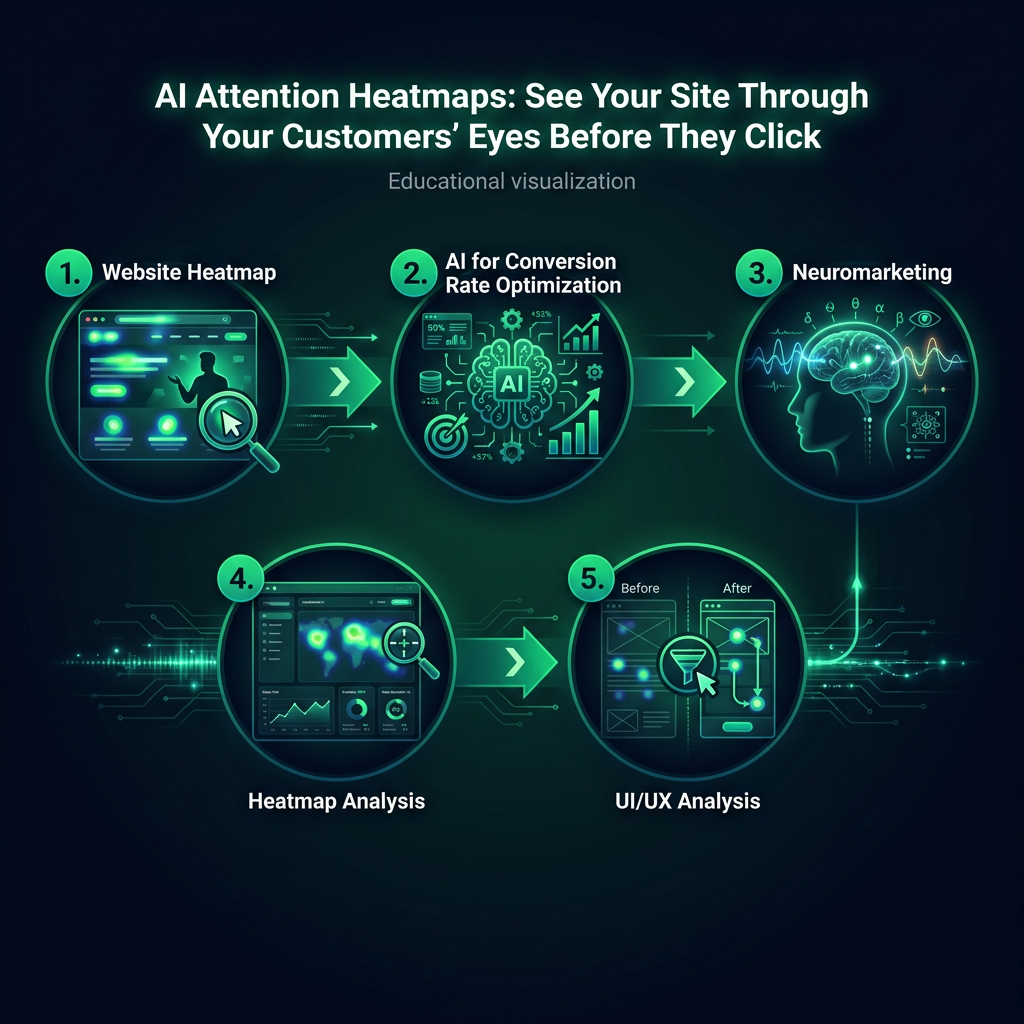

Is your new website failing to convert visitors into customers? This is a common challenge. While traditional analytics can show you what happened on your site, they often fail to explain why users ignored your key calls-to-action. This is where a predictive website heatmap, powered by AI for conversion rate optimization, offers a significant advantage. It reveals what your visitors truly see and pay attention to - before you lose potential customers.
You might be left guessing whether the main image, button placement, or product layout was the problem. Standard analytics show click data, but that's after you've already lost the visitor's interest. They cannot tell you where users were looking before they decided not to click, or why they scrolled right past your most important message. This gap in understanding is precisely what AI-driven attention heatmaps are designed to fill.
What is an AI Website Heatmap and How Does it Work?
First, it is important to distinguish these from traditional website heatmaps. A conventional heatmap tracks mouse movements and clicks, which is reactive data. You need a significant amount of traffic and time - often thousands of visits - to gather useful insights. By then, you may have already lost substantial revenue.
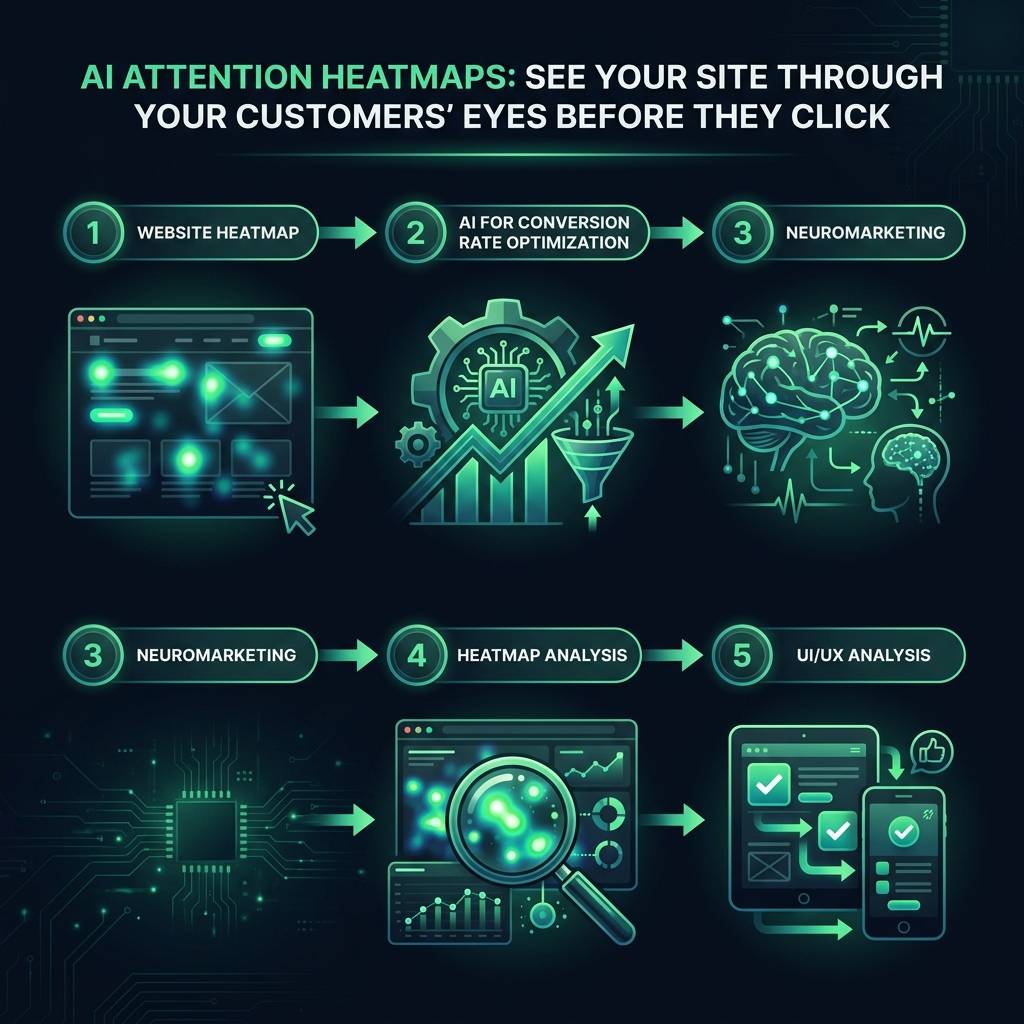
AI attention heatmaps are a proactive tool for UI/UX analysis. They operate on powerful algorithms trained on decades of scientific eye-tracking studies from globally recognized research institutions. This technology, known as predictive eye-tracking, has learned the core principles of human vision. It can forecast with over 90% accuracy where a person's eyes will land in the first 3-5 seconds of viewing a page. That initial window is critical; it is when a visitor decides to stay or leave.
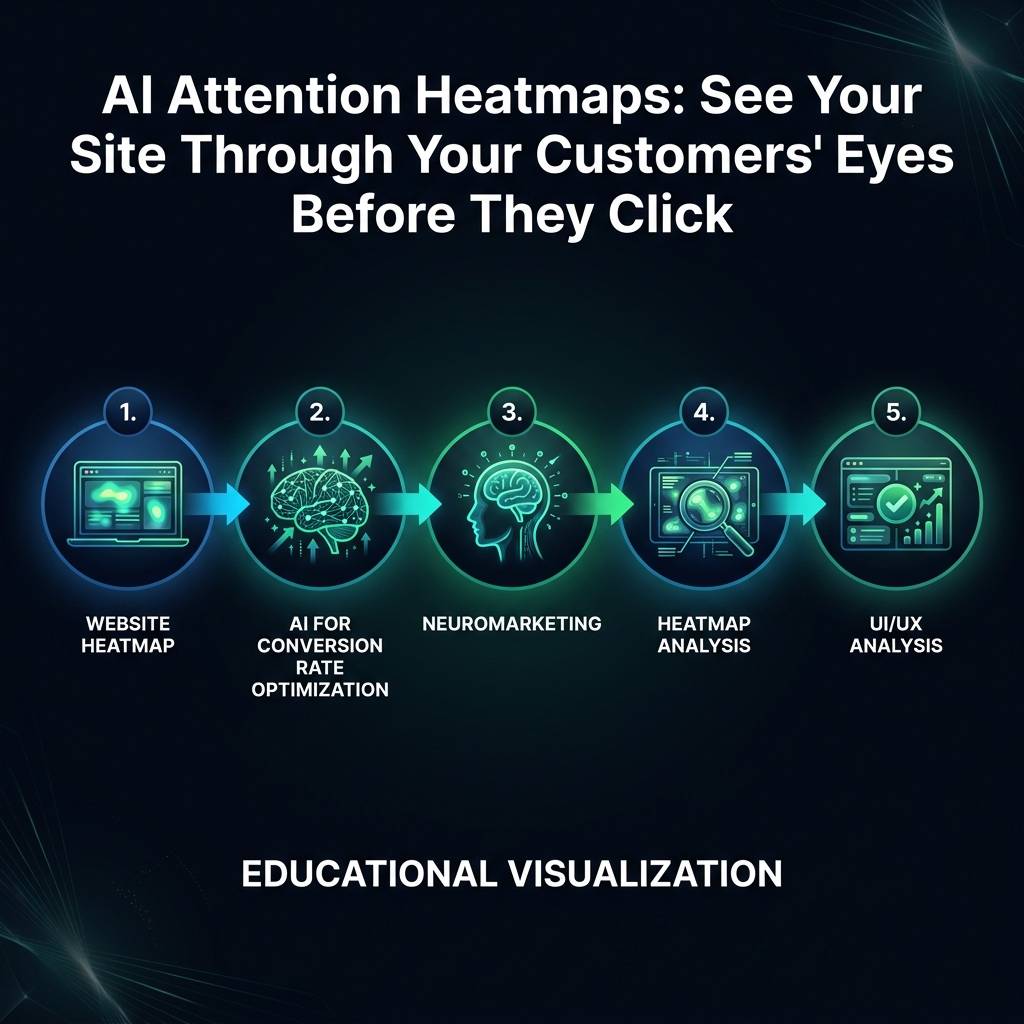

This fusion of data science and cognitive psychology is a core component of modern neuromarketing, turning design intuition into actionable data.
The AI analyzes visual elements like contrast, color, faces, and text to predict attention flow. For instance, it understands that a high-contrast item will grab focus, or that a human face will draw the eye away from other elements. The models also account for cultural reading patterns, such as left-to-right for English or right-to-left for Arabic, to provide relevant predictions. The process is simple: upload a design or screenshot, and within seconds, you receive a detailed heatmap analysis. Red indicates high attention, while blue means an area is likely to be ignored - no traffic or waiting required.
Why Key Elements Are Ignored: A Neuromarketing Perspective
When a visitor lands on your site, they form a first impression in just 50 milliseconds, a finding confirmed by research from the Nielsen Norman Group. In that instant, your design must effectively guide their focus to what matters most. If it fails, their attention scatters, and your message is lost.
Many websites unintentionally create visual chaos. You might have a perfectly worded call-to-action (CTA), but if it lacks visual prominence, the brain simply overlooks it. Your unique value proposition might be compelling, but if the font is too small or lacks contrast, it becomes functionally invisible. This is where AI for conversion rate optimization becomes invaluable, exposing these blind spots instantly.
Common mistakes an AI heatmap can reveal include:
- Misplaced CTAs: Placing a CTA in the center of a large banner seems logical, but if a high-contrast image is off to the side, the user's eye will go there first. By the time their gaze shifts, they may already be scrolling down.
- Overly Prominent Navigation: A navigation menu with bold colors can steal attention from the main headline, causing visitors to evaluate navigation options before understanding your core offer.
- Improper Use of Faces: Faces are powerful attention magnets. A photo of someone looking at the camera will dominate the visual hierarchy. However, using the principle of gaze-cuing - where the person in the photo looks towards your CTA - is a proven neuromarketing technique to direct user attention precisely where you want it.
Often, a conversion problem is not about your offer, copy, or price. It is simply that no one is actually seeing the most important information.