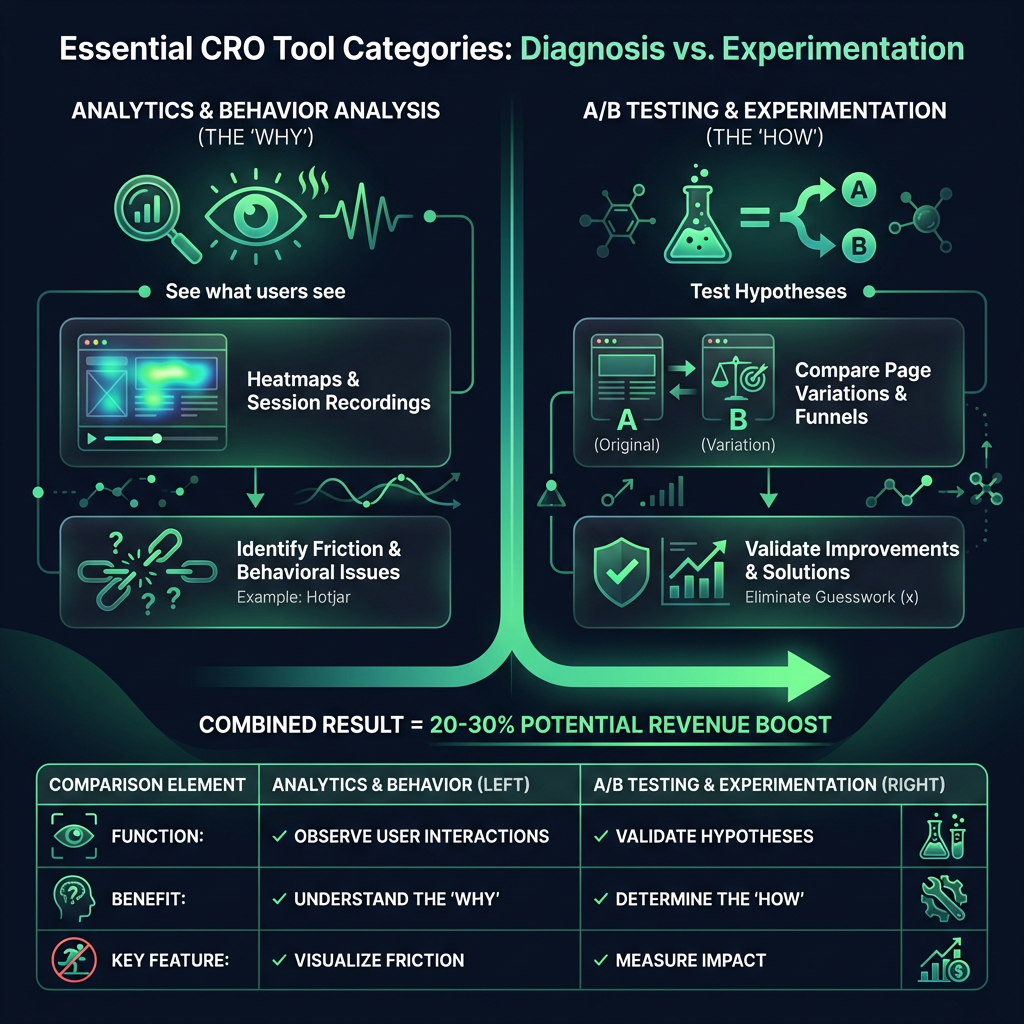

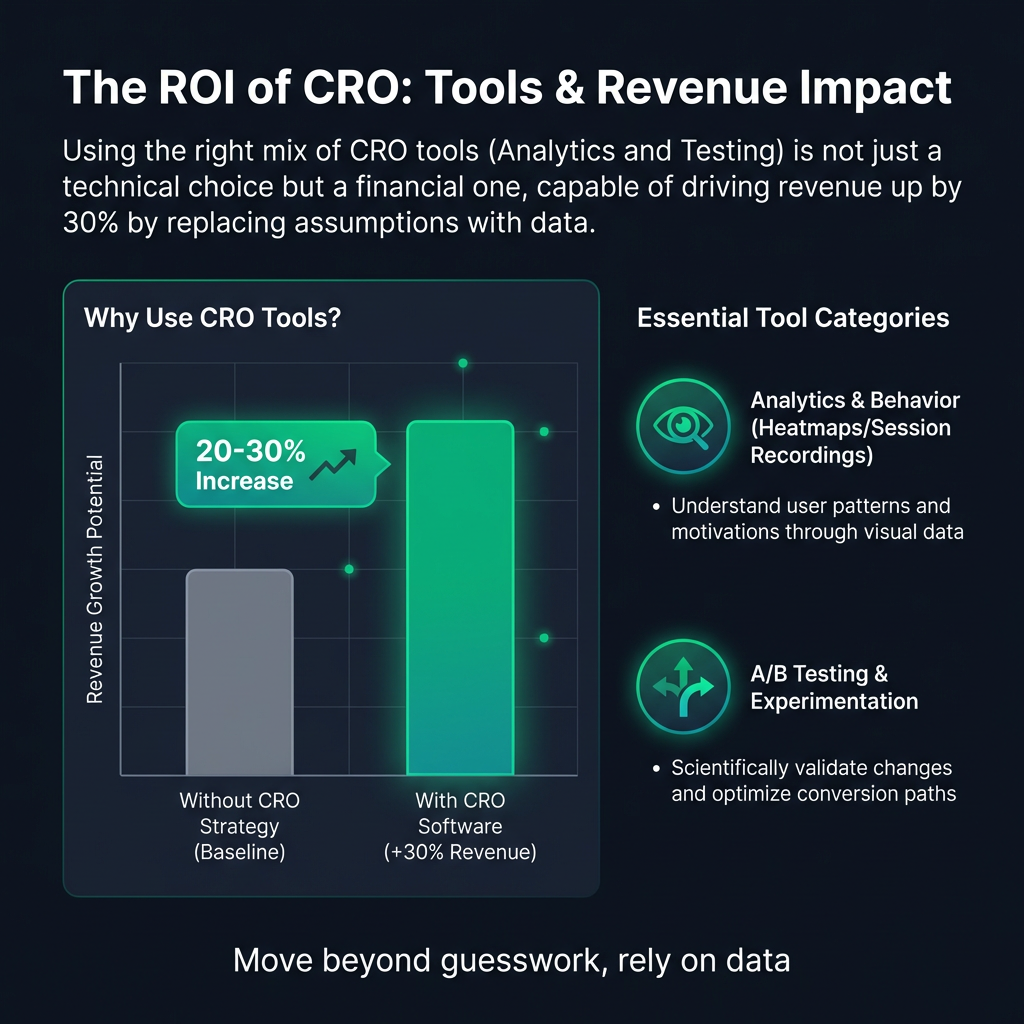
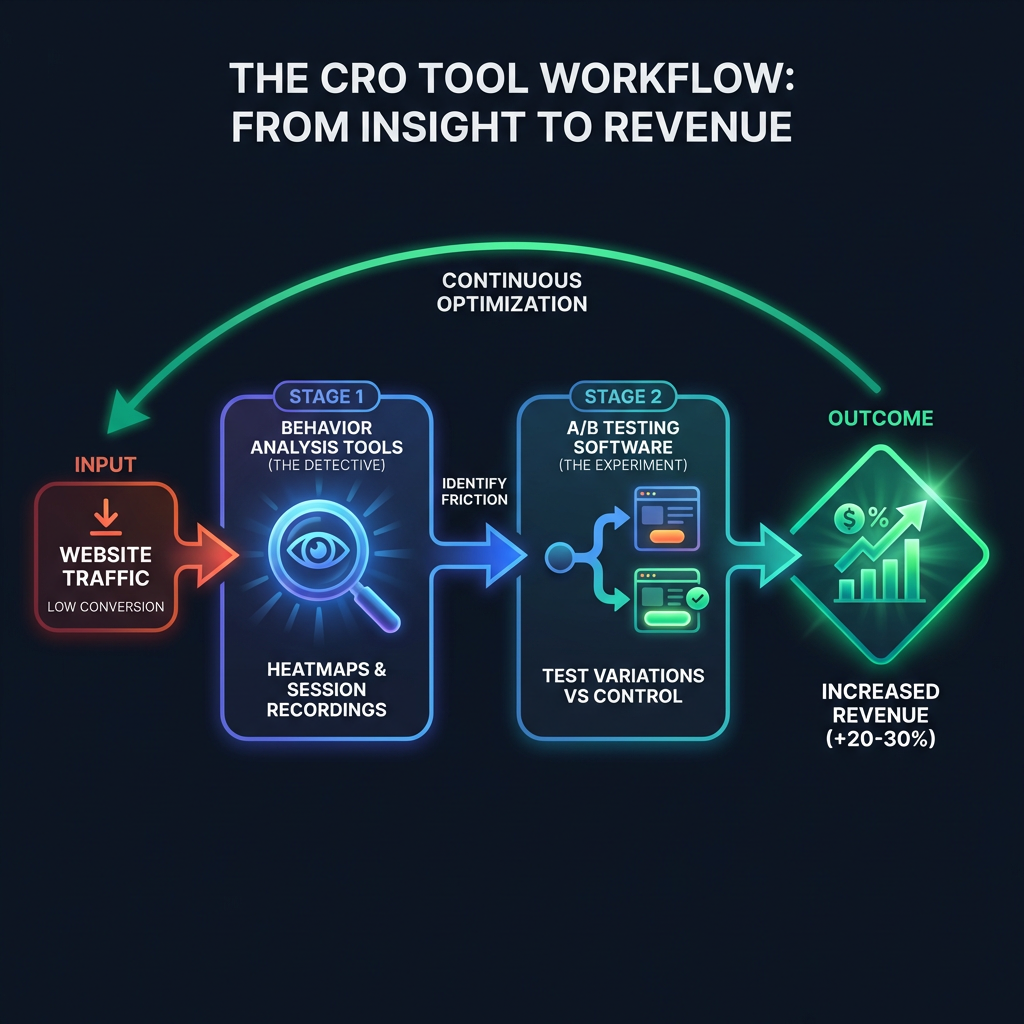
The best CRO tools are not one product but a stack of five jobs: analytics tells you where visitors drop off, heatmaps and session recordings show what they do on the page, surveys and user tests tell you why, conversion audit tools tell you what to fix first, and A/B testing tools prove whether the fix worked. Most sites should start with free analytics (GA4) and free behavior recording (Microsoft Clarity), add an audit, and buy A/B testing software only once a page has enough traffic to reach a result in a few weeks.
What is the best tool for CRO analysis?
There is no single best tool, because "CRO analysis" covers different questions. Pick the tool by the question you need answered right now:
| Job | Question it answers | Start with | Upgrade to |
|---|---|---|---|
| Analytics | Where in the funnel do we lose people, and which segments? | GA4 | PostHog, GA4 360 |
| Heatmaps and session recordings | What do visitors click, scroll past or struggle with? | Microsoft Clarity | Contentsquare (now includes Hotjar), Fullstory |
| Surveys and user testing | Why do they hesitate or leave? | Hotjar surveys, Lyssna free plan | Maze, UserTesting |
| AI CRO audits | What is wrong with this page, and what should we fix first? | A free one-page audit | A paid audit tool or an agency audit |
| A/B testing and experimentation | Did the change cause the lift? | PostHog or Statsig free tiers | VWO, Convert, Optimizely, AB Tasty, Kameleoon |
The order matters. Analytics and recordings find the problem pages, audits and research generate hypotheses, and testing validates them. Buying a testing tool before you know what to test wastes the budget.
Which CRO tools are worth comparing? The full table
Pricing models below were checked in October 2026. Vendors change plans often, so confirm on each pricing page before you buy. Where a vendor does not publish a price, the table says "quote-based" rather than guessing.
| Tool | Job | Best at | Main limit | Pricing model |
|---|---|---|---|---|
| GA4 | Analytics | Funnels, segments, ad-platform integration | Steep learning curve; reports need configuration | Free; GA4 360 is paid enterprise |
| PostHog | Analytics + replay + experiments | Product analytics, replay and flags in one tool | Built for product teams; marketers need setup help | Free monthly allowance, then usage-based |
| Microsoft Clarity | Heatmaps + recordings | Unlimited recordings at no cost | Few survey or feedback features; no testing | Free |
| Hotjar | Heatmaps + recordings + surveys | Easy setup, on-page surveys and feedback widgets | Free plan caps daily sessions recorded | Free plan; paid tiers |
| Contentsquare | Experience analytics | Zone-based analysis at enterprise scale | Enterprise sales cycle and price | Quote-based for full platform |
| FullStory | Session replay + analytics | Searchable, indexed sessions and frustration signals | Expensive at volume | Quote-based paid tiers |
| VWO | A/B testing | Visual editor plus built-in heatmaps and recordings | Cost rises with tracked users | Free trial; paid by monthly tracked users |
| Convert | A/B testing | Privacy focus, publicly listed plans | No permanent free plan | Paid plans; free trial |
| Optimizely | Experimentation | Web and feature experimentation at enterprise scale | Price and implementation effort | Quote-based |
| AB Tasty | Experimentation + personalization | Marketer-friendly personalization | Not built for low-traffic sites | Quote-based |
| Kameleoon | Experimentation + personalization | Web and feature tests in one platform | Mid-market to enterprise focus | Quote-based, by monthly unique users |
| Statsig | Experimentation | Warehouse-grade stats for engineering teams | Developer-first; acquired by OpenAI in 2025 | Free tier, then paid |
| Maze | User testing | Fast unmoderated prototype and page tests | Panel recruitment costs extra | Free plan; paid tiers |
| Lyssna | User testing + surveys | Five-second, first-click and preference tests | Short tests on free plan | Free plan; paid tiers |
| UserTesting | User testing | Large participant panel, video think-alouds | Annual contracts, high entry cost | Quote-based |
| EyeCaptain | AI CRO audit | Ranked findings and fixes from a URL, no script | Not analytics, recordings or A/B testing | Free one-page audit; paid plans |
| EyeQuant | AI attention prediction | Attention and clarity scores, API access | Enterprise focus | Quote-based |
Which analytics tool should a CRO program start with?
Analytics answers "where": which pages, steps and segments lose the most visitors. It cannot tell you why.
- GA4. Strength: free, connects to Google Ads, and funnel explorations show step-by-step drop-off by device or source. Limit: default reports are thin; useful CRO analysis needs custom events and explorations. Pricing: free, with GA4 360 as Google's paid enterprise tier.
- PostHog. Strength: product analytics, session replay, feature flags and experiments share one dataset, so you can jump from a funnel step to the replays behind it. Limit: event-based setup suits SaaS and product teams more than content sites. Pricing: free monthly allowance, then pay per usage.
When to buy: never pay for analytics before GA4 is configured properly. A walk-through of building a GA4 funnel exploration for checkout drop-off covers the setup most sites skip. Move to PostHog when your conversion happens inside a product (sign-up, activation, upgrade) rather than on marketing pages.

Which heatmap and session recording tools are worth it?
An update for 2026: Hotjar's features now live inside Contentsquare, and new accounts sign up for Contentsquare rather than Hotjar. Existing Hotjar accounts keep working. Read Hotjar below as Contentsquare, or see our list of Hotjar alternatives.
Behavior tools answer "what": which elements get clicks, how far people scroll, where they rage-click or abandon a form field.
- Microsoft Clarity. Strength: Microsoft's pricing page states it is free with no traffic limits, which makes it the default first install. Limit: little beyond heatmaps, recordings and frustration signals; no surveys. Pricing: free.
- Hotjar. Strength: heatmaps, recordings, on-page surveys and feedback widgets in one simple tool; owned by Contentsquare since 2021. Limit: the free plan stops recording after a daily session cap, so low-traffic sampling is uneven. Pricing: free plan, then paid tiers.
- Contentsquare. Strength: zone-based analytics that attribute revenue and engagement to page areas across thousands of pages. Limit: enterprise buying process. Pricing: quote-based for the full platform.
- FullStory. Strength: every interaction is indexed, so you can search for "users who clicked the coupon field and then left." Limit: cost scales with sessions. Pricing: quote-based paid tiers.
When to buy: start with Clarity. Pay for Contentsquare, which now sells Hotjar's features, when you want surveys next to recordings, and for its higher plans or Fullstory when you have high traffic and an analyst. This guide to click, scroll, move and attention heatmaps explains what each one can and cannot show.
Which A/B testing software is best for CRO?
Testing tools answer "did it work". They are the only tools in this list that prove cause and effect, and the only ones that need a lot of traffic. Google Optimize, the old free default, was shut down on September 30, 2023, according to Google's Analytics help center, so every option below is either a free developer tier or a paid product.
- VWO. Strength: visual editor plus built-in heatmaps, recordings and surveys, so a marketing team can run the full loop in one tool. Limit: price scales with monthly tracked users. Pricing: free trial, paid plans by traffic.
- Convert. Strength: privacy-focused positioning, publicly listed plans and multi-project setups that suit agencies. Limit: no permanent free plan. Pricing: paid plans with a trial.
- Optimizely. Strength: mature web and feature experimentation with strong statistics. Limit: enterprise cost and setup time. Pricing: quote-based.
- AB Tasty and Kameleoon. Strength: experimentation plus personalization for marketing and product teams, popular in Europe. Limit: overkill for one landing page. Pricing: quote-based.
- PostHog and Statsig. Strength: free tiers and rigorous statistics for teams that can ship variants in code. Limit: no visual editor for marketers. OpenAI agreed to acquire Statsig in September 2025 (reported by Bloomberg), so check its roadmap before a long commitment.
Worked example: do you have enough traffic to test?
Lehr's rule of thumb (Lehr, Statistics in Medicine, 1992) estimates the sample size per variant at 5% significance and 80% power as n ≈ 16 × p × (1 − p) ÷ δ², where p is the baseline conversion rate and δ is the absolute difference you want to detect.
- Baseline conversion rate p = 3% (0.03). You want to detect a lift to 3.6%, so δ = 0.006.
- p × (1 − p) = 0.03 × 0.97 = 0.0291.
- n ≈ 16 × 0.0291 ÷ 0.000036 ≈ 12,933 visitors per variant, about 25,900 for an A/B test.
- At 8,000 visitors a week, the test needs a bit over 3 weeks. At 1,500 a week, it needs about 17 weeks.
Decision rule: if the page cannot reach the sample in about 4 to 6 weeks, do not buy a testing tool for it yet. Make research-backed changes, measure before and after in analytics, and test only big swings. For exact figures use a calculator such as Evan Miller's, and read our guide to A/B test sample size and duration.
Which survey and user testing tools explain why visitors don't convert?
Research tools answer "why": what visitors expected, what confused them, and what objection stopped them. Jakob Nielsen's article "Why You Only Need to Test with 5 Users" (Nielsen Norman Group) argues that five participants surface about 85% of usability problems in a design, so small studies are worth running.