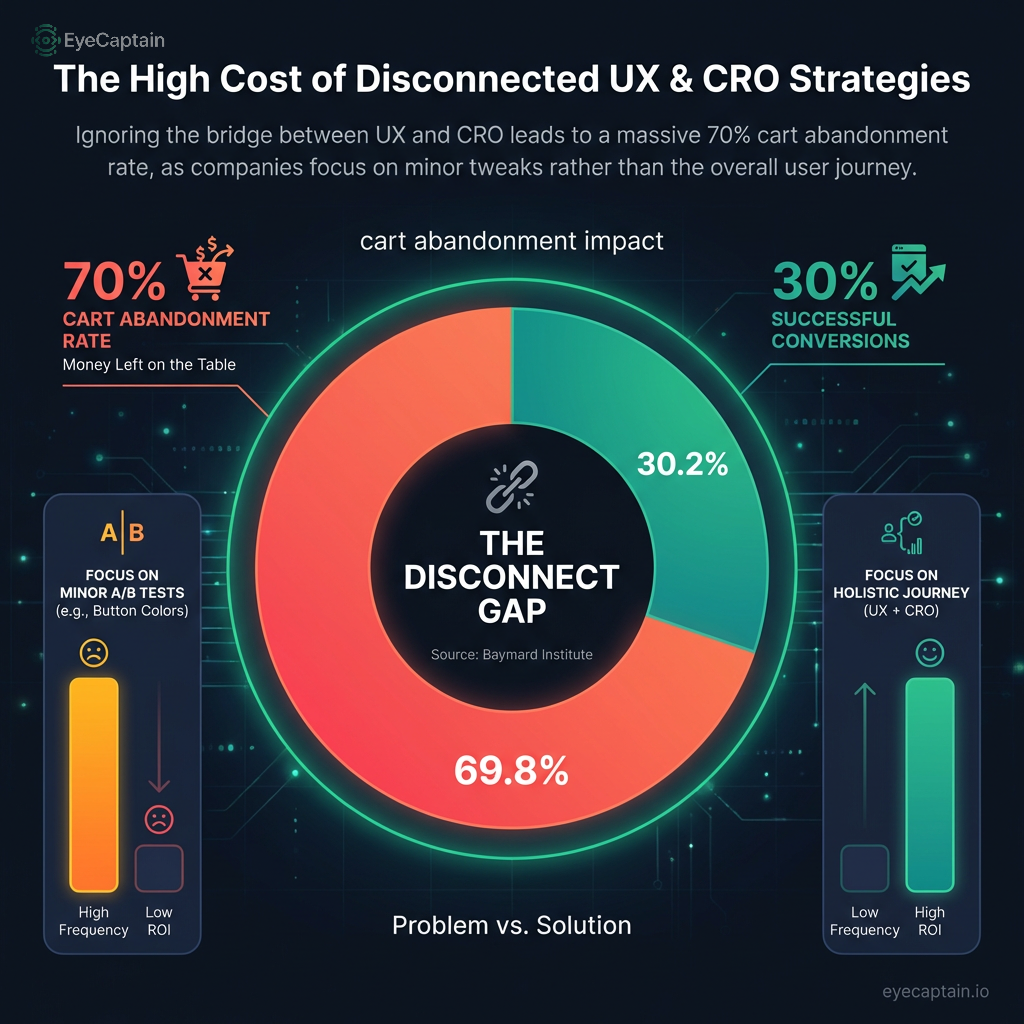

In the world of digital marketing, treating user experience (UX) design and conversion rate optimization (CRO) as separate disciplines is a critical mistake. A truly effective strategy understands that these two elements are deeply intertwined. While many businesses focus on minor A/B tests, they often overlook the significant UX issues that prevent users from converting, ultimately hindering growth and impacting the overall return on investment (ROI).
The High Cost of a Disconnected Strategy
Too many companies get lost in optimizing minor details - like button colors or headline variations - while ignoring the broader user experience that determines whether a customer stays or leaves. This disconnect between the user's overall journey and the push for a single conversion is a massive blind spot in many digital marketing efforts.
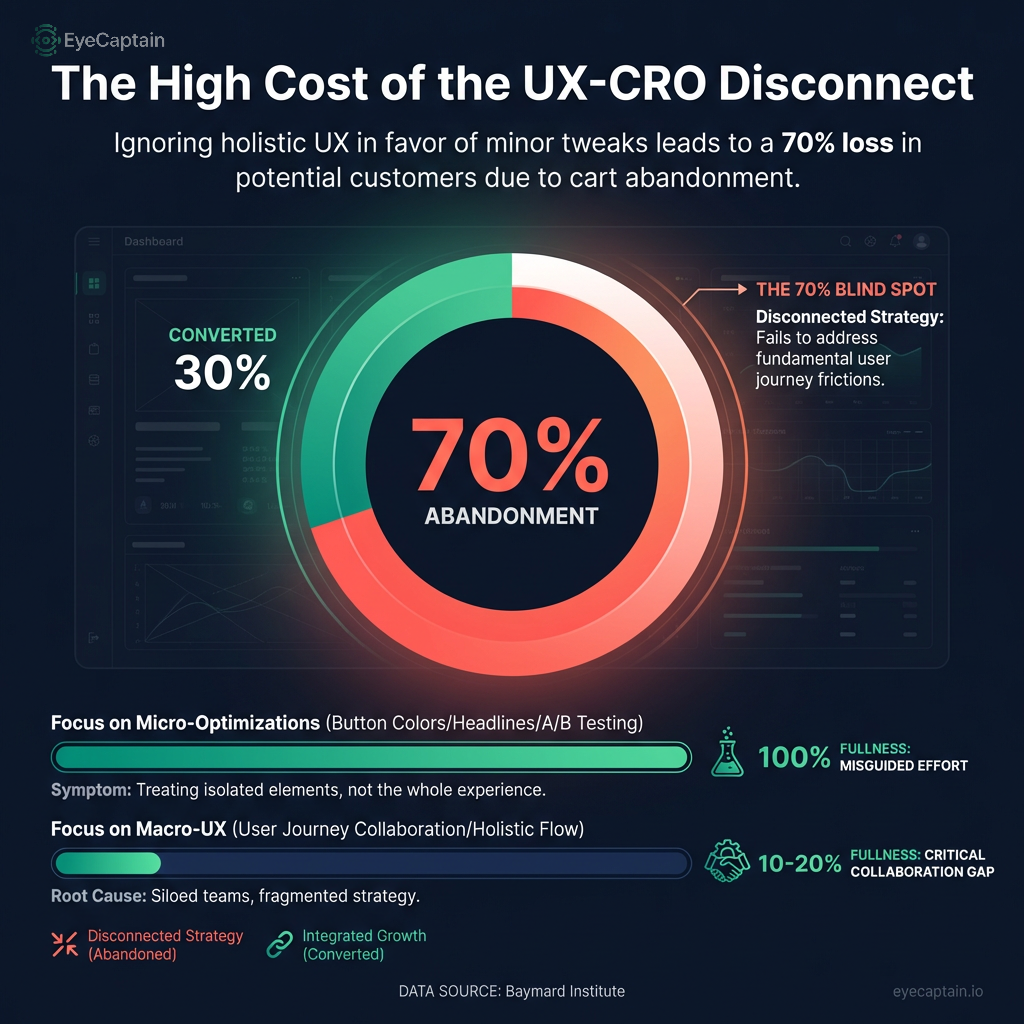
Data from the Baymard Institute reveals a stark reality: nearly 70% of online shopping carts are abandoned. Yet, a surprisingly small number of companies foster collaboration between their UX and CRO teams, treating two critical functions as if they exist in different universes.
This separation is the heart of the problem. Effective CRO aims to persuade users to take a specific action. However, great UX design is what shapes the entire journey, making users want to take that action in the first place by building trust and reducing friction.
Bridging the Gap: How User Experience Drives Conversions
For years, a false dichotomy has pitted UX design against conversion rate optimization. UX teams advocate for clean, simple interfaces, while CRO specialists often push for more aggressive calls-to-action and persuasive elements. The truth is, both are aiming for the same goal: a successful user outcome that benefits the business.
Consider a SaaS company that spent eight months A/B testing its pricing page with no success, stuck at a 2.1% conversion rate. The real issue was not the pricing page itself, but a major UX flaw earlier in the journey: requiring credit card information for a product demo. This created distrust long before users considered pricing. By simply moving the credit card request to after the free trial, their pricing page conversion rate increased dramatically to 4.7% without a single change to the page itself.
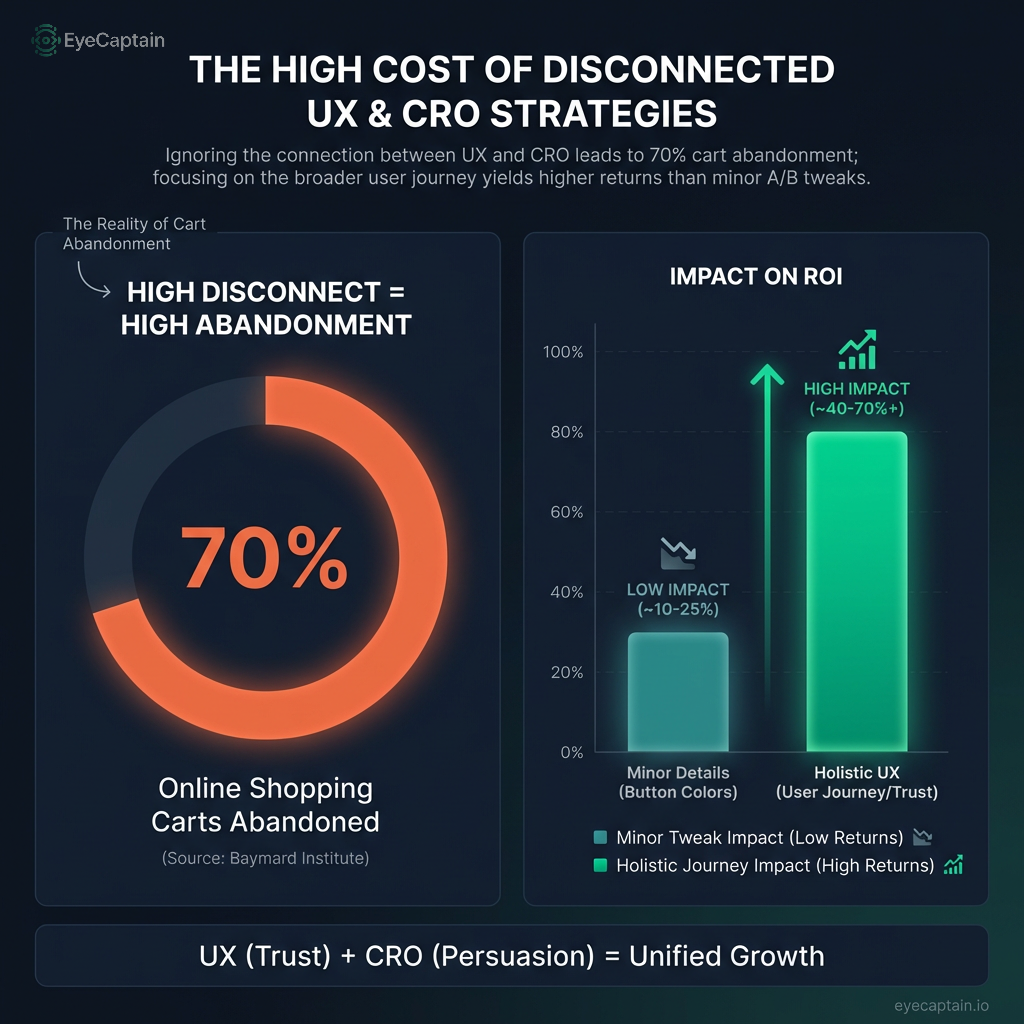

This illustrates a core principle: CRO tactics cannot fix a fundamentally poor user experience. Conversely, a beautiful user experience that ignores clear conversion goals can fail to generate revenue.
Cognitive Load and Conversion Psychology
Every element on a page contributes to a user's cognitive load - the mental effort required to process information. While traditional CRO sometimes adds to this load with more pop-ups or text, a UX-focused approach aims to reduce it. Research from the Nielsen Norman Group highlights that users can only process about seven pieces of information at once, yet many websites overwhelm them with far more.
Best Buy's checkout redesign is a masterclass in this principle. Instead of just reducing form fields, they applied UX thinking to their CRO goals. They grouped related information, hid optional details, and created a clear, step-by-step path. While they actually increased the number of fields, the improved organization lowered cognitive load, leading to a 15% increase in checkout completions.
Integrating UX and CRO Data for Smarter Decisions
In most organizations, UX data (like heat maps and user interviews) and conversion data (like A/B test results) live in separate silos. This creates blind spots. A heat map might show users ignoring a call-to-action, but only qualitative UX research can explain why.
E-commerce leader ASOS solved this by creating cross-functional data reviews. Every A/B test hypothesis must now be supported by UX research, and every insight from user studies is evaluated for its potential impact on conversions. For instance, when heat maps showed users clicking non-interactive product images, they did not just address the "dead clicks." Usability tests revealed users expected a "quick view" feature. After implementing it, engagement rose by 31% and conversions by 12% because the user experience was aligned with user expectations.
The Attribution Problem in Digital Marketing
Traditional attribution models often fail to credit UX improvements for their role in a conversion. If a user visits five times before buying, the credit usually goes to the last ad clicked, ignoring the UX enhancements that may have streamlined the decision-making process. Good UX boosts conversions indirectly by lowering bounce rates, building trust, and encouraging site exploration - factors that standard CRO dashboards often miss.
Booking.com overcomes this with cohort analysis, tracking user groups over time to measure the long-term ROI of UX changes. When a simpler search interface initially caused a 3% dip in immediate conversions, a typical CRO analysis would have deemed it a failure. However, their cohort data showed these users spent 18% more over the next month. The superior user experience led to more confident, higher-value customers.