Best CRO Tools: 5 Testing Platforms Compared for 2026
    EyeCaptain

    Best CRO Tools: 5 Testing Platforms Compared for 2026

    Wasting money on testing tools that deliver zero statistically valid data? Learn how to evaluate platforms and avoid the common 40% false-positive trap.

    Dimitris Andreadakis

    5 min read
    124 views
    best CRO toolsCRO softwareconversion optimization toolA/B testing toolsCRO tool

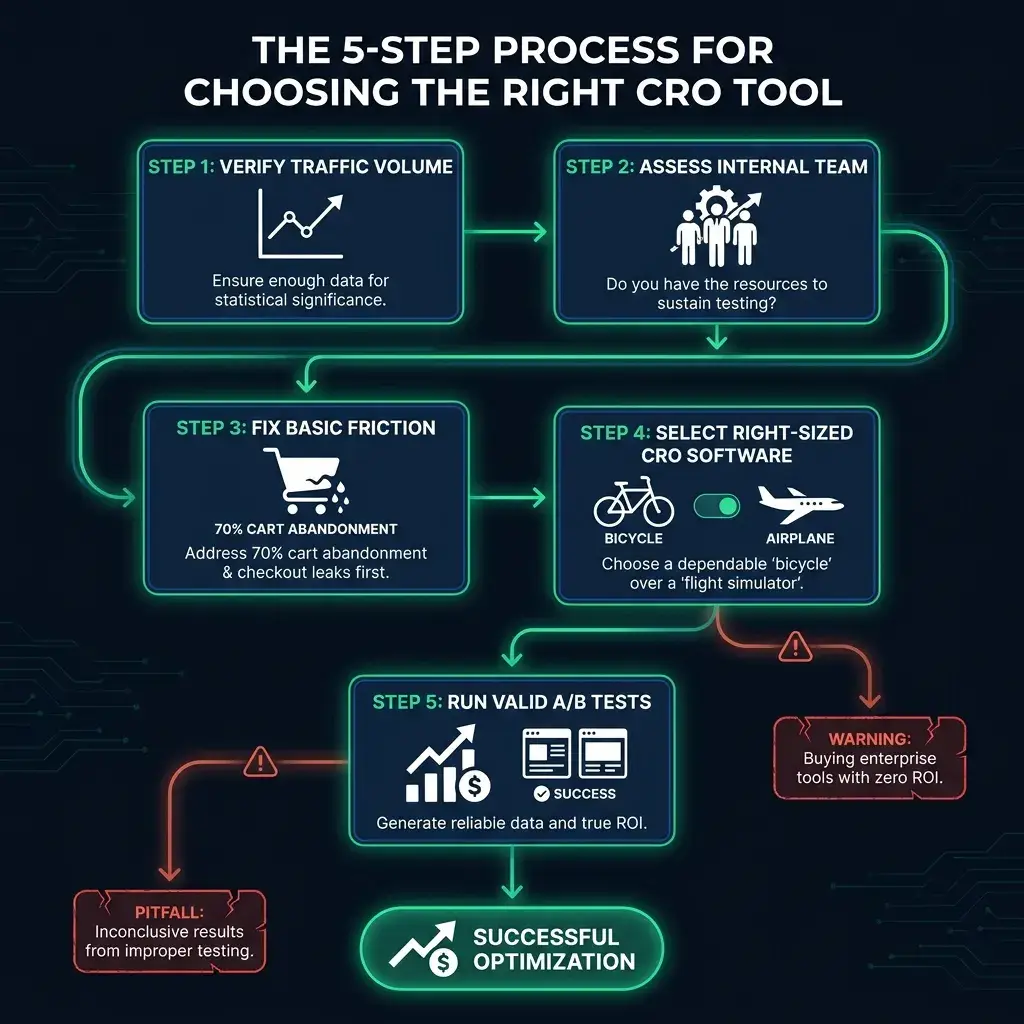
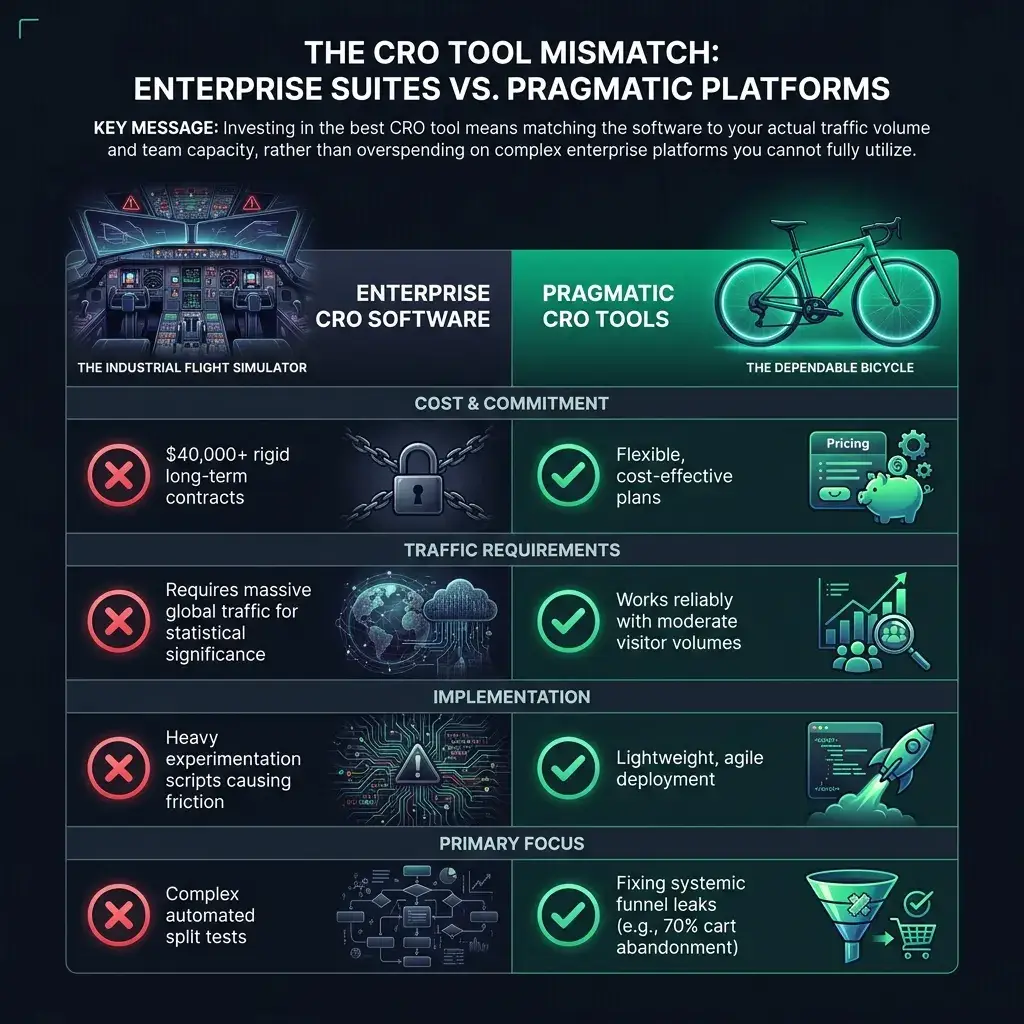
    Finding the best CRO tools shouldn't require committing tens of thousands of dollars or euros to complex enterprise software platforms. An e-commerce founder recently invested over $40,000 on an enterprise experimentation suite, only to run two basic headline tests that produced zero statistically valid findings. The decision was driven by polished vendor presentations rather than an honest assessment of what their actual traffic volume and internal team could realistically sustain.

    Sound familiar? You are not alone.

    Evaluating a reliable conversion optimization tool often feels like purchasing an industrial flight simulator when all your business needs is a dependable bicycle. Founders and digital marketing leaders across international markets frequently enter rigid, long-term CRO software contracts before verifying whether their digital properties generate sufficient visitor volume to achieve statistical significance. Many operate under the misconception that a high-end analytics dashboard will spontaneously convert modest traffic into exponential global revenue.

    According to research from the Baymard Institute, the average global cart abandonment rate hovers around 70% across e-commerce platforms. For international shoppers navigating cross-border checkouts, this drop-off rate is often higher due to hidden shipping fees, currency conversion surprises, and absent local payment options. Alarmed by these leaks in the funnel, store operators frequently deploy heavy experimentation scripts, hoping an automated split test will magically resolve systemic checkout friction.

    The reality is straightforward: modern testing platforms function as advertised, but serious friction emerges when enterprise-grade tools are introduced without the traffic, technical infrastructure, or data governance required to support them.
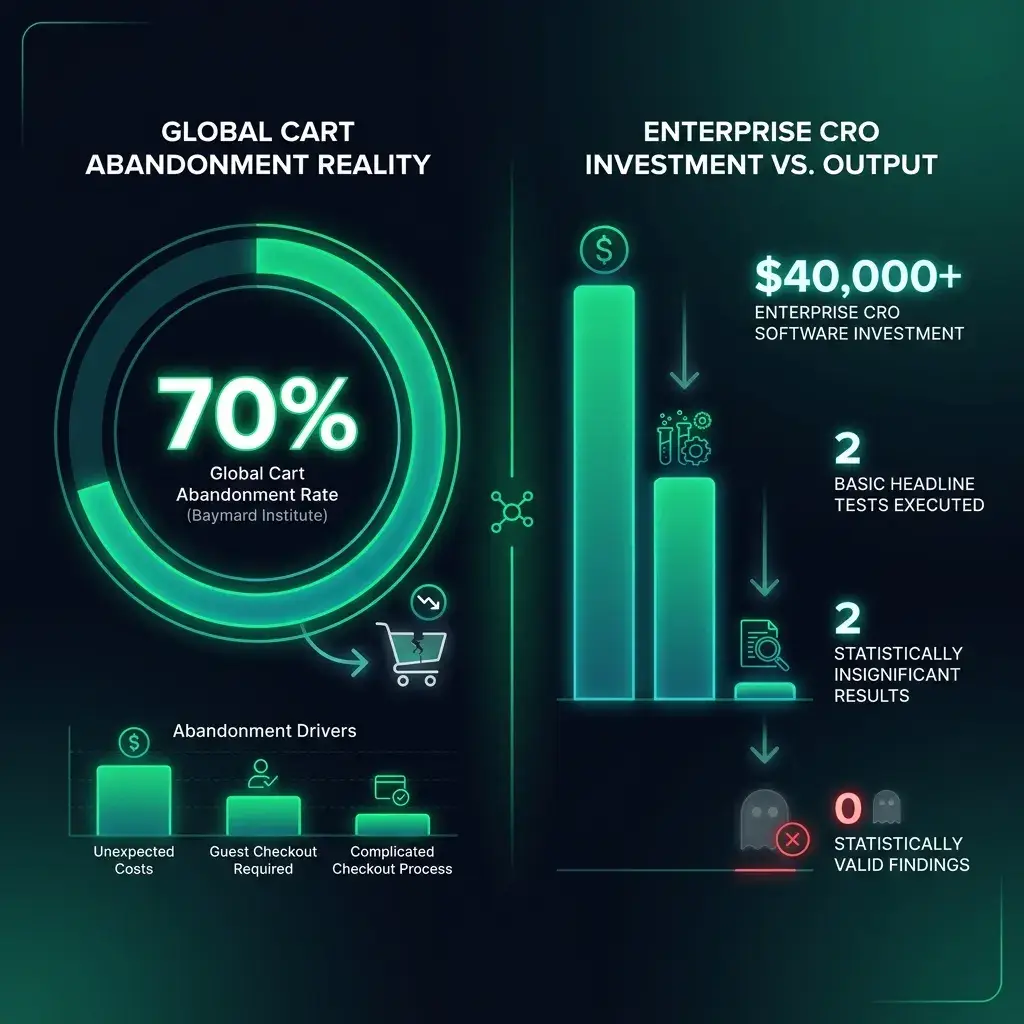
    Illustration 1: Best CRO Tools: 5 Testing Platforms Compared for 2026EyeCaptain

    Why Most Teams Pick the Wrong CRO Software

    Online customers worldwide expect near-instant page responsiveness, yet standard client-side A/B testing tools introduce noticeable latency. When an experiment is configured through a browser-based visual editor, the visitor's device must download the base page, halt rendering while a third-party script executes, and then repaint the layout with the alternative version.

    Engineers classify this delay as page flicker or layout instability. On high-speed desktop connections, this visual shift is distracting; on mobile networks across emerging digital markets or international roaming connections, it significantly degrades performance metrics, negatively impacting Google's Core Web Vitals (specifically Cumulative Layout Shift).

    Research from the Nielsen Norman Group confirms that sudden visual layout shifts erode consumer trust far faster than outdated design aesthetics. When a checkout or payment page flickers as an international shopper enters card or banking details, they often suspect the site is insecure or malfunctioning, resulting in immediate abandonment.

    Furthermore, stringent international privacy frameworks - such as the EU's GDPR, the UK Data Protection Act, and Brazil's LGPD - restrict how third-party tracking scripts execute. If a significant percentage of your European visitors reject tracking cookies on your consent banner, client-side CRO tools will collect incomplete, biased datasets, invalidating test conclusions before statistical thresholds are met.

    The Statistical Limitations of Standard A/B Testing Tools

    Many legacy A/B testing tools rely on frequentist statistical frameworks requiring predetermined sample sizes and fixed testing windows. Reviewing preliminary conversion spikes and altering active experiments fundamentally undermines the validity of the underlying data.

    Digital teams frequently examine test dashboards within forty-eight hours, observe a temporary 30% lift in conversions, and prematurely implement the variation. Weeks later, aggregate revenue returns to normal levels as regression to the mean takes effect.

    While modern platforms utilizing Bayesian statistical frameworks reduce false positives by calculating real-time probabilities, mathematical models still demand adequate transaction volumes. For businesses operating regional storefronts with fragmented traffic across multiple localized domains (such as separate UK, German, and Australian subdomains), dividing already limited traffic makes achieving clean, statistically sound results virtually impossible.

    How to Match a CRO Tool to Your Real Traffic

    If your digital storefront handles fewer than 1,000 completed orders per month, running continuous split tests is rarely the most effective path forward. Validating small micro-adjustments under lower traffic conditions can take months of observation. At this stage, qualitative customer insight tools provide faster, more practical intelligence than an automated quantitative conversion optimization tool.

    High-leverage alternatives for early-stage or lower-volume international sites include:

    EyeCaptainEyeCaptain
    97%
    Conversions Booster

    Your visitors leave without converting

    Most websites lose 97% of their traffic without a single conversion. Our AI scans 200+ CRO elements to find exactly where visitors drop off.

    Hero CTA missing

    • Session recordings: Isolate specific usability friction points where visitors encounter broken inputs, confusing navigation, or unresponsive forms.
    • Targeted exit-intent surveys: Gather direct qualitative feedback on why international prospects leave without buying, identifying unaddressed concerns regarding shipping timelines, import duties, or return policies.
    • Direct customer interviews: Uncover qualitative objections surrounding local currency presentation, brand credibility, and payment preferences (such as Klarna in northern Europe, Pix in Brazil, or digital wallets across APAC).

    Observing real users navigate your product pages delivers actionable optimization data far faster than maintaining inconclusive split tests for entire business quarters.

    Once order volume consistently exceeds 10,000 monthly transactions, technical priorities shift toward website stability, security, and rendering speed. At enterprise volume, a server-side CRO tool executes variations directly within the application architecture, bypassing client-side browser manipulation and maintaining pristine site performance across global regions.

    Illustration 2: Best CRO Tools: 5 Testing Platforms Compared for 2026EyeCaptain

    Choosing the Best CRO Tools: Enterprise Suites vs. Open-Source Platforms

    Traditional experimentation suites package visual editors, audience segment builders, and behavioral targeting into all-in-one commercial platforms. While non-technical teams value visual editing tools that bypass engineering sprints, these platforms often introduce heavy JavaScript tags, complex cross-border privacy liabilities, and substantial recurring annual subscription costs.

    In response, technical and product-led organizations are adopting modern, developer-centric platforms like GrowthBook that decouple testing logic from front-end page rendering:

    • Direct data warehouse integration: Experiment events stream directly into centralized data infrastructure like Snowflake, BigQuery, or Amazon Redshift, ensuring full data sovereignty and adherence to local data storage regulations.
    • Feature flagging architecture: Developers launch controlled experiments directly inside the production codebase, eliminating visual layout shifts across mobile and desktop devices.
    • First-party user tracking: Teams monitor visitor actions across localized platforms using authenticated customer IDs and server-side events rather than fragile third-party tracking cookies.

    Selecting the best CRO tools for your organization depends on available engineering support and data infrastructure. While warehouse-native, open-source solutions demand initial developer configuration, they remove proprietary tag weight, safeguard user privacy, and scale effortlessly across multi-market digital storefronts.

    Illustration 3: Best CRO Tools: 5 Testing Platforms Compared for 2026EyeCaptain

    Calculate Your Sample Size Before Investing in a Conversion Optimization Tool

    Prior to committing budget to commercial CRO software, always determine your Minimum Detectable Effect (MDE) - the smallest relative conversion lift your website's baseline traffic can reliably verify without confusing random variance with measurable performance improvements.

    If a product landing page converts at 2% across 20,000 monthly international visitors, validating a realistic 5% relative conversion lift demands months of uninterrupted testing without launching concurrent marketing campaigns, flash sales, or seasonal promotions.

    Teams facing sample size restrictions often redirect test objectives from completed orders to upper-funnel micro-conversions, such as navigation clicks or image gallery interactions. While micro-events accumulate data quickly, an increase in gallery clicks rarely translates into higher net revenue or improved profit margins.

    High-volume global retailers benefit continually from dedicated A/B testing tools because fractional percentage gains yield significant absolute revenue. For emerging and mid-market global brands, clarifying the core value proposition, providing local payment options, and removing friction from checkout workflows will consistently deliver greater commercial impact than prematurely deploying enterprise experimentation software.

    Enjoyed this article?

    One short email a week with practical CRO and UX tips

    No spam. Unsubscribe anytime.

    Find what stops your visitors from converting

    EyeCaptain is an AI-powered CRO & UX audit tool that automatically scans your pages, identifies UX issues, and gives you actionable optimization suggestions to increase conversions. Try it for free, no card, no commitment.

    Free CRO Audit
    Share this article
    LinkedIn X

    About the author

    Founder of EyeCaptain. Writes about conversion rate optimization, UX analysis and the neuromarketing behind pages that actually sell.

    More articles by Dimitris Andreadakis