
Bayesian vs. Frequentist A/B Testing: Which Method Actually Works for You?
    eyecaptain.io

    Bayesian vs. Frequentist A/B Testing: Which Method Actually Works for You?

    Confused about statistical significance in your A/B tests? Learn which testing method matches your traffic, goals, and timeline—explained without the math jargon.

    EyeCaptain

    Dimitris

    23 August 2026

    5 min read
    313 views
    A/B testing methodologyBayesian vs Frequentiststatistical significanceconversion optimization tooladvanced A/B testing techniques

    Have you ever run an A/B test where one version seems to be performing better, only for your conversion optimization tool to report that the result lacks statistical significance? This common frustration points to a crucial, often overlooked aspect of digital marketing: your A/B testing methodology. The statistical engine behind your experiments determines when you can trust your data. Choosing the right approach - typically between the Bayesian and Frequentist models - can dramatically impact your results, speed, and business outcomes.

    Understanding the difference between these two core statistical models is one of the most important advanced A/B testing techniques you can master. Let's explore how each method works, why most platforms default to the Frequentist model, and how to select the right A/B testing methodology for your business to achieve faster, more reliable conversion optimization.

    The Frequentist Model: Understanding Statistical Significance

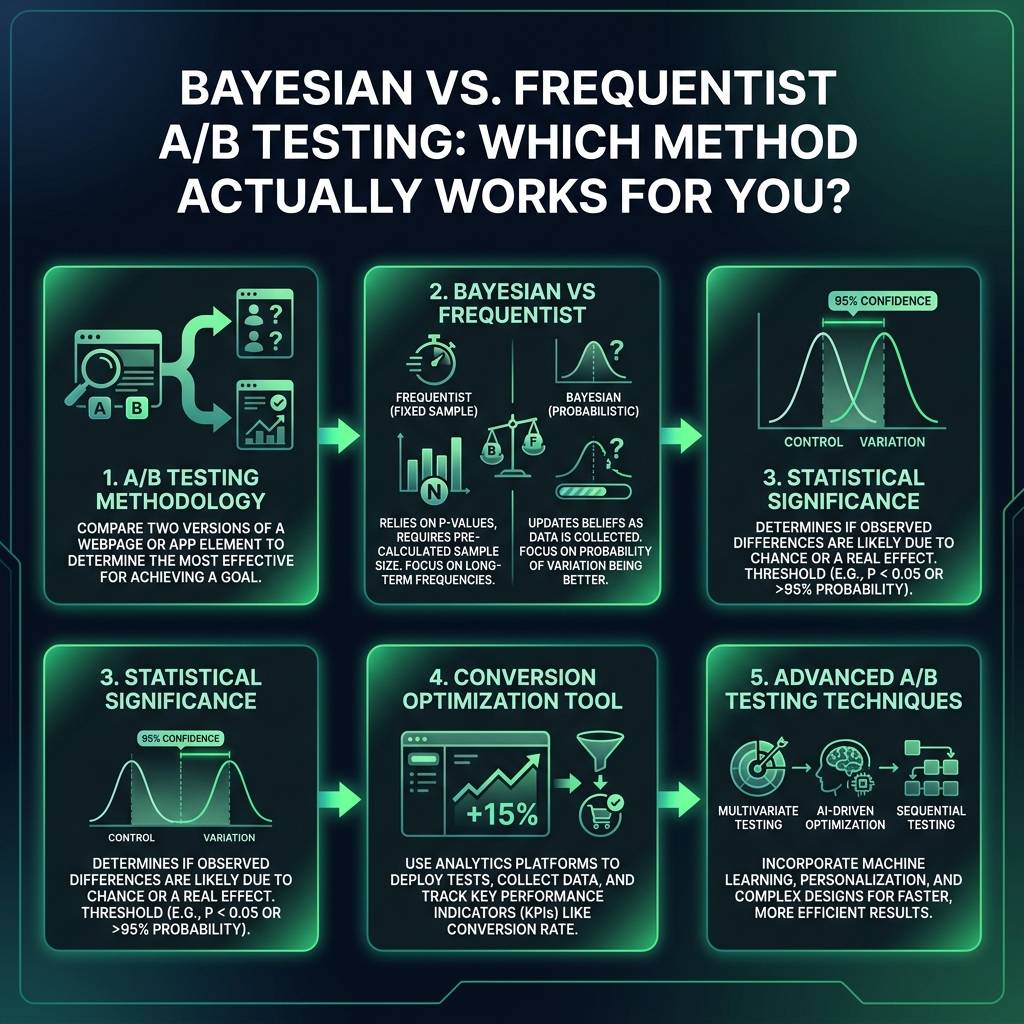
    If you have used tools like Google Optimize, Optimizely, or VWO, you have likely been using the Frequentist approach. This methodology treats your experiment like a formal evaluation: the original version (the control) is assumed to have no difference until the new version (the variant) is proven to be better with a very high degree of certainty.

    The process starts with a hypothesis (e.g., "Variant B will increase signups"). You then collect data until you reach a pre-calculated sample size and a specific level of statistical significance, usually a 95% confidence level. This 95% figure means that if the two variants were actually the same, you would only see a result this extreme by random chance 5% of the time. It provides a definitive "yes or no" answer to the question of whether a change had an effect.

    However, there is a significant limitation. The Frequentist model requires you to determine a fixed sample size before the test begins and only analyze the results once that number is reached. Checking your results prematurely - a common practice for eager marketers - technically invalidates the statistics each time you do it, increasing the risk of a false positive.

    The Challenge of Sample Size and Premature Checking in Frequentist Tests

    This is where statistical theory often clashes with practical business needs. To reliably detect a 10% uplift with a 2% conversion rate, you might need over 17,500 visitors for each variant. For many websites, gathering this much data can take weeks or even months. What happens when stakeholders need results for an upcoming meeting, or a developer needs to release a conflicting feature?

    You are forced to either stop the test early or extend it, hoping to cross the 95% significance threshold. Both actions violate the core assumptions of the Frequentist model and compromise the integrity of your confidence level. A test showing 94% confidence is, by this model's rules, inconclusive and should continue running.

    Research from WiderFunnel revealed that a staggering 73% of A/B tests are stopped before reaching their calculated sample size. This suggests that the majority of A/B test results based on this methodology may be statistically questionable.
    Bayesian vs Frequentist: A More Flexible A/B Testing Methodology

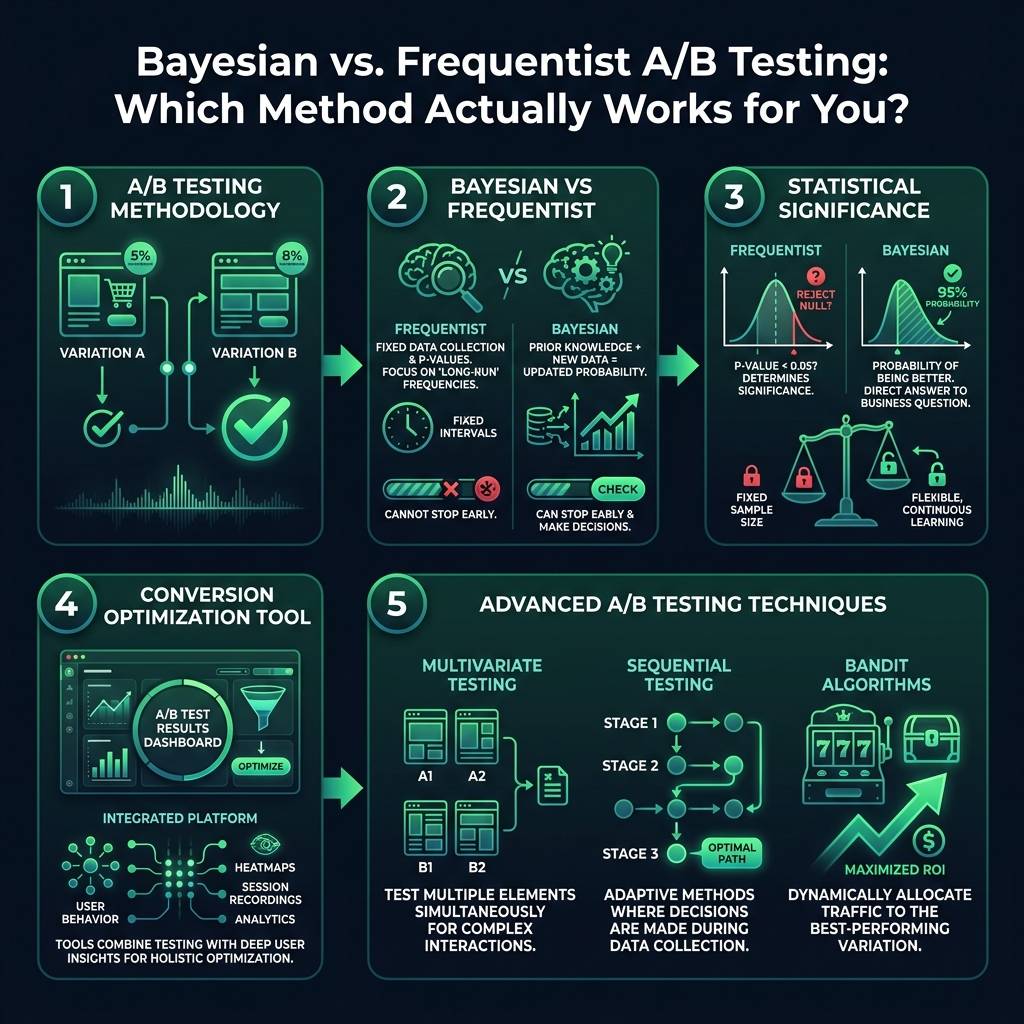
    The Bayesian approach to A/B testing offers a fundamentally different and more intuitive perspective. Instead of a rigid yes/no question, it asks, "What is the probability that Variant B is better than Variant A?" This aligns much more closely with how strategic business decisions are made.

    EyeCaptainEyeCaptain
    Conversions Booster

    Your visitors leave without converting

    Most websites lose 97% of their traffic without a single conversion. Our AI scans 200+ CRO elements to find exactly where visitors drop off.

    Hero CTA missing

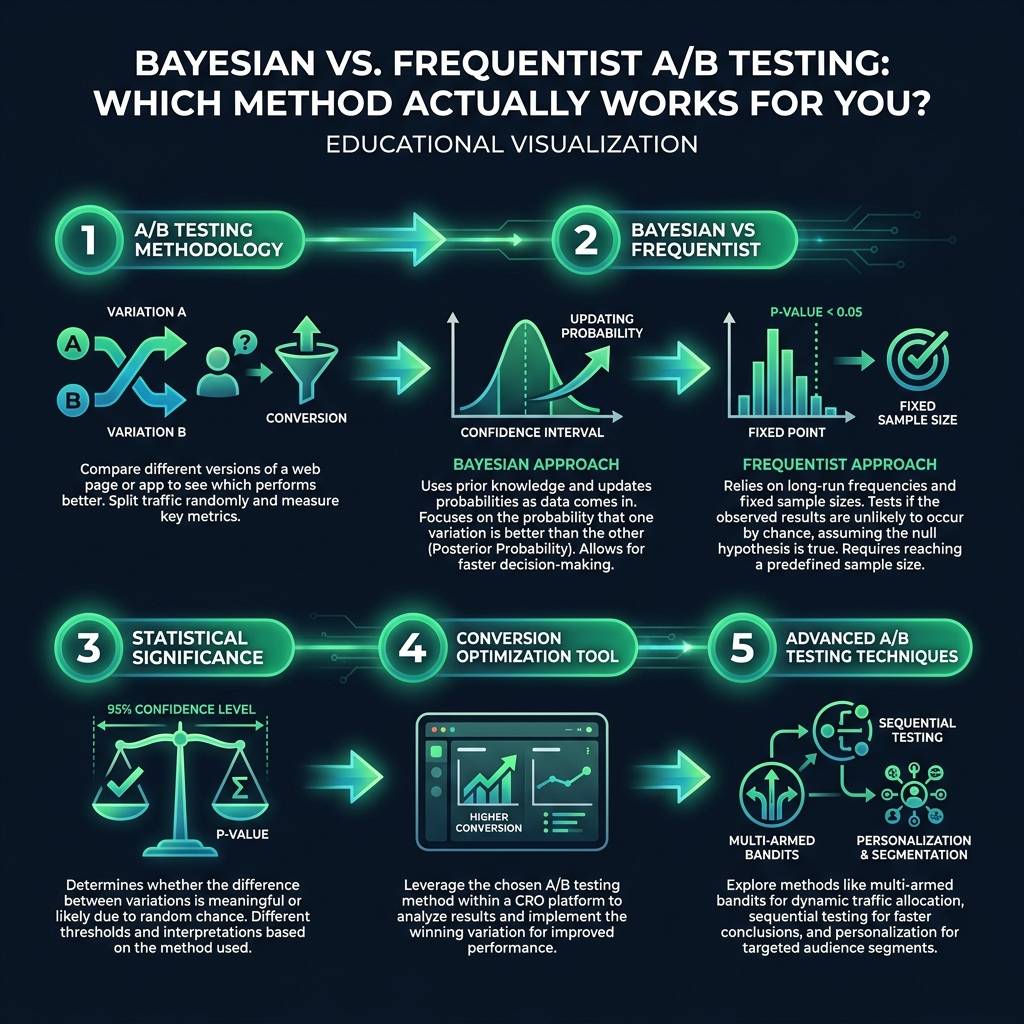
    With the Bayesian method, you start with a "prior belief" (usually that each variant has an equal chance of winning). As data is collected, the model continuously updates this belief. The output is not a binary "significant/not significant" label but a probability, such as, "There is an 87% chance that Variant B is better." This allows you to make decisions based on your organization's risk tolerance.

    The key advantage of this A/B testing methodology is flexibility. You can check your results at any time without corrupting the data. You can stop the test whenever the evidence is strong enough for you to make a confident decision. An analysis by Dynamic Yield found that Bayesian methods reached an actionable conclusion 40% faster on average than Frequentist tests. This means you can learn and iterate more quickly, making it one of the most impactful advanced A/B testing techniques for agile teams.

    The Tradeoff: Priors and Interpreting Probabilities

    The Bayesian model is not without its own considerations. It requires setting a "prior," which introduces a degree of subjectivity that is a point of concern for some statisticians. However, most modern A/B testing platforms use neutral, uninformative priors, minimizing this issue in practice.

    The real challenge is one of interpretation. While a Frequentist result is definitive, a Bayesian result is probabilistic and requires your judgment. Is a 78% probability of being better enough to implement a change? What about 65%? The answer depends on your business context, the cost of implementation, and your team's appetite for risk.

    Choosing Your A/B Testing Methodology: Bayesian vs Frequentist

    So, which statistical model is right for you? The best choice depends on your website's traffic, your organizational culture, and your need for speed. Here is a simple guide to help you decide.

    • For low-traffic websites: The Bayesian approach is almost always superior. It allows you to make informed decisions based on probability rather than waiting months to achieve statistical significance, which may never happen.
    • For high-traffic websites: Either method can work well. With high traffic, you can reach the required sample sizes for Frequentist tests quickly, making the practical differences between the two models less pronounced.
    • For fast-paced, agile teams: Bayesian is a clear winner. The freedom to interpret results and stop tests early based on strong evidence is invaluable for maintaining momentum and increasing testing velocity.
    • For regulated or risk-averse industries: The Frequentist model often provides a more defensible standard. The fixed 95% significance threshold is a widely accepted benchmark that is easier to justify to regulators or skeptical stakeholders.

    Ultimately, the right A/B testing methodology is the one that allows your team to make better decisions, faster. Nielsen Norman Group found that teams using Bayesian methods run significantly more tests per year, not because the math is inherently superior, but because it better accommodates the realities of business operations.

    If your team frequently checks test results before they have concluded, you are already operating outside the strict rules of the Frequentist framework. In that case, it is more practical to adopt a conversion optimization tool and methodology built for the way you actually work.

    Enjoyed this article?

    Join 1,500+ professionals getting weekly CRO & UX tips

    🎁 Bonus: Weekly CRO insights + exclusive resources

    No spam. Unsubscribe anytime.

    🚀 Boost Your Conversion Rate with EyeCaptain

    EyeCaptain is an AI-powered CRO & UX analysis tool that automatically scans your pages, identifies UX issues, and gives you actionable optimization suggestions to increase conversions. Try it for free, no card, no commitment.

    Free CRO Audit

    Did you find this helpful?

    Share it with someone who might find it useful.

    Be the first to learn CRO secrets

    Actionable tips, case studies & early access to new AI tools. Weekly in your inbox.

    1,200+ marketers trust us

    Cookie Settings

    We use cookies to improve your experience.