
Infographic για digital marketing - οπτικοποίηση εννοιών statistical significance A/B test, sample size calculation, Bayesian vs Frequentist
    eyecaptain.io

    A/B Testing Reality Check: Why 90% of Your Tests Are Statistically Invalid

    Struggling with meaningless A/B tests? Learn why your current approach is burning money and how to fix statistical testing forever.

    EyeCaptain

    Dimitris

    11 May 2026

    4 min read
    394 views
    statistical significance A/B testsample size calculationBayesian vs FrequentistA/B testing methodology

    To achieve successful outcomes, understanding the statistical significance of your A/B test is not just important - it is essential. Many marketers believe they are running scientific experiments, but without a proper A/B testing methodology, they often make critical business decisions based on statistically unreliable results. This can lead to wasted resources and, even worse, a decrease in your overall conversion rates.

    It is time to move beyond guesswork and implement a framework for dependable results. We will explore why many tests fail, how to correctly interpret statistical significance, and the common mistakes that could be undermining your entire testing strategy.

    Understanding Statistical Significance in A/B Testing

    Statistical significance is the crucial dividing line between making intelligent, data-driven decisions and simply guessing. It confirms that the results of your test are not due to random chance but are instead a likely outcome of the changes you made. When a result is statistically significant, you can be confident that one variation is genuinely performing differently from another.

    A revealing study by the Baymard Institute, which analyzed thousands of e-commerce experiments, highlighted a widespread problem: the vast majority of tests failed to reach the minimum sample size required for a meaningful result. This points to a fundamental flaw in many common A/B testing approaches.
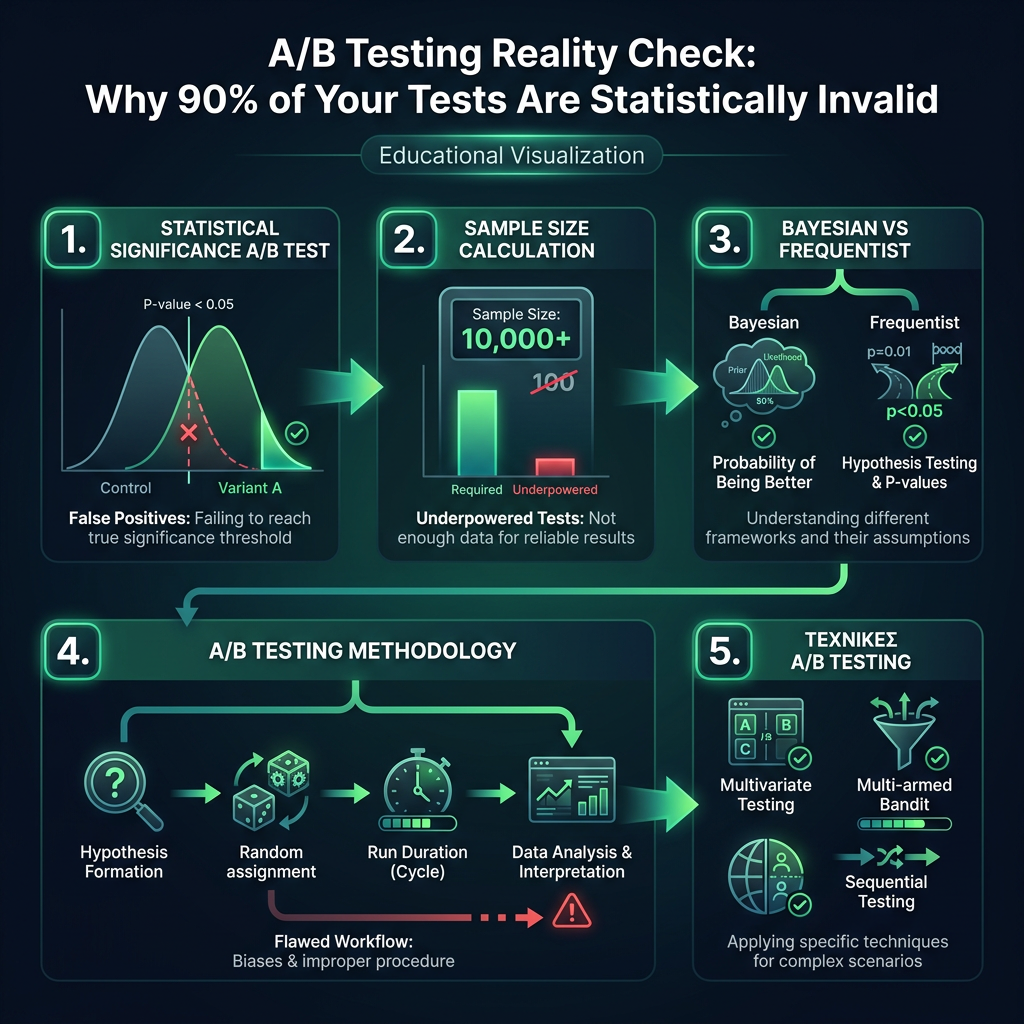

    A/B Testing Reality Check: Why 90% of Your Tests Are Statistically Invalid infographic showing statistical significance A/B test, sample size calculation, Bayesian vs Frequentist for digital marketing
    EyeCaptain
    eyecaptain.io

    The Importance of Sample Size Calculation

    The core issue that invalidates most A/B tests is an inadequate sample size. If you run a test on only a few hundred visitors and declare a winner, you have not gathered enough data to learn anything conclusive. Mathematically, the results are likely random noise, not a true signal of user behavior. A proper sample size calculation is the foundation of any valid A/B test.

    You do not need to be a statistician to determine your sample size, but you do need to understand the concept of statistical power. This calculation relies on three key inputs:

    • Baseline Conversion Rate: Your current conversion rate for the original page (the control).
    • Minimum Detectable Effect (MDE): The smallest improvement you want to be able to detect. A smaller MDE requires a larger sample size.
    • Statistical Significance / Confidence Level: How confident you want to be in the result. The global industry standard is 95% confidence.

    For example, if your baseline conversion rate is 3% and you want to reliably detect a 15% uplift with 95% confidence, your sample size calculation would show that you need several thousand visitors for each variation. Ending a test prematurely with insufficient traffic is the primary reason tests produce unreliable, statistically insignificant results.
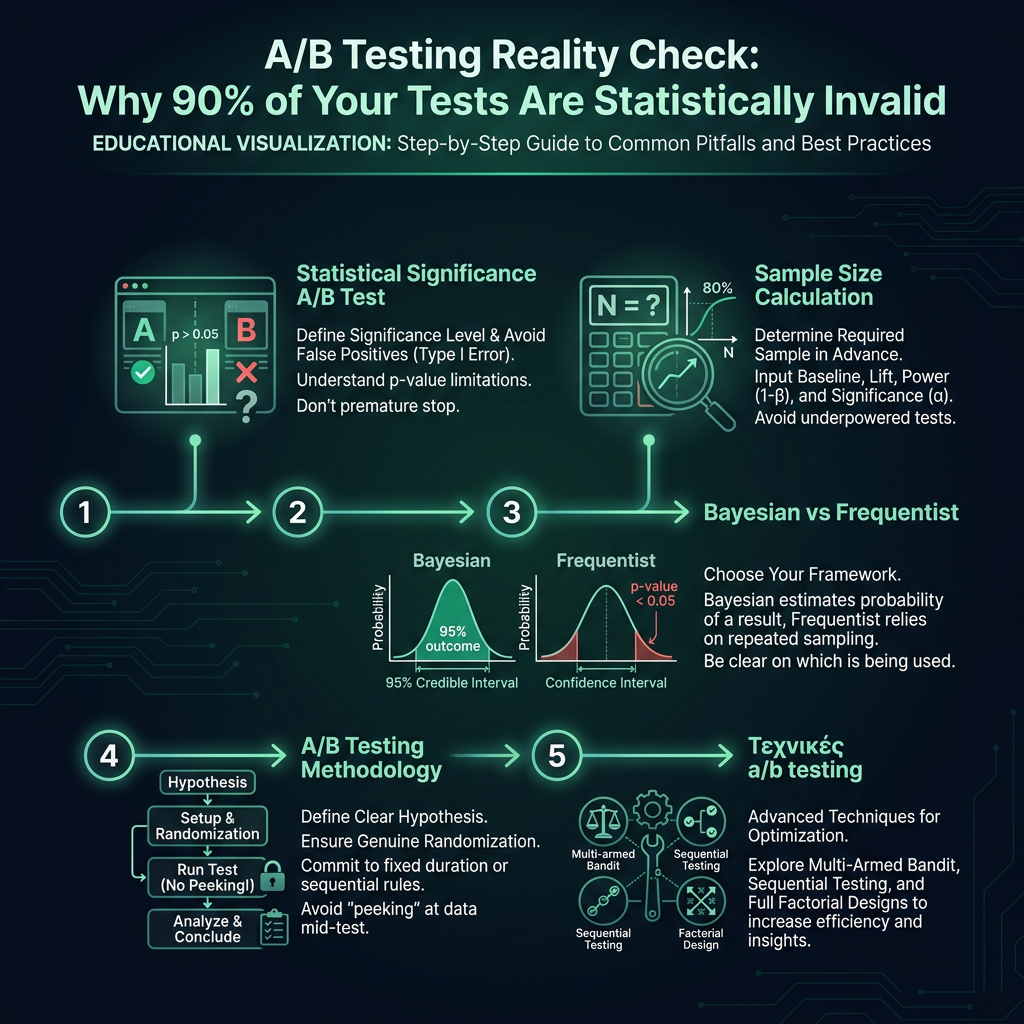
    A/B Testing Reality Check: Why 90% of Your Tests Are Statistically Invalid infographic showing statistical significance A/B test, sample size calculation, Bayesian vs Frequentist for digital marketing
    EyeCaptain
    eyecaptain.io

    Bayesian vs. Frequentist: A Key Debate in A/B Testing Methodology

    A less-known but critical aspect of A/B testing methodology is the statistical approach used to analyze results. The two primary schools of thought are the traditional Frequentist method and the more modern Bayesian method. Understanding the difference is key to selecting the right tools and interpreting your data correctly.

    EyeCaptainEyeCaptain
    97%
    Conversions Booster

    Your visitors leave without converting

    Most websites lose 97% of their traffic without a single conversion. Our AI scans 200+ CRO elements to find exactly where visitors drop off.

    Hero CTA missing

    The core questions they answer are different:

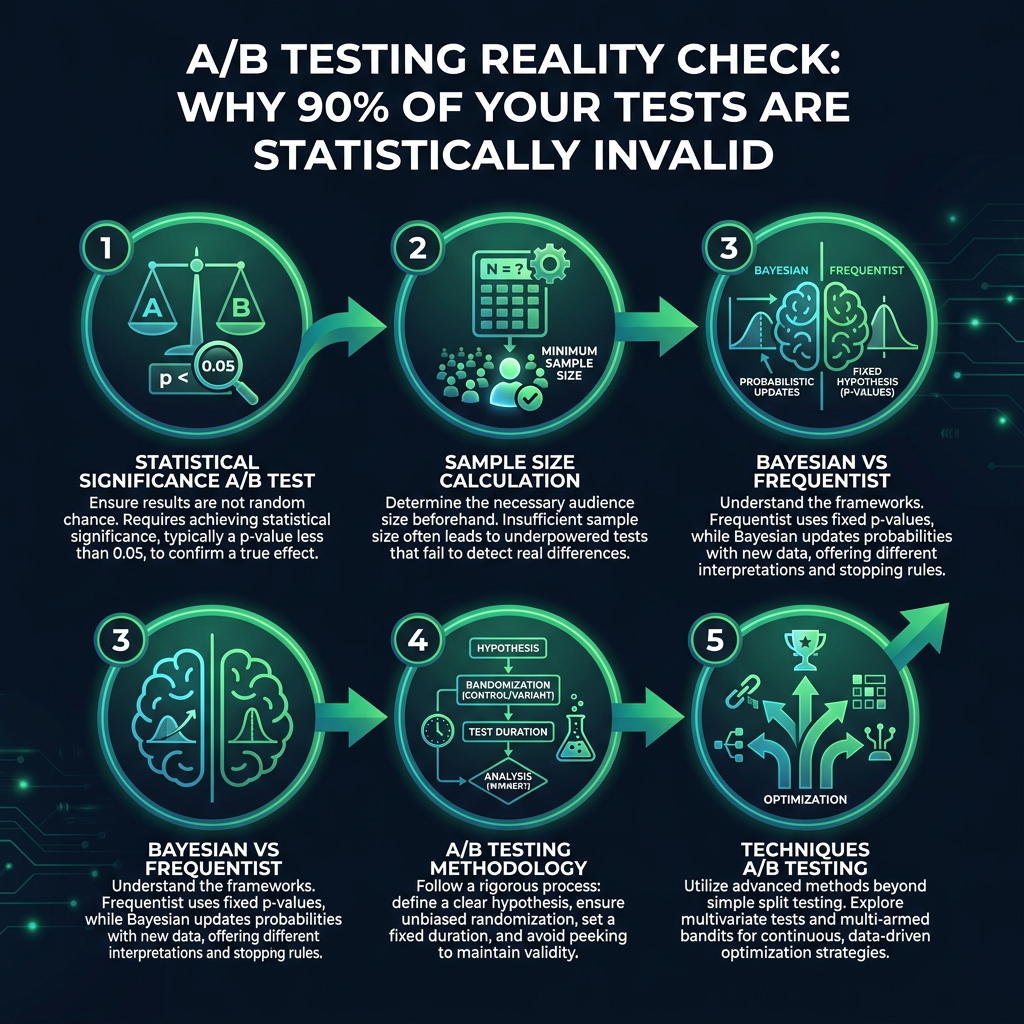
    • A Frequentist test asks: "Assuming the variations are identical, what is the probability of seeing a result this extreme just by random chance?" (This is the p-value).
    • A Bayesian test asks: "Based on the data we have collected, what is the probability that variation B is actually better than variation A?"

    The Bayesian vs. Frequentist debate matters because the approach can significantly impact your testing process. Bayesian methods are often more intuitive and can provide actionable insights faster, sometimes with less traffic. Research from the globally recognized Nielsen Norman Group suggests a Bayesian approach can deliver reliable conclusions more quickly than Frequentist methods. However, it is crucial to understand the principles behind whichever of these A/B testing techniques your platform uses.

    A/B Testing Reality Check: Why 90% of Your Tests Are Statistically Invalid infographic showing statistical significance A/B test, sample size calculation, Bayesian vs Frequentist for digital marketing
    EyeCaptain
    eyecaptain.io

    Adopting a Better A/B Testing Methodology

    The reality is that an improper testing process is likely costing your business money and opportunities for growth. Every time you act on an invalid test, you risk implementing a "winner" that actually harms your financial performance in the long run. You might be confidently implementing changes that do more harm than good.

    It is time to stop guessing and start measuring what truly matters. By focusing on a sound A/B testing methodology - including proper sample size calculation and understanding the principles of statistical significance - you can turn your testing program into a powerful engine for reliable, data-driven growth. The success of your conversion optimization efforts depends on it.

    Enjoyed this article?

    Join 1,500+ professionals getting weekly CRO & UX tips

    🎁 Bonus: Weekly CRO insights + exclusive resources

    No spam. Unsubscribe anytime.

    🚀 Boost Your Conversion Rate with EyeCaptain

    EyeCaptain is an AI-powered CRO & UX analysis tool that automatically scans your pages, identifies UX issues, and gives you actionable optimization suggestions to increase conversions. Try it for free, no card, no commitment.

    Free CRO Audit

    Did you find this helpful?

    Share it with someone who might find it useful.

    Be the first to learn CRO secrets

    Actionable tips, case studies & early access to new AI tools. Weekly in your inbox.

    1,200+ marketers trust us

    Cookie Settings

    We use cookies to improve your experience.