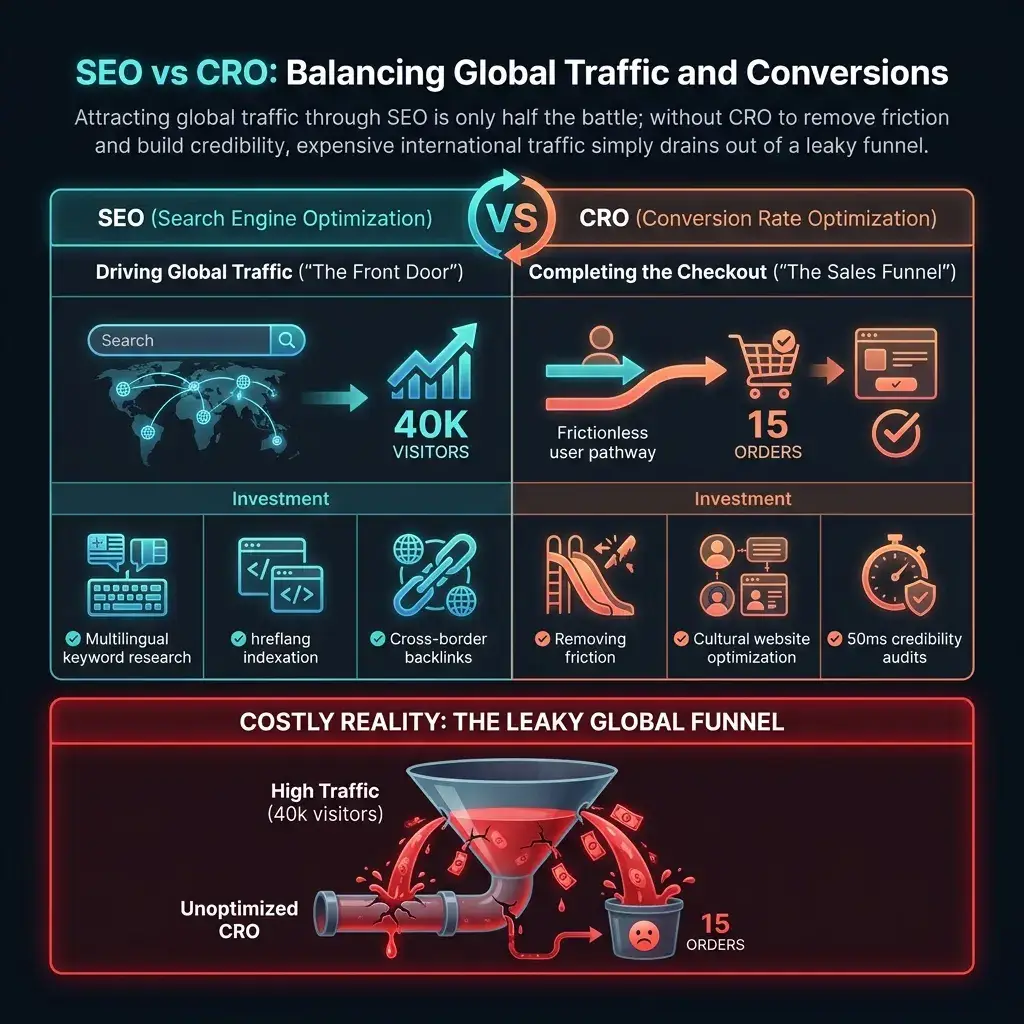

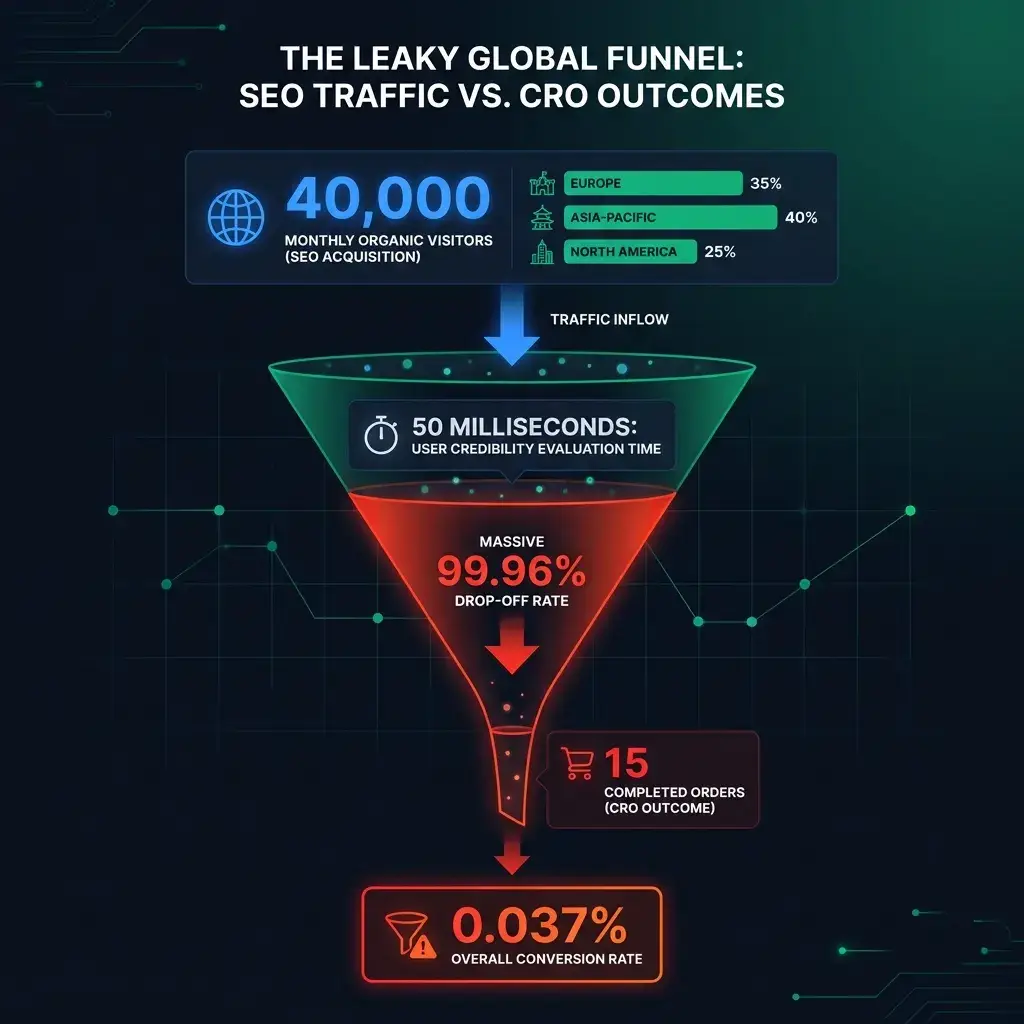
An international founder recently shared an analytics dashboard revealing a costly reality: forty thousand monthly organic visitors across European, Asia-Pacific, and North American markets resulting in just fifteen completed orders. When evaluating SEO vs CRO, cross-border enterprises often struggle to determine whether to prioritize traffic or conversions. Attracting qualified search traffic across borders is only half the battle; without culturally attuned website optimization, high visibility simply masks a leaky global sales funnel.
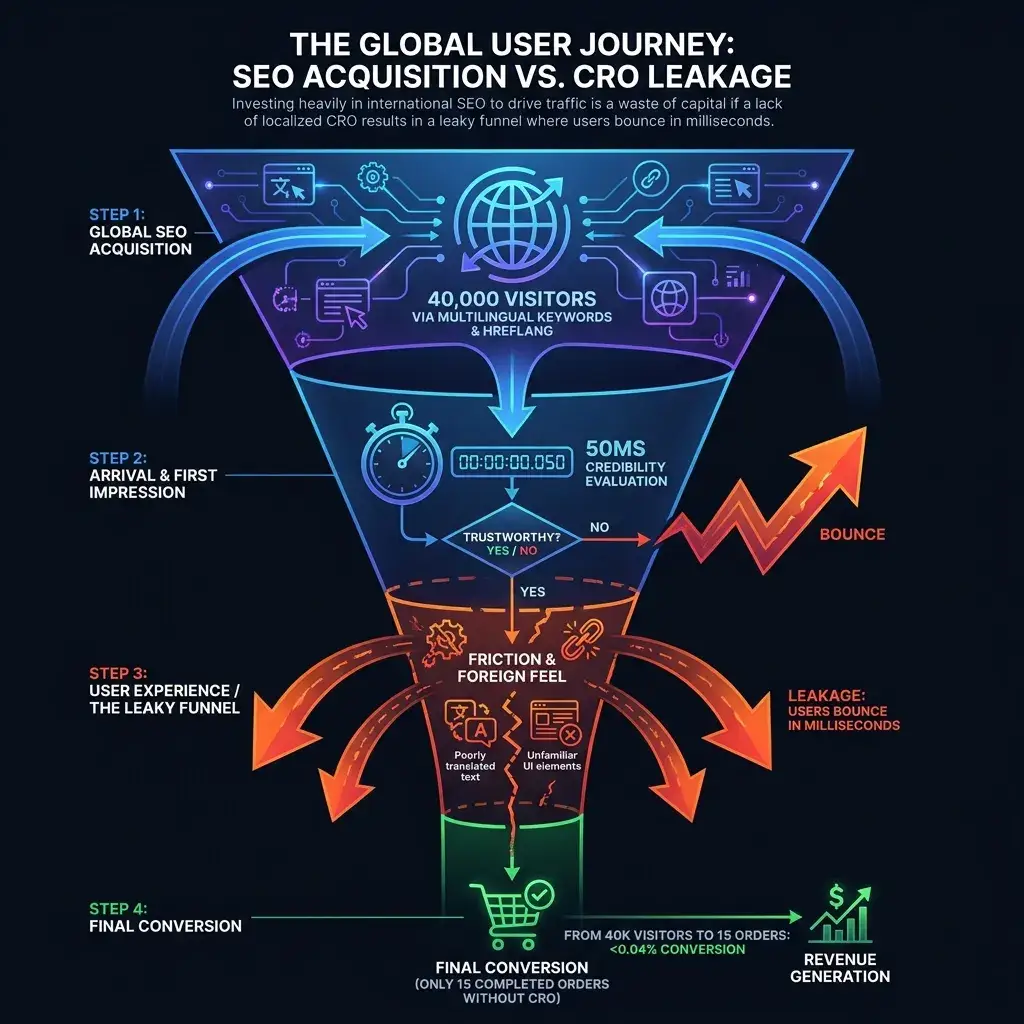
Consider the scale of that mismatch: thousands of prospective buyers arriving from different continents, finding an experience that feels foreign or disjointed, and departing within seconds. For digital brands operating across borders, this breakdown is remarkably common.
Founders frequently divide their attention between search engine visibility across platforms like Google, Bing, and regional search engines, and on-page conversion rate optimization (CRO). Search engine optimization brings global users through the front door based on search intent, while CRO removes friction so they complete checkout. Attempting to rank higher in multiple territories without auditing how international users behave after landing yields diminishing returns on your acquisition spend.

Why Driving Global Traffic into an Unoptimized Funnel Drains Capital
Acquiring sustained organic traffic across multiple territories requires intensive investment. Marketing teams spend months conducting multilingual keyword research, resolving international hreflang indexation errors, building cross-border backlink profiles, and tailoring technical architecture. Yet regardless of geography, when a qualified user clicks through, they evaluate site credibility in approximately fifty milliseconds.
Research from the Nielsen Norman Group confirms that users form credibility opinions about a digital interface almost instantaneously.
If clear value propositions are undermined by sluggish international load times, unlocalized messaging, or confusing site hierarchy, visitors abandon the site immediately. A high bounce rate across international sessions typically indicates that regional search intent was met with friction, non-native terminology, or poor mobile performance.
Consider the baseline unit economics governing traffic acquisition versus conversion efficiency:
- Scenario A (Traffic Focus): You attract 20,000 global visitors per month with an average 0.5% conversion rate, yielding 100 transactions. Doubling organic visibility to 40,000 visits across multiple regions demands extensive capital, translation workflows, and technical overhead to reach 200 transactions.
- Scenario B (Conversion Focus): You maintain that initial 20,000 visitors but optimize the localized buying experience, lifting your conversion rate to 1.0%. You generate the exact same 200 transactions at a fraction of the cost, preserving marketing margin.
Should You Prioritize Traffic or Conversions First?
Resource allocation between SEO expansion and conversion rate testing depends largely on your current data sample size across target territories:
- Sites with under 500 monthly visitors per market: Avoid investing heavily in complex multivariate A/B testing frameworks. Meaningful statistical significance requires transaction volume. In nascent territories, prioritize content localization, core technical SEO, and indexation to build baseline demand.
- Sites with established international traffic: Direct your efforts toward checkout UX and localized friction points. Global research from the Baymard Institute highlights that roughly 70% of online shopping carts are abandoned prior to purchase. These represent high-intent buyers who intend to transact but encounter structural barriers.
Conducting a Conversion Rate Analysis for Cross-Border Audiences
A rigorous conversion rate analysis uncovers international design flaws and regional behavioral bottlenecks that aggregated analytics platforms conceal. While commercial teams often attribute low foreign conversion rates to pricing sensitivity or domestic competitors, behavioral analytics reveal tactical user experience failures.