
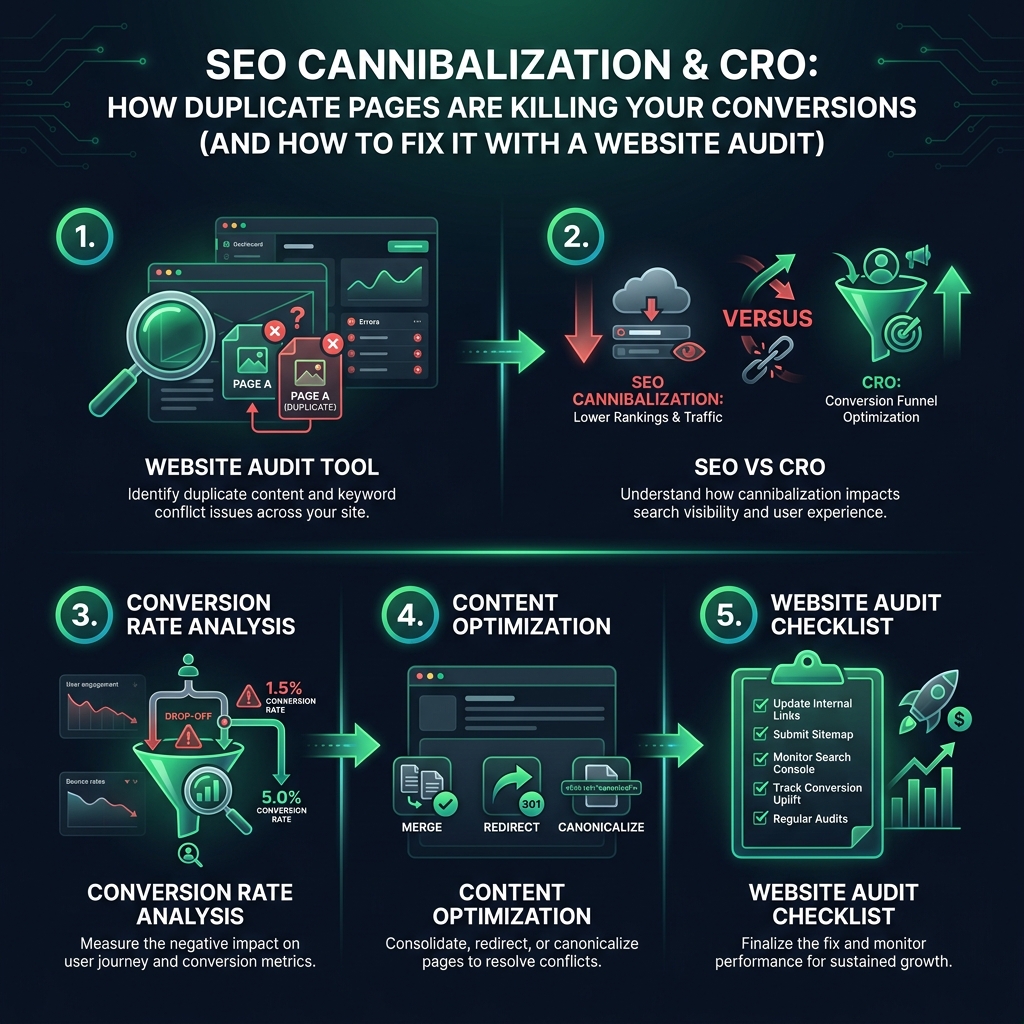
Infographic για digital marketing - οπτικοποίηση εννοιών website audit tool, SEO vs CRO, conversion rate analysis
    eyecaptain.io

    SEO Cannibalization & CRO: How Duplicate Pages Are Killing Your Conversions (And How to Fix It with a Website Audit)

    Your duplicate pages are splitting traffic and destroying conversions. Learn how website audit tools reveal cannibalization and the 3-step fix that works.

    EyeCaptain

    Dimitris

    05 August 2026

    4 min read
    77 views
    website audit toolSEO vs CROconversion rate analysiscontent optimizationwebsite audit checklist

    What is Keyword Cannibalization and Why It's Hurting Your Conversions

    When two or more of your website's pages rank for the same keyword, you might think you have increased your chances of getting a click. In reality, you have created a problem known as keyword cannibalization. This common SEO issue confuses search engines and users, splitting your traffic, diluting your authority, and damaging your conversion rate. Instead of winning, you are competing against yourself.

    This is not just a technical SEO problem; it is a direct threat to your profitability. You are splitting potential traffic, your conversion rate is likely suffering, and search engines are unsure which page is the most relevant. As a result, neither page ranks as high as a single, consolidated page could. Let's explore how to identify this issue with a professional website audit tool and resolve it permanently.

    The Hidden Cost: Where SEO and CRO Conflict

    Keyword cannibalization goes deeper than rankings; it is a customer experience problem that directly impacts your sales. The conflict between Search Engine Optimization (SEO) and Conversion Rate Optimization (CRO) becomes very clear here. You might have pages that are optimized for search but fail to convert visitors into customers.

    When you have multiple pages targeting the same search intent, you force search engines to divide your authority. A page that should be ranking in the top three gets pushed down to position eight, while its competing page languishes on the second page of results. Together, they attract far less traffic than one authoritative page ever would. This is a classic example of how a poor SEO strategy directly harms CRO efforts.

    According to research from the Baymard Institute, a confusing site structure is a major reason for cart abandonment. When a user lands on the wrong page - for example, an informational blog post instead of a product page - they are more likely to leave your site than to search for the correct page.
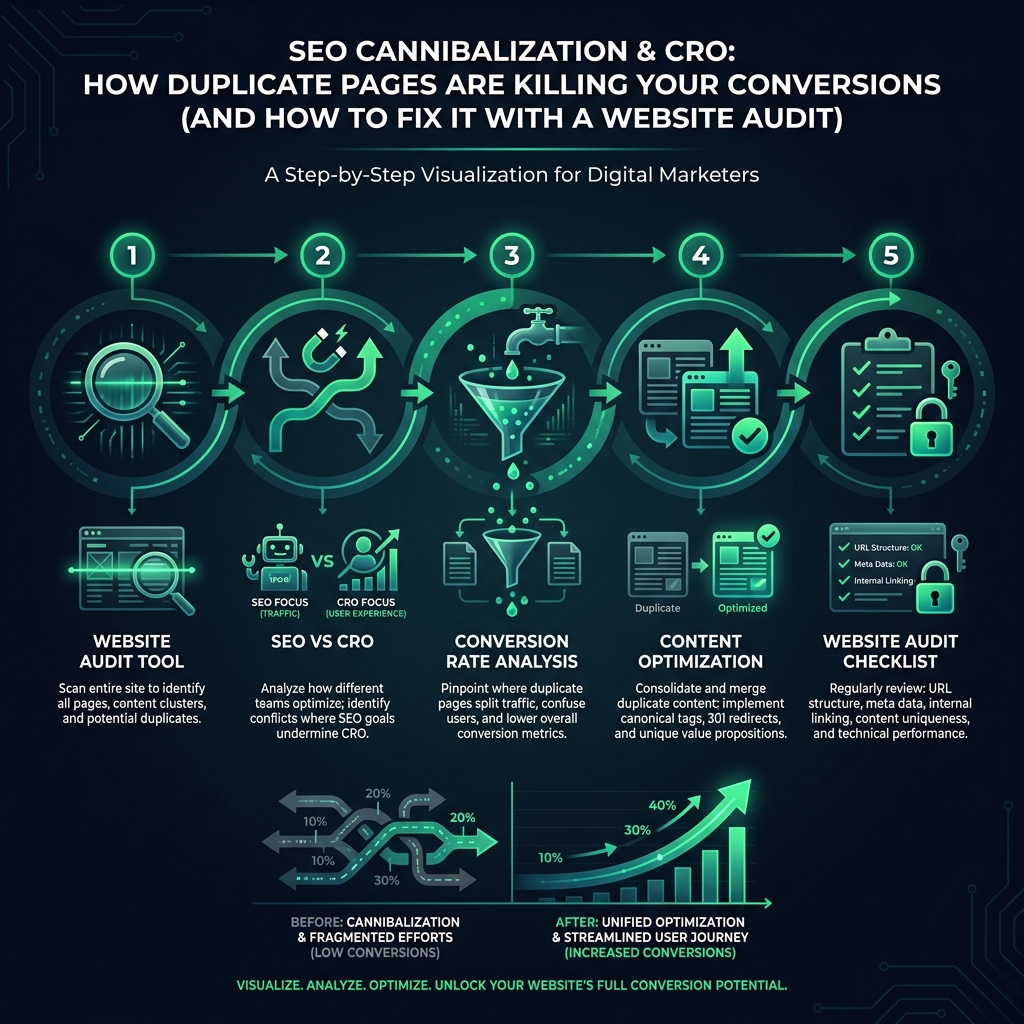
    SEO Cannibalization & CRO: How Duplicate Pages Are Killing Your Conversions (And How to Fix It with a Website Audit) infographic showing website audit tool, SEO vs CRO, conversion rate analysis for digital marketing
    EyeCaptain
    eyecaptain.io

    Consider an online retailer with three different pages for "noise-canceling headphones": a product category page, a specific product page, and a blog post reviewing top models. All three ranked for the same term, which scattered their traffic. The problem was that the blog post linked to out-of-stock items, and the category page lacked a clear "buy" button. Only the product page could secure a sale. A significant 61% of their organic traffic for that high-intent keyword was leading to a page that could not convert. This was a structural issue that no amount of advertising could fix.

    How to Uncover Keyword Conflicts with a Website Audit Tool

    You cannot identify keyword cannibalization by simply browsing your website. The conflicts are often invisible because they exist within search engine results and analytics data. This is where a professional website audit tool becomes essential.

    A comprehensive site audit acts like an X-ray of your website, crawling every URL and mapping out which keywords each page ranks for. It reveals the exact points where you are competing against yourself, providing insights you could never find manually. You might see that your informational blog post is outranking your transactional product page, or that two service pages are splitting traffic for a critical keyword. These are the insights that drive meaningful content optimization.

    Your Website Audit Checklist for Finding Cannibalization

    When running your audit, you are not just looking for duplicate content; you are searching for conflicting search intents. A solid website audit checklist should include the following analysis.

    • Keyword Overlap Report: This is your starting point. A good website audit tool will show you every search query that brings up multiple URLs from your domain. If three of your pages rank for "women's red running shoes," you have found a cannibalization issue that requires consolidation.
    • Click Depth Analysis: How many clicks does it take for a user to get from their landing page to a conversion page? If users cannot find what they need within three clicks, they are likely to leave. Duplicate pages often create confusing user journeys that increase click depth and reduce conversions.
    • Conversion Rate Analysis: This is where the business impact becomes clear. Use your analytics to perform a conversion rate analysis by landing page. You might discover Page A gets 60% of the traffic but has a 0.8% conversion rate, while Page B gets 40% of the traffic but converts at 3.2%. This data tells you which page is the true performer.
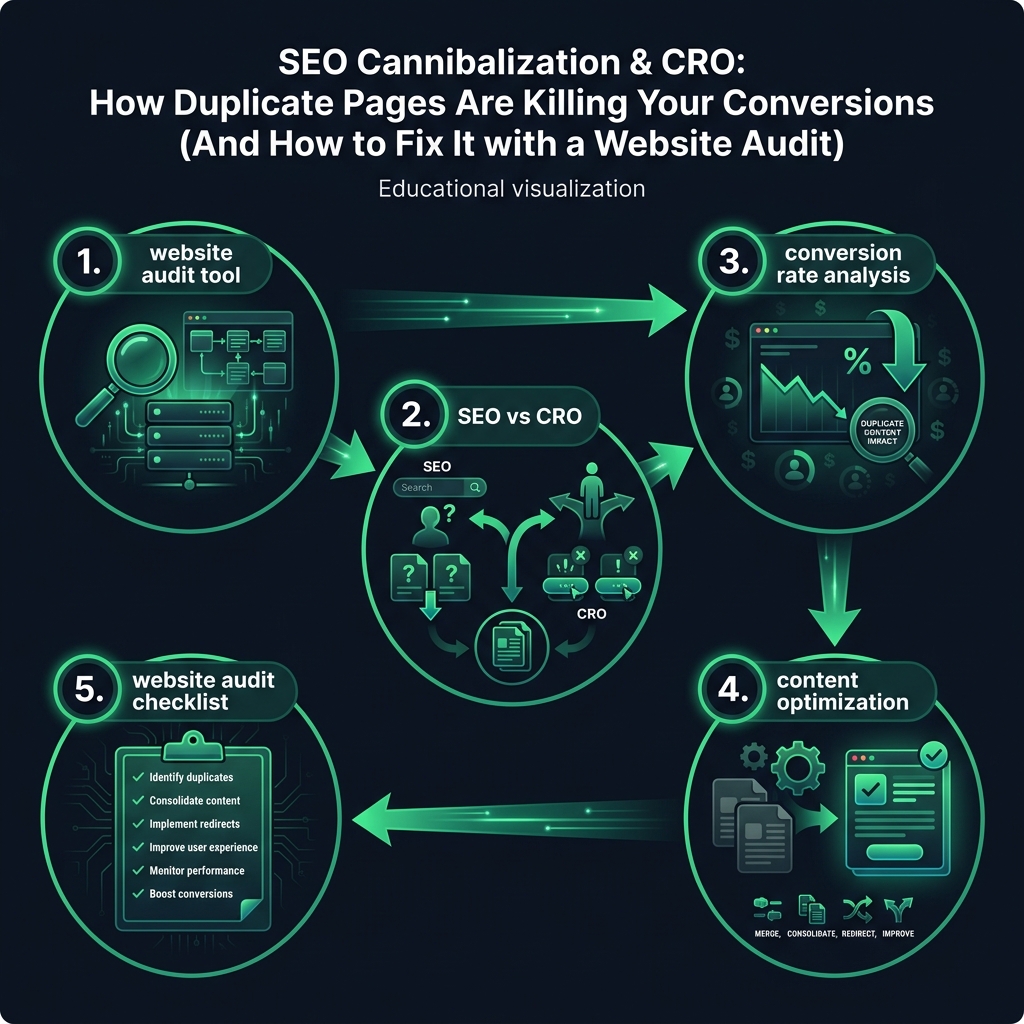
    SEO Cannibalization & CRO: How Duplicate Pages Are Killing Your Conversions (And How to Fix It with a Website Audit) infographic showing website audit tool, SEO vs CRO, conversion rate analysis for digital marketing
    EyeCaptain
    eyecaptain.io

    However, the solution is not always to keep the higher-converting page. Sometimes, the page with more traffic has greater SEO authority but a poor user experience. The true art of content optimization is merging the SEO power of one page with the conversion-focused design of another.

    EyeCaptainEyeCaptain
    97%
    Conversions Booster

    Your visitors leave without converting

    Most websites lose 97% of their traffic without a single conversion. Our AI scans 200+ CRO elements to find exactly where visitors drop off.

    Hero CTA missing

    A 3-Step Guide to Effective Content Optimization

    Once you have used a site audit to identify the problem areas, fixing them is a straightforward process. Follow these steps to resolve the conflicts and improve your performance.

    Step 1: Identify and Prioritize the Conflicts

    Run your website audit and create a list of all keywords with multiple ranking pages. Next, prioritize this list by search volume and business value. Focus your energy on the conflicts that are costing you the most in potential revenue. Start with your most valuable commercial keywords.

    Step 2: Choose Your Consolidation Strategy

    For each conflict, you have three primary options. Choosing the right one is key to successful content optimization.

    • Consolidate and Redirect: This is the most common and effective solution. Merge the best elements of both pages into a single, comprehensive page. Choose the URL with more authority (e.g., more backlinks or higher rankings) as your primary version. Then, implement a 301 redirect from the weaker page to the stronger one. This passes on ranking signals and tells search engines the page has permanently moved.
    • Differentiate and Re-Optimize: Sometimes two pages serve different user intents (e.g., informational vs. transactional). In this case, you can keep both pages but must make them distinct. Re-optimize one page for a "buy now" intent (e.g., "buy leather laptop bag") and the other for a research intent (e.g., "how to choose a leather bag"). Update titles, headings, and content to clearly signal each page's unique purpose to search engines.
    • Delete and Prune: Do not be afraid to delete a page if it is outdated, low-quality, and provides no value. If a page has no significant traffic or backlinks, you can often remove it. This cleanup helps focus your site's authority on the pages that truly matter.
    SEO Cannibalization & CRO: How Duplicate Pages Are Killing Your Conversions (And How to Fix It with a Website Audit) infographic showing website audit tool, SEO vs CRO, conversion rate analysis for digital marketing
    EyeCaptain
    eyecaptain.io

    Step 3: Monitor and Measure the Results

    After implementing your changes, your work is not finished. For the next 30-60 days, closely monitor your analytics. You should see organic traffic to the consolidated page increase, often by 15-30% or more. Your keyword rankings for the target term should climb, and most importantly, your conversion rate should improve now that users are on the correct path. This ongoing monitoring is a critical part of both SEO and CRO.

    Fixing keyword cannibalization is not a one-time task; it is a regular maintenance process. Plan to run an audit every quarter to ensure new content is not creating new conflicts. If you have not performed this type of conversion rate analysis and content audit, you are almost certainly missing out on potential revenue.

    Enjoyed this article?

    Join 1,500+ professionals getting weekly CRO & UX tips

    🎁 Bonus: Weekly CRO insights + exclusive resources

    No spam. Unsubscribe anytime.

    🚀 Boost Your Conversion Rate with EyeCaptain

    EyeCaptain is an AI-powered CRO & UX analysis tool that automatically scans your pages, identifies UX issues, and gives you actionable optimization suggestions to increase conversions. Try it for free, no card, no commitment.

    Free CRO Audit

    Did you find this helpful?

    Share it with someone who might find it useful.

    Be the first to learn CRO secrets

    Actionable tips, case studies & early access to new AI tools. Weekly in your inbox.

    1,200+ marketers trust us

    Cookie Settings

    We use cookies to improve your experience.