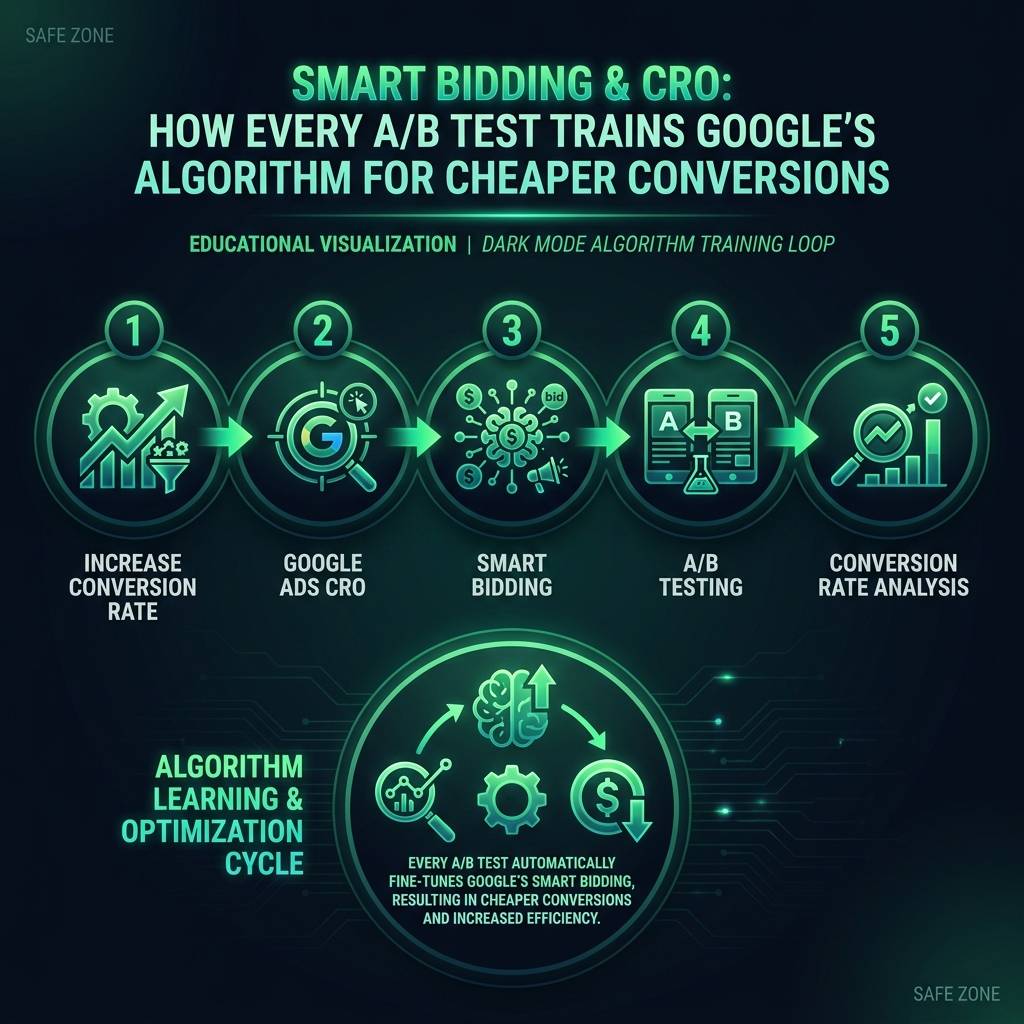

Struggling to see a real return on your Google Ads investment? If your clicks are not turning into sales, the problem might not be your bid strategy, but the data you are feeding Google's algorithm. To truly increase your conversion rate and make your ad spend effective, you need to understand how Google Ads CRO (Conversion Rate Optimization) directly impacts the performance of powerful tools like Smart Bidding.
You keep adjusting your campaigns, but the results are stagnant. The reason is simple: Google's AI is working with poor-quality data. Let's explore how to fix that.
Why Smart Bidding Needs High-Quality Conversion Data
Google's Smart Bidding is an incredibly powerful system. It adjusts your bids in real-time, analyzing millions of signals to predict who is most likely to convert. But this advanced algorithm needs good, clean data to learn what an actual buyer looks like for your business. If your website only converts 1.2% of visitors, the algorithm is starving for information. It is trying to find a meaningful pattern in an ocean of noise.
This is the critical connection most advertisers miss. Every successful A/B testing experiment you run is not just about a one-time performance increase. You are fundamentally retraining Google's AI, giving it a much clearer picture of who to target.
The "Garbage In, Garbage Out" Problem
In every ad auction, Google analyzes over 70 million signals - device type, location, time of day, browsing history, and more - to find clues that indicate buying intent. But here is the challenge: if only 12 out of every 1,000 visitors make a purchase, the algorithm has just a mere 12 data points to learn from. The other 988 are simply noise. It is like trying to hear a whisper during a rock concert.
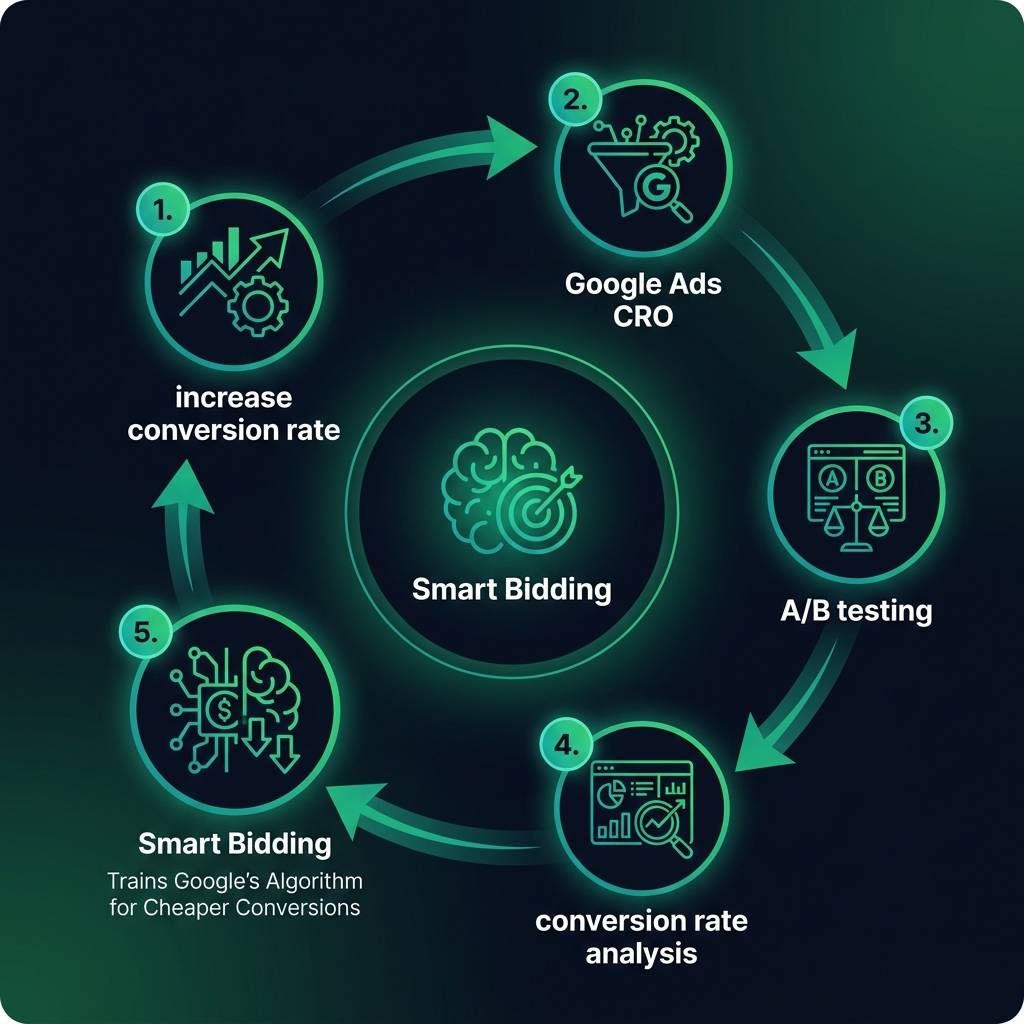

When you use A/B testing to improve your website's user experience and increase your conversion rate, you are not just getting more sales today. You are giving Google's AI exponentially more training data for tomorrow.
Research from the Baymard Institute shows the average e-commerce site converts under 2%, and cart abandonment is around 70%. For most advertisers, this means Google's algorithm is essentially operating with insufficient information.
Consider this: a site that converts at 3% instead of 1.2% gives the algorithm two and a half times more successful outcomes to analyze from the exact same amount of traffic. Suddenly, Google has enough data to find real, statistically significant patterns. It learns that mobile users from a specific region who visit in the evening convert at a much higher rate. As a result, it bids more aggressively for that group and reduces bids for low-intent clicks.
The Flywheel Effect: How A/B Testing Amplifies Google Ads Performance
The impact of effective Google Ads CRO creates a powerful, compounding effect on your advertising results. Imagine you run a simple A/B test on your checkout flow by removing two unnecessary form fields. Your conversion rate jumps from 2.1% to 2.8% - a 33% lift from the same traffic. That is a great result on its own.
But the real impact is happening behind the scenes. Your Smart Bidding strategy just received 33% more high-quality conversion data. Over the next few weeks, it recalibrates and discovers new patterns. Your cost-per-click (CPC) might even rise for high-intent users, but your overall cost per acquisition (CPA) will plummet because you are no longer wasting ad spend on clicks that fail to convert.

This initiates a virtuous cycle: