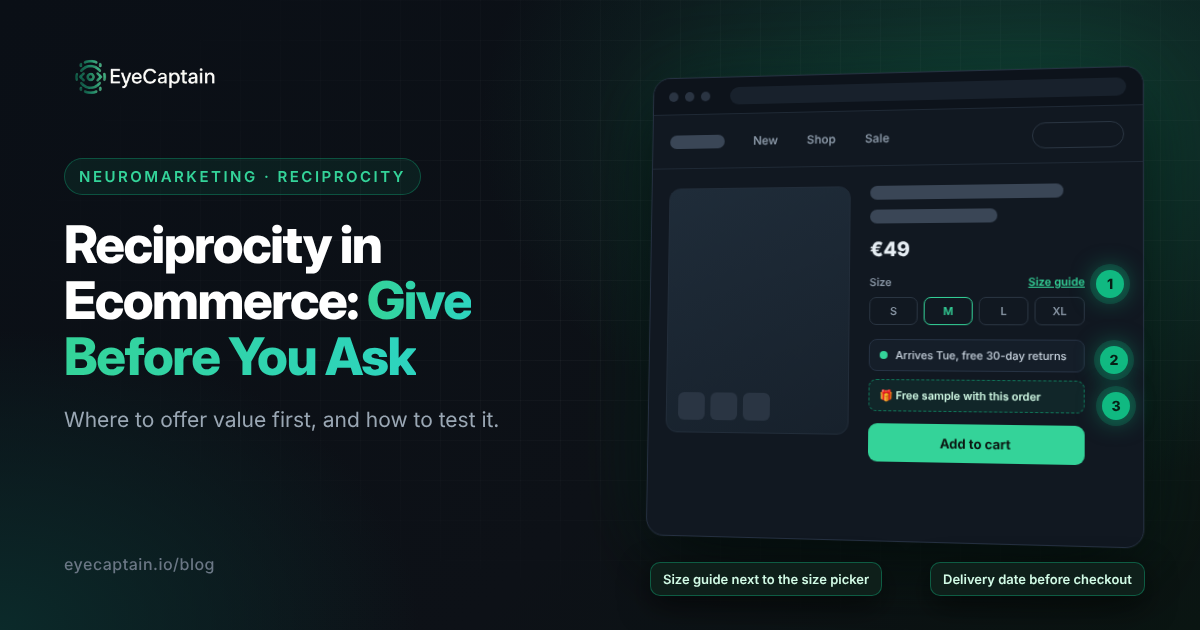


Most online stores ask before they give. A popup asks for an email address two seconds after the page loads. A guide sits behind a form. An app wants notification permission before the shopper has seen a single product. Each of these requests asks the visitor to trust you first, at the moment they know the least about you.
The reciprocity principle points the other way. People feel a natural pull to return a favour, so a store that gives something useful first tends to get more back later: more attention, more information and more patience with the next step. This guide explains how reciprocity works, where it fits in an ecommerce journey, and how to check whether your own site gives before it asks.
What the reciprocity principle is
Reciprocity is the social norm that we repay what others give us. Robert Cialdini listed it as one of his six principles of influence, and it is one of the most studied ideas in social psychology. If you want a wider overview of the biases that shape buying decisions, our guide to marketing psychology and conversion biases covers the main ones. Here we stay with reciprocity and how to apply it on a store.
A well known field example comes from restaurants. In a study published in the Journal of Applied Social Psychology, researchers found that diners who received a small piece of chocolate with the bill tipped more than diners who received no candy, and that the size of the effect changed with how much candy was given and how it was offered. The authors concluded that reciprocity explained the result better than a simple good mood. The gift was tiny; what mattered was that it came first.
Why it matters for online stores
An ecommerce site is full of small requests: sign up, create an account, allow cookies, enter a postcode, leave a review. Reciprocity changes the balance by making the visitor feel that the store has already done something for them.
The Nielsen Norman Group describes a study from the University of Padova that compared two versions of the same website. In one version, visitors filled in a form and then received a set of guidelines. In the other, they received the guidelines first and were asked to fill in the form afterwards. According to the Nielsen Norman Group summary of the study, people gave out more information when they received the content first, although more people submitted the form when it was required up front.
That trade off is useful for anyone running a store. A gate can produce more form submissions in the short term, but giving first tends to produce better quality data and a better relationship. If your email list is full of fake addresses, a forced gate may be the reason.
Where to give first in the ecommerce journey
Reciprocity is not one tactic. It is a way of ordering the journey so that value comes before effort. Here are the places where it usually fits best.
Product pages: answer the questions before you ask for the sale
The most valuable gift on a product page is a clear answer. Size guidance, real dimensions, materials, care instructions, delivery dates and return conditions all save the shopper time. When these answers are easy to find, the request to add to cart feels fair. When they are missing, the shopper has to do work before you have done any.
- Put the size guide next to the size selector, not in a footer link.
- Show the estimated delivery date before checkout, not only on the confirmation page.
- Explain the returns policy in one plain sentence near the buy button.
Content: show part of it before the form
If you offer a buying guide, a lookbook or a calculator, let visitors see a meaningful part of it before you ask for an email address. The visitor learns that the content is worth having, and the request then reads as an offer rather than a toll. Our guide to content upgrades for lead generation covers how to build offers that match each article.
Email capture: give a reason, then ask
A signup box that only says "Subscribe" gives nothing first. A box that explains what the subscriber gets, such as restock alerts, size advice or early access to a sale, gives the visitor a reason to reply in kind. An entry popup that fires before the visitor has read anything asks too early; our article on when exit intent popups help explains better triggers.
Checkout: do the work for the shopper
At checkout, giving first means removing effort. Prefill what you already know, offer address lookup, keep guest checkout available and explain costs before the final step. Every field you remove is a small favour, and our guide on how many form fields to use shows how to decide which ones to keep.