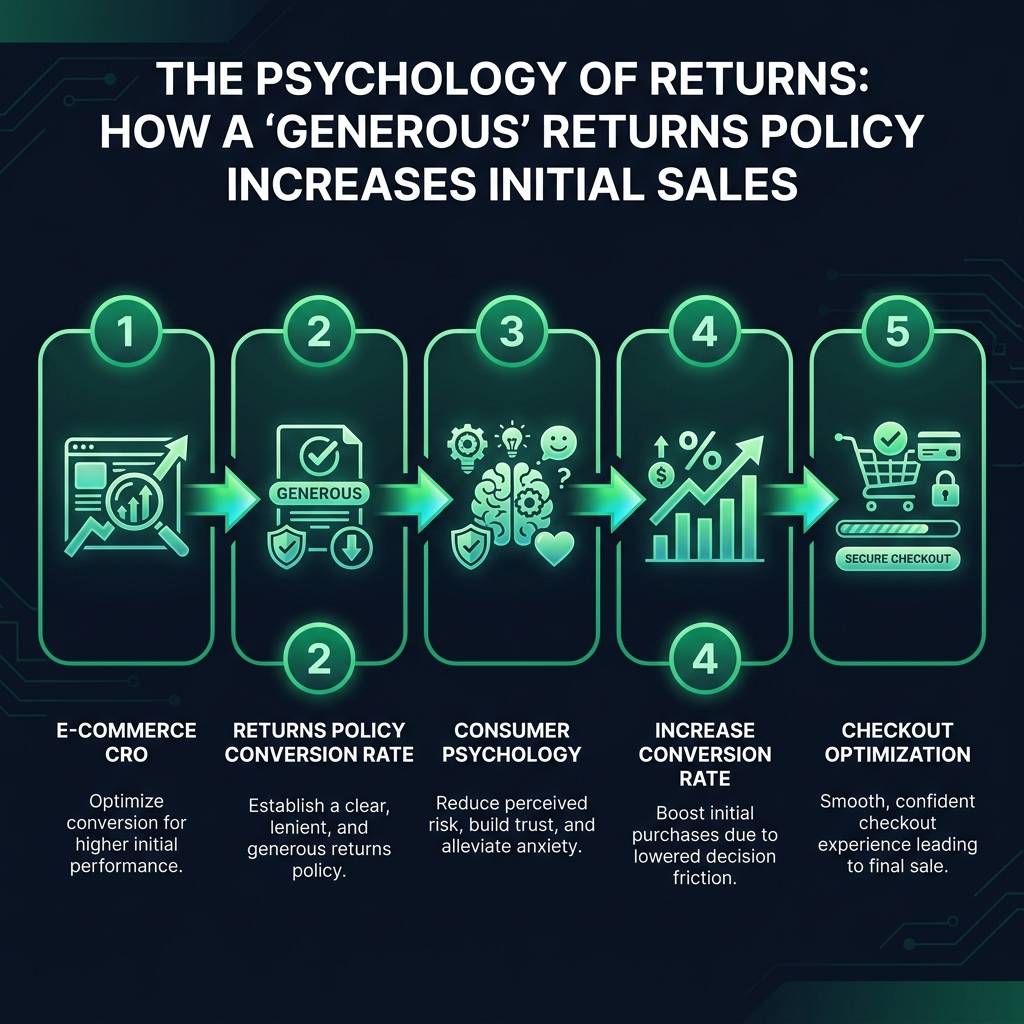
Infographic για digital marketing - οπτικοποίηση εννοιών ecommerce CRO, returns policy conversion rate, consumer psychology
    eyecaptain.io

    The Psychology of Returns: How a 'Generous' Returns Policy Increases Initial Sales

    Afraid a generous returns policy will cost you money? Research shows it increases conversion rate by 58%. Here's the psychology behind it.

    Dimitris Andreadakis

    02 September 2026

    3 min read
    46 views
    ecommerce CROreturns policy conversion rateconsumer psychologyincrease conversion ratecheckout optimization

    Are you struggling to increase your conversion rate? A restrictive returns policy might be the hidden obstacle reducing your sales. Effective ecommerce CRO (Conversion Rate Optimization) goes beyond design elements; it delves into consumer psychology to remove purchase anxiety. Transforming your returns policy from a defensive measure into a proactive sales tool is one of the most powerful ways to build trust and drive revenue.

    Many online business owners view returns as a direct loss - a lost sale, shipping costs, and operational challenges. This often leads to defensive, restrictive policies: short 14-day limits, demands for original packaging, and restocking fees. But what if this entire approach is counterproductive, actively harming your financial results?

    The data is surprisingly clear: businesses with generous, easy-to-understand return policies convert significantly more visitors into customers. This happens not in spite of the policy, but because of it.

    Why Your Returns Policy Could Be Lowering Your Conversion Rate

    The moment a potential customer considers buying from you, their mind begins a quiet risk calculation. Will it fit? Is the color accurate online? Does this product truly solve my problem? Every one of these questions introduces friction, and friction is the ultimate barrier to conversion. Your returns policy is your single best tool for risk reversal.

    Think of it as your promise to the customer: "Go ahead and try it. If you don't love it, sending it back is simple and straightforward. We will take care of you."

    This is not just a theory. The Baymard Institute found that for 49% of shoppers who abandon their carts, concerns about an unsatisfactory returns policy were a contributing factor. It's the final doubt that prevents them from clicking "Buy Now." A confusing or strict policy at the final stage of a purchase is a major failure in checkout optimization.

    The Psychology of Returns: How a 'Generous' Returns Policy Increases Initial Sales infographic showing ecommerce CRO, returns policy conversion rate, consumer psychology for digital marketing
    EyeCaptain
    eyecaptain.io

    The Psychology of Purchase Anxiety

    Put yourself in your customer's position. They are about to pay and see your policy: "14-day returns, original packaging required, unused items only." Suddenly, their risk analysis intensifies:

    • What if I'm busy and need more than two weeks to decide?
    • What if the box gets damaged when I open it?
    • How can I know if these shoes fit if I can't try them on around the house?

    You have just introduced new points of friction. A famous case study from the online retailer Zappos proves the opposite approach works. When they extended their return policy from 30 days to 365 days, their rate of repeat customers increased significantly. It was not because more people returned products; it was because the perceived risk of buying was completely eliminated.
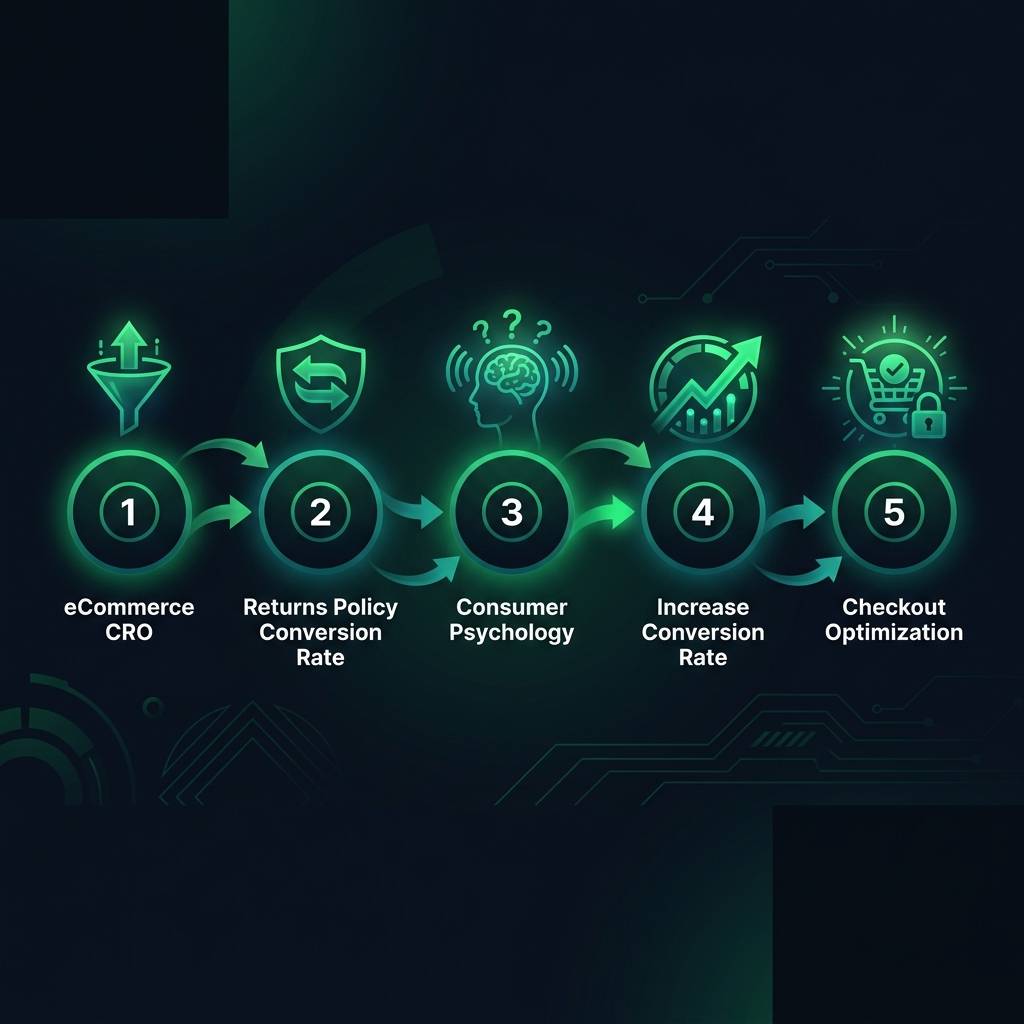

    How a Generous Returns Policy Drives Ecommerce CRO

    Here is where the strategy can feel counterintuitive. You might assume a generous policy simply means more returns and higher costs. While your return rate might increase slightly, the significant impact is seen in your total revenue. The positive effect of a clear returns policy on conversion rate often leads to a dramatic increase in overall sales.

    Why? Because customers feel safe enough to take a chance. They will order two sizes of a shirt to find the perfect fit. They will finally try that new product they were curious about. Their average order value increases because their personal financial risk decreases. The transaction shifts from a permanent, high-stakes decision to a low-risk trial.

    A study of customers from the global fashion retailer Asos revealed a powerful insight: shoppers who made at least one return went on to purchase three times more over the next year than customers who never returned anything. They learned firsthand that the process was painless and, more importantly, that they could trust the company.
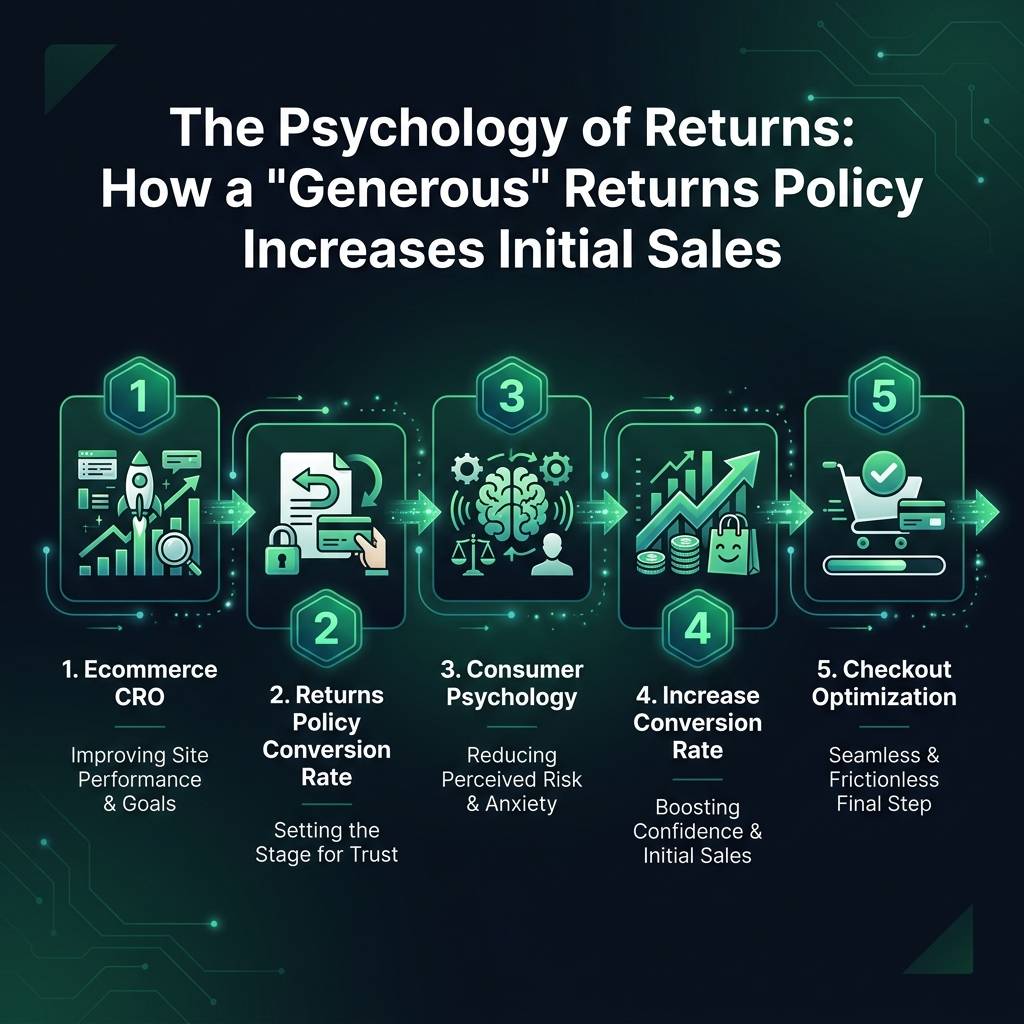
    The Psychology of Returns: How a 'Generous' Returns Policy Increases Initial Sales infographic showing ecommerce CRO, returns policy conversion rate, consumer psychology for digital marketing
    EyeCaptain
    eyecaptain.io

    Crafting a Returns Policy that Increases Conversions

    You do not need a 365-day window to see results. A "generous" policy is simply one that is longer than your competitors', easier than the customer expects, and communicated with absolute clarity. It's important to build on any legally required minimums (such as the 14-day period in the EU) and use them as a baseline, not a limit.

    EyeCaptainEyeCaptain
    97%
    Conversions Booster

    Your visitors leave without converting

    Most websites lose 97% of their traffic without a single conversion. Our AI scans 200+ CRO elements to find exactly where visitors drop off.

    Hero CTA missing

    Key Elements of a High-Converting Policy

    Data from thousands of ecommerce sites points to a widely recommended range for your return window: 30 to 60 days. Anything less than 30 days often fails to provide the necessary psychological safety net. But even more important than the timeframe is the cost and ease of the process.

    Free or low-cost return shipping is a vital part of modern ecommerce CRO. One study found that 67% of shoppers check the returns policy before buying. If they see a high or unexpected fee, many will abandon your site immediately. While free returns are the gold standard, if this is not logistically feasible in your market, consider alternatives like a flat-rate subsidized fee or convenient local drop-off points. The goal is to reduce customer friction.

    Finally, do not hide your policy. You need to advertise it as a key benefit. This is a crucial part of checkout optimization. Display a simple, clear summary on your product pages, in the shopping cart, and at checkout. A simple banner that says, "Free & Easy 30-Day Returns" is highly effective.

    The Real Calculation: Analyzing the ROI of Better Returns

    Let's address the fear of costs with a simple example. Imagine your store currently has an 8% return rate with a strict policy. You implement 30-day free returns, and that rate climbs to 12%. That 4-point increase might seem concerning on its own.

    The Psychology of Returns: How a 'Generous' Returns Policy Increases Initial Sales infographic showing ecommerce CRO, returns policy conversion rate, consumer psychology for digital marketing
    EyeCaptain
    eyecaptain.io

    But what if, by removing purchase anxiety, your overall conversion rate also jumps from 2.1% to 3.3%? You just achieved 57% more sales. Even after accounting for the higher return costs, your net revenue is very likely to be up significantly.

    This strategy is most effective for products where fit, feel, or function is uncertain (like fashion or electronics), but it provides a solid lift for almost any online store. If products are returned due to poor quality or misleading descriptions, a better returns policy will not fix a flawed business model. But if they are returned as part of the natural "try-on" process, you have secured a sale you would have otherwise missed.

    This business logic is sound when you shift your focus from a single transaction to the lifetime value of a happy, trusting customer. That is the true secret to sustainable growth and how a smart returns policy can increase your conversion rate for years to come.

    Enjoyed this article?

    Join 1,500+ professionals getting weekly CRO & UX tips

    🎁 Bonus: Weekly CRO insights + exclusive resources

    No spam. Unsubscribe anytime.

    🚀 Boost Your Conversion Rate with EyeCaptain

    EyeCaptain is an AI-powered CRO & UX analysis tool that automatically scans your pages, identifies UX issues, and gives you actionable optimization suggestions to increase conversions. Try it for free, no card, no commitment.

    Free CRO Audit

    Did you find this helpful?

    Share it with someone who might find it useful.

    Dimitris Andreadakis

    About the author

    Founder of EyeCaptain. Writes about conversion rate optimization, UX analysis and the neuromarketing behind pages that actually sell.

    More articles by Dimitris Andreadakis

    Be the first to learn CRO secrets

    Actionable tips, case studies & early access to new AI tools. Weekly in your inbox.

    1,200+ marketers trust us

    Cookie Settings

    We use cookies to improve your experience.