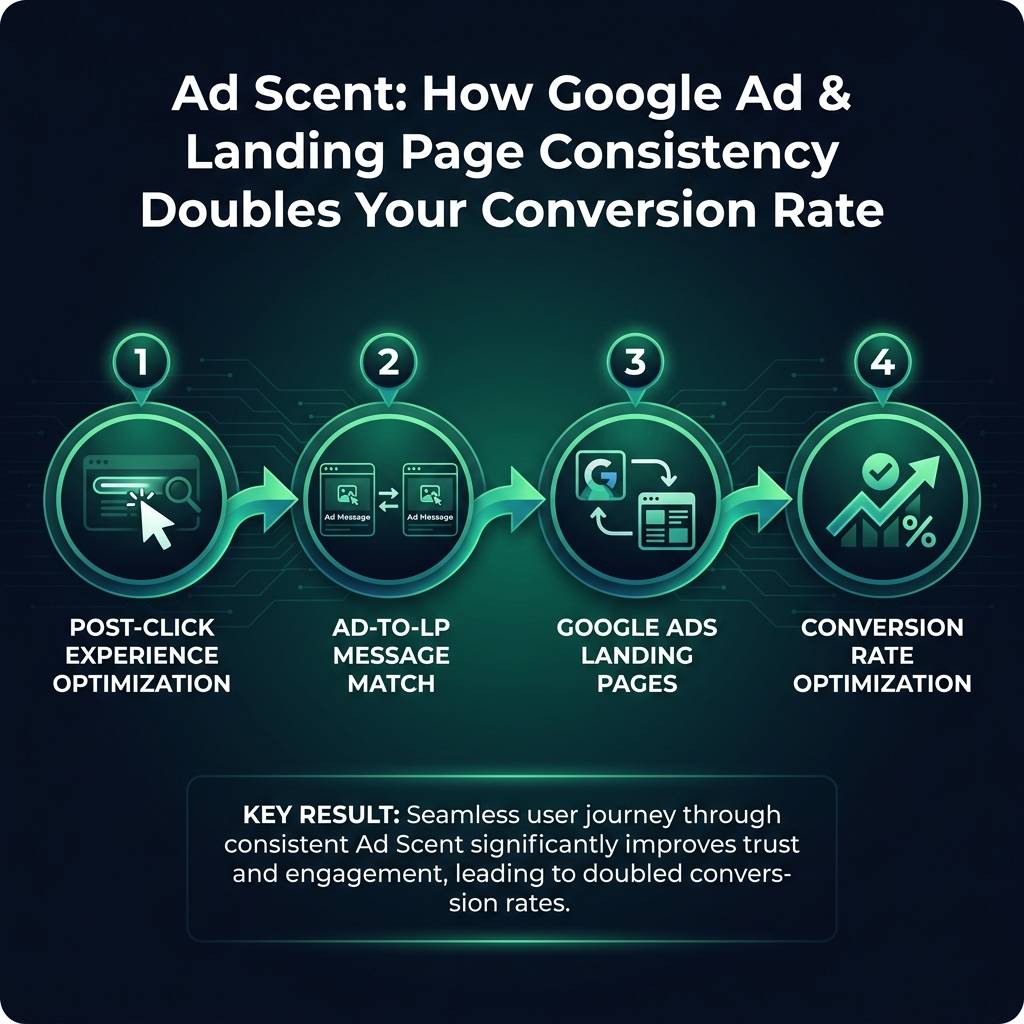

Are your Google Ads campaigns losing money despite high click-through rates? The culprit is often a poor post-click experience, where a jarring disconnect between your ad and its destination damages your return on investment. This guide will show you how to master ad-to-LP message match and implement effective conversion rate optimization strategies to fix the leaks in your paid advertising funnel.
You're paying for every click, but if visitors leave your site within seconds, the problem may not be your product - it's the broken promise between your ad and your page. We'll explain why this "ad scent" is critical for your conversions and how to fix the mismatches that are draining your ad budget.

Understanding Ad-to-LP Message Match and Its Impact on Conversions
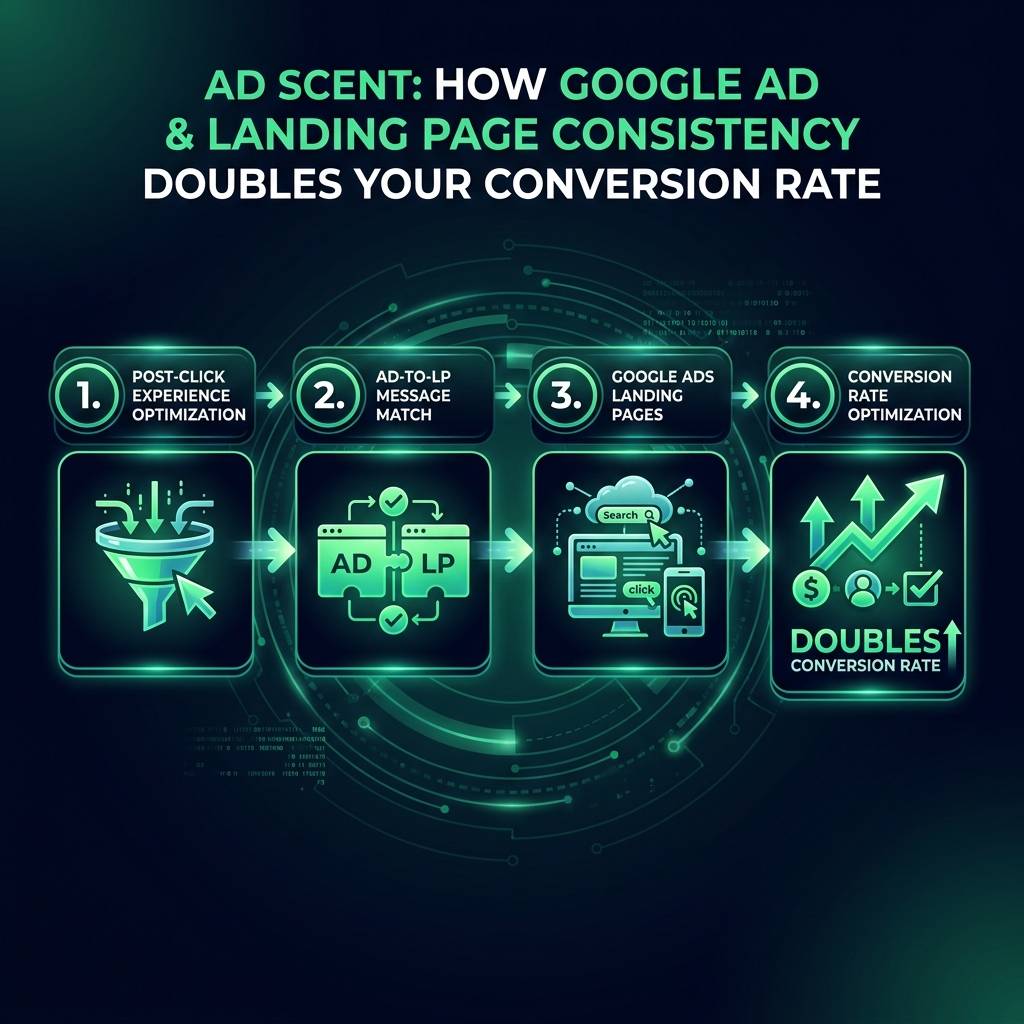
Think of ad scent, or ad-to-LP message match, as the seamless consistency between your advertisement and your landing page. When a user clicks your Google Ad promising "20% Off Running Shoes," they have a clear expectation. They anticipate landing on a page dedicated to running shoes that prominently features that exact discount. A strong message match is a fundamental principle of conversion rate optimization (CRO).
So where do they often end up? A generic homepage or a cluttered category page with no mention of the sale. This disconnect causes confusion, erodes trust, and leads to an immediate bounce. This is not just a theory; it is backed by data.
The Baymard Institute found that 68% of users who abandoned an e-commerce site cited a primary reason: "the page didn't match what I expected." The issue wasn't slow load times or poor design; it was a broken promise.
A strong ad scent creates a clear path for your visitor, guiding them from the ad directly to the conversion action. If you break that trail, they get lost and leave. The stronger the alignment between your ad copy, headline, imagery, and offer, the better your conversion rate. Perfecting this can boost conversions by over 200%. This is not just about copying and pasting text; it is about maintaining the same promise, tone, and visual cues. This brings us to the three-second rule: a visitor must know "Am I in the right place?" within three seconds. If the answer is anything but a confident "yes," your post-click experience is failing.
Auditing Your Post-Click Experience to Find Message Mismatch
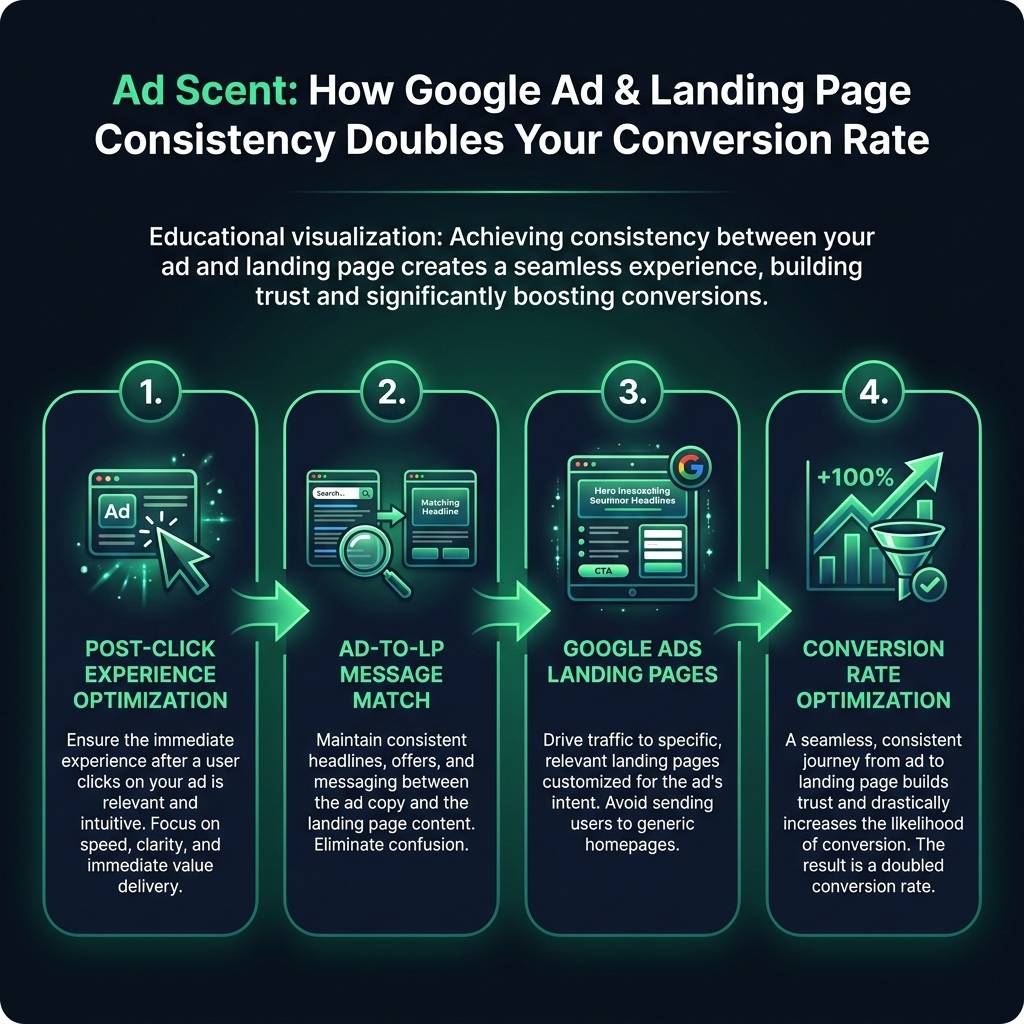
Many marketers focus on ad copy and bidding strategies but neglect to analyze their post-click experience optimization. They direct expensive, highly targeted traffic to generic Google Ads landing pages built without any connection to the campaign's message. To fix this, you must audit your highest-spending campaigns.
Start by reviewing each ad and identifying its core promise. Then, click the ad and experience the journey as a customer would.
- Headline Match: Does the landing page headline echo the ad's message? If your ad says "Get Organized in 10 Minutes," a headline like "Welcome to TaskFlow" is a failure. It should be "Finally Organize Your Entire Life in Just 10 Minutes."
- Visual Consistency: Does the main image align with the ad? If you advertise women's winter coats, the page must feature a woman in a winter coat, not a generic lifestyle photo. The visual connection is just as crucial as the text.
- Call-to-Action (CTA) Alignment: Does the CTA button use the same language as the ad? If your ad offers a "Free Trial," the button cannot say "Buy Now." Every inconsistency introduces friction and doubt.
We saw a SaaS company sending traffic for "free project management templates" to their pricing page, resulting in an 81% bounce rate. After creating a dedicated landing page with the templates front and center, their bounce rate dropped to 34%, and their conversion rate tripled. This is a classic example of successful post-click experience optimization.