
Infographic για digital marketing - οπτικοποίηση εννοιών Meta Ads, CAPI, increase conversion rate
    eyecaptain.io

    Meta CAPI & CRO: How Server-Side Tracking Increases Conversion Accuracy and Lowers CPA

    Your Meta Ads are tracking 40% fewer conversions than actually happen. Learn how CAPI fixes attribution and drops your cost per acquisition.

    EyeCaptain

    Dimitris

    05 July 2026

    4 min read
    56 views
    Meta AdsCAPIincrease conversion rateserver-side trackingconversion rate analysis

    Are your Meta Ads underperforming? If your ad dashboard reports 70 conversions but your own analytics platform shows 100, this is not a minor discrepancy - it is a critical data gap that costs you money. This guide explains how implementing the Meta Conversions API (CAPI) through server-side tracking can resolve these data gaps, leading to a significant increase in your conversion rate and more effective conversion rate analysis.

    The Problem with Browser-Only Ad Tracking

    For many years, the Meta Pixel was the standard for tracking ad performance. This piece of code on your website informed Meta whenever a user completed a valuable action. However, in today's privacy-conscious digital environment, this browser-based tracking method is becoming increasingly unreliable, resulting in incomplete data that undermines your campaign's effectiveness.

    Why Browser-Side Tracking Is Becoming Obsolete

    The traditional pixel, which operates within a user's browser, is now frequently blocked. This is not a small issue; it represents a fundamental shift in how the internet operates. Key factors driving this change include:

    • Device-Level Privacy Controls: Apple's App Tracking Transparency (ATT) framework, introduced with iOS 14.5, allows users to easily opt out of tracking. A significant majority of users globally have chosen to do so, making a large portion of mobile traffic invisible to the pixel.
    • Browser Privacy Enhancements: Modern web browsers like Safari and Firefox block many third-party tracking cookies by default. Google Chrome is also phasing out third-party cookies, which will further diminish the pixel's data-gathering capabilities.
    • Ad-Blocking Software: A growing percentage of users worldwide use ad-blocking software that often prevents tracking scripts, like the Meta Pixel, from loading at all.

    When tracking is blocked, Meta never receives the conversion data. Your pixel might report 70 sales while your e-commerce system shows 100. This data discrepancy is where the real damage occurs. Meta's algorithm, seeing only 70 sales, assumes your campaign is underperforming. It may then reduce your ad delivery or bid less effectively, increasing your cost per result and causing you to acquire fewer customers because the system is making decisions based on incomplete information.

    How CAPI and Server-Side Tracking Solve Data Loss

    The solution to this data gap is server-side tracking, implemented via the Meta Conversions API (CAPI). Instead of relying on a user's browser, CAPI establishes a direct, secure, and reliable connection between your business server and Meta's servers. This method bypasses the browser-level elements that block the pixel.

    The Advantage of a Server-to-Server Connection

    Think of CAPI as a dedicated and robust channel for your data. When a customer completes an action like a purchase on your site, your server processes the transaction and simultaneously sends that conversion event data directly to Meta. This data is sent with privacy-safe identifiers to match the conversion to the user who interacted with your ad.

    Because this communication happens between your server and Meta's server, it is not affected by browser settings, cookies, or ad blockers. It is a more durable and future-proof method for conversion tracking.

    By using both the pixel and CAPI (a setup known as Redundancy), you provide two ways to capture a conversion. The system automatically deduplicates these events, ensuring you never count the same conversion twice. The result? Instead of capturing only 60-70% of your conversions, you can reclaim that lost data and provide Meta with a much more complete picture of your campaign's true performance. This high-quality data is precisely what the algorithm needs to optimize effectively.
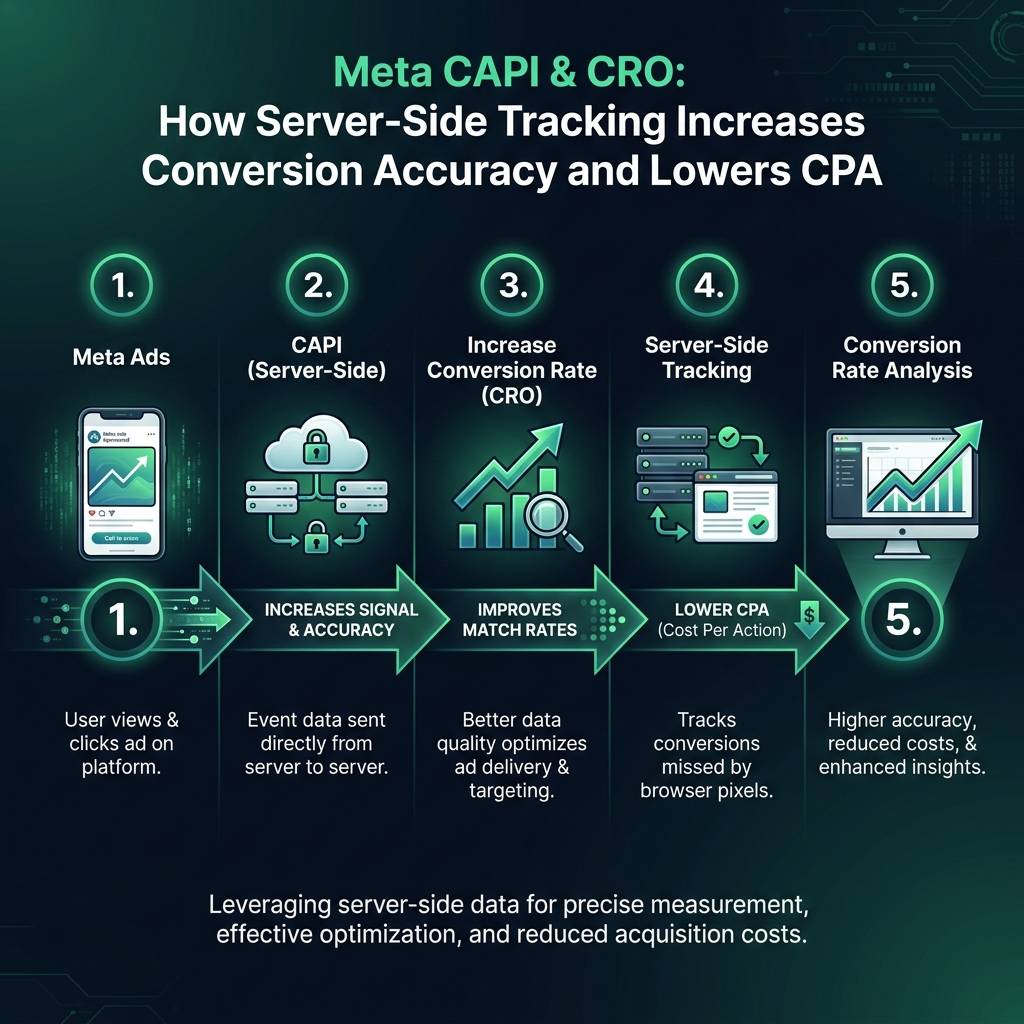

    Meta CAPI & CRO: How Server-Side Tracking Increases Conversion Accuracy and Lowers CPA infographic showing Meta Ads, CAPI, increase conversion rate for digital marketing
    EyeCaptain
    eyecaptain.io

    Boost Performance: How CAPI Helps Increase Your Conversion Rate

    The primary goal of Meta's advertising algorithm is to find you more customers at the lowest possible cost. To do this, it depends entirely on the conversion data it receives. When that data is incomplete, the entire optimization process is compromised. Implementing CAPI provides the accurate data needed to truly optimize your campaigns and increase your conversion rate.


    EyeCaptainEyeCaptain
    97%
    Conversions Booster

    Your visitors leave without converting

    Most websites lose 97% of their traffic without a single conversion. Our AI scans 200+ CRO elements to find exactly where visitors drop off.

    Hero CTA missing

    Lowering Your Cost Per Acquisition with Accurate Data

    Let's consider a simple example. Imagine you spend 1,000 units of currency on a Meta Ads campaign.

    • With Browser-Only Tracking: The pixel reports 70 conversions. Meta calculates your cost per acquisition (CPA) as 14.29.
    • The Reality: You actually achieved 100 conversions, meaning your true CPA was only 10.00.

    Based on the inflated 14.29 CPA, Meta's algorithm may conclude your ads are too expensive and reduce delivery, leaving potential customers unreached. Once you enable CAPI, Meta sees a number much closer to the true 100 conversions. It recognizes your campaign is highly efficient, bids more confidently to find similar customers, and your CPA begins to decrease. A global study from Meta confirmed this, finding that advertisers who properly implemented CAPI saw their cost per result decrease significantly.

    Improving Your Conversion Rate Analysis for Better Business Decisions

    Beyond more efficient advertising, server-side tracking creates a single source of truth that transforms your conversion rate analysis and optimization (CRO) efforts. When your ad platform and analytics tools show conflicting numbers, how can you make confident decisions? You are left guessing whether a change to your marketing or website was a success.

    CAPI helps align your data across platforms. The conversion events your server sends to Meta can be the same events sent to your analytics tools. This alignment means you can:

    • Trust your test results: When an A/B test shows a 10% lift in conversions, you can be confident Meta's algorithm also sees that lift and will optimize accordingly.
    • Optimize for higher value: Accurately track purchase values to enable Meta's algorithm to find customers with higher potential lifetime value (LTV).
    • Track the full customer journey: Capture events that browsers cannot, such as subscription renewals or offline purchases that originated from an online ad.

    Setting up server-side tracking requires a technical investment, but for any business serious about growth, it is no longer optional. The difference between optimizing on 70% of your data versus over 95% is substantial. In today's competitive landscape, advertising without it is like asking a powerful algorithm to work in the dark, while your competitors are using a complete dataset to win.

    Enjoyed this article?

    Join 1,500+ professionals getting weekly CRO & UX tips

    🎁 Bonus: Weekly CRO insights + exclusive resources

    No spam. Unsubscribe anytime.

    🚀 Boost Your Conversion Rate with EyeCaptain

    EyeCaptain is an AI-powered CRO & UX analysis tool that automatically scans your pages, identifies UX issues, and gives you actionable optimization suggestions to increase conversions. Try it for free, no card, no commitment.

    Free CRO Audit

    Did you find this helpful?

    Share it with someone who might find it useful.

    Be the first to learn CRO secrets

    Actionable tips, case studies & early access to new AI tools. Weekly in your inbox.

    1,200+ marketers trust us

    Cookie Settings

    We use cookies to improve your experience.