The Ultimate A/B Testing Guide
No jargon, no fluff. Just a straight-up guide that takes you from "what even is an A/B test?" to running experiments like a pro. With real examples, honest tool reviews, and the stats stuff explained like a human would explain it.
So... What Actually IS A/B Testing?
Let's keep this simple. You have a webpage (or an email, or an ad, anything digital, really). You suspect there's a better version of it out there. So instead of guessing, you create two versions: the one you already have (that's "A," the control) and one with a change (that's "B," the variant). You show version A to half your visitors and version B to the other half, then you see which one gets more people to do the thing you want, buy, sign up, click, whatever. That's it. That's A/B testing.
It's basically the scientific method, but for your website. Instead of two scientists arguing over which formula is better, you let your actual customers vote with their behavior. And the beautiful part? It's not about who has the best opinion in the room, it's about what the data says. Your designer might love the blue button. Your CEO might insist on green. A/B testing settles the debate for good.
Fun fact: this idea goes way back. A guy named Sir Ronald Fisher basically invented statistical testing in the 1920s for agricultural experiments. Fast forward to the internet age, and Google took it to the extreme, they once tested 41 different shades of blue for their links. Sounds obsessive? Maybe. But that test reportedly brought in an extra $200 million a year. So yeah, shades of blue can matter. Today, companies like Netflix, Amazon, and Booking.com run thousands of tests at the same time. For them, testing isn't a nice-to-have, it's how they do business.
And don't think A/B testing is just for websites. You can test email subject lines ("20% off!" vs "Your exclusive deal inside"), ad headlines, pricing pages, onboarding flows, even push notification copy. The principle is always the same: change one thing, measure what happens, learn from it. The only real requirement? Enough traffic to get meaningful results. Otherwise, you're basically reading tea leaves.
Why Should You Actually Care?
Look, I get it. "testing" doesn't sound as exciting as "launch a new campaign" or "redesign the whole site." But here's the thing: A/B testing is probably the highest-ROI activity you're NOT doing right now.
Here's the math that keeps me up at night: Google Ads costs go up by about 15% every year. But the average e-commerce conversion rate? Stuck at 2-3%. Think about what that means, you're paying more and more to send people to a website that hasn't gotten any better at converting them. That's like pouring water into a leaky bucket and buying more water instead of fixing the holes. A/B testing fixes the holes. Even a tiny 0.5% boost in conversion rate can mean hundreds of thousands of euros for a mid-size online store. And you don't spend a single extra cent on ads.
But it's not just about money (though the money part is pretty nice). Every test you run teaches you something about your customers. What words resonate with them. What confuses them. What makes them trust you. Even a "failed" test, one where the variant didn't win, gives you a valuable data point. Over time, this knowledge adds up into something your competitors can't buy: a deep, nuanced understanding of the people who give you money.
Get More from What You Have
Why pay for more visitors when you can convert more of the ones already showing up? A 1% bump in conversions on 100K monthly visitors means 1,000 more customers, without spending a cent more on ads. That's real money.
Sleep Better at Night
Launching a big redesign without testing is like jumping out of a plane without checking your parachute. Testing lets you validate changes before going all-in. If a variant tanks, no problem, you just keep the original. Zero risk.
Actually Understand Your Customers
Every test is a conversation with your users. They're telling you, through their behavior, what works and what doesn't. Over time, you build this incredible library of insights that makes every marketing decision smarter.
The Snowball Effect
5% up this month, 3% next month, 7% the month after. Each win is small on its own, but they stack. Companies that test consistently grow 2-3x faster than those that don't. It's compound interest for your conversion rate.
The Mindset That Changes Everything
Here's a truth that's hard to swallow: you don't know what works. I don't know what works. Your designer doesn't know. Your CEO definitely doesn't know (sorry, boss). The CXL Institute ran a study where they asked CRO experts to predict A/B test winners. These are people who do this for a living. Their accuracy? About 50%. The same as flipping a coin. Let that sink in.
That's why A/B testing isn't just a tool, it's a completely different way of thinking. Traditional marketing is about having the best ideas and the most experience. Experimentation-driven marketing is about admitting you might be wrong and letting the data decide. And you know what? The companies that get this right absolutely destroy their competition.
Google, Amazon, Netflix, Microsoft, what do they all have in common? Testing is in their DNA. At Google, nothing big launches without an experiment. At Netflix, even the thumbnail images you see are the winners of thousands of tests. Microsoft's experimentation platform runs millions of experiments per year. MILLIONS. These aren't companies that test when they have time. They've built their entire product development around it.
My favorite story? Bing (yes, Microsoft's search engine) ran a tiny experiment adding relevant links to search results. Someone had suggested it before but it got dismissed as "too minor to matter." When they finally tested it, it increased revenue by 12%. that's over $100 million a year. One hundred million dollars, sitting there, because someone thought the idea was too simple. That's what happens when you don't test.
Think Like a Scientist
Observe → Hypothesize → Test → Analyze. Every single test should follow this cycle. No random changes "just to see what happens." Have a theory, test it, learn from it.
Stay Humble
Accept that you'll be wrong. A lot. The best testing programs treat "failed" tests as tuition fees, you paid to learn something. A losing test that teaches you about your users is worth more than a lucky win you can't explain.
Speed Beats Perfection
Don't agonize over the perfect test. Run lots of good tests instead. Booking.com runs 25,000+ tests per year. The competitive advantage isn't having the smartest people, it's learning faster than everyone else.
"If you're not testing, you're guessing. And guessing in business is expensive."
— Peep Laja, Founder of CXL
Types of Testing. Pick Your Weapon
There's more than one way to test. Here are the main approaches, when to use each, and how much traffic you'll need.
A/B Testing
This is the one you've probably heard about. You take your current page (that's the "A," or control) and create a slightly different version (the "B"). Then you show each version to half your visitors and see which one gets more people to do what you want, sign up, buy, click. Simple as that.
Multivariate Testing (MVT)
Okay, so what if you want to test a bunch of things at once? Like 3 different headlines, 2 images, and 2 CTAs? That's 12 combinations. MVT lets you find the winning combo, but here's the catch, you need a LOT of traffic. We're talking tens of thousands of visitors. If you don't have that, stick with regular A/B tests.
Split URL Testing
Sometimes you want to test something so radically different that a tweak won't cut it. Maybe a completely new checkout flow, or a totally redesigned landing page. In split URL testing, you send half your traffic to a different URL entirely. It's like A/B testing, but on steroids.
Bandit Testing (Multi-Armed)
Here's a clever one. Instead of splitting traffic 50/50 and waiting weeks, bandit testing automatically sends more visitors to whichever version is winning, in real-time. It's great when you can't afford to wait, like during a flash sale. The tradeoff? You sacrifice some statistical rigor, but you make money faster.
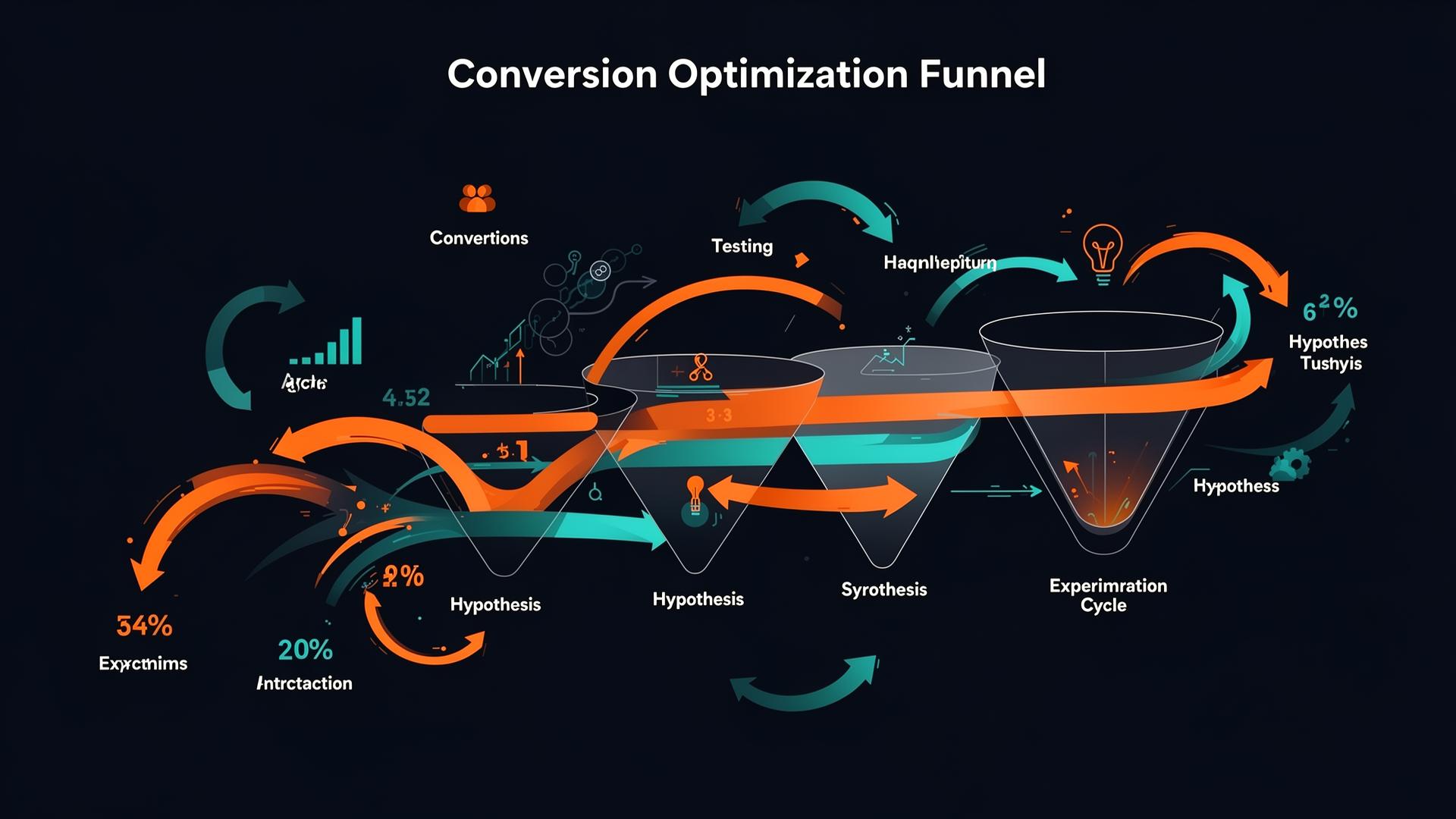
The 7-Step Process (That Actually Works)
Follow this step by step and you literally can't go wrong.
1. Dig Into Your Data
Before you test anything, look at what's actually happening on your site. Pull up your analytics and find the pages where tons of people visit but barely anyone converts. Those are your goldmines. Use heatmaps and session recordings too, they'll show you exactly where people get stuck, confused, or just leave. You'd be surprised how often the problem is obvious once you actually watch people using your site.
2. Come Up with a Hypothesis
Don't just randomly change stuff. Write down what you think will happen and why. Use this formula: "If we [change X], then [metric Y] will go up by [Z%] because [reason]." For example: "If we change the button from 'Submit' to 'Get My Free Report,' form submissions will go up by 15% because it tells people exactly what they're getting." See? Now you're not guessing, you're being scientific about it.
3. Prioritize with ICE
You probably have a dozen ideas for tests. So which one do you run first? Score each one using ICE: Impact (1-10). how big could the win be? Confidence (1-10). how sure are you it'll work? Ease (1-10). how easy is it to build? Multiply the three numbers and start with the highest score. It's not perfect, but it's way better than going with your gut feeling.
4. Pre-validate with AI (Save Yourself Weeks)
Here's where it gets exciting. Before you spend real traffic, use AI tools like EyeCaptain to predict where people will look on both versions. If your new design doesn't actually draw more attention to the buy button, why bother testing it live? This single step can save you weeks of wasted time and thousands of visitors sent to a losing variant.
5. Set Up the Test
Time to get technical (but don't worry, it's not hard). Set your traffic split, usually 50/50 is fine. Pick ONE main metric you care about most (conversion rate? revenue per visitor?). Set up tracking to make sure everything's being measured correctly. And use a sample size calculator to figure out how many visitors you need. Skipping this part is like starting a road trip without checking if you have enough gas.
6. Let It Run (and Don't Touch It!)
This is the hardest part, doing nothing. Let the test run until it hits statistical significance (95%+ confidence). I know it's tempting to peek after 2 days and declare a winner, but early results are incredibly misleading. Run for at least 2 full weeks to catch weekday vs weekend behavior. Go have a coffee. Catch up on Netflix. Just don't stop the test early.
7. Learn, Apply, Repeat
Got a winner? Awesome, implement it and write down what you learned. No clear winner? That's okay too! Figure out why, was the change too small? Not enough visitors? Every single test, even the "failures," teaches you something valuable about your customers. Then take what you learned and start the whole cycle again. This is where the magic of compounding kicks in.
Stats Made Simple (Promise, No Headaches)
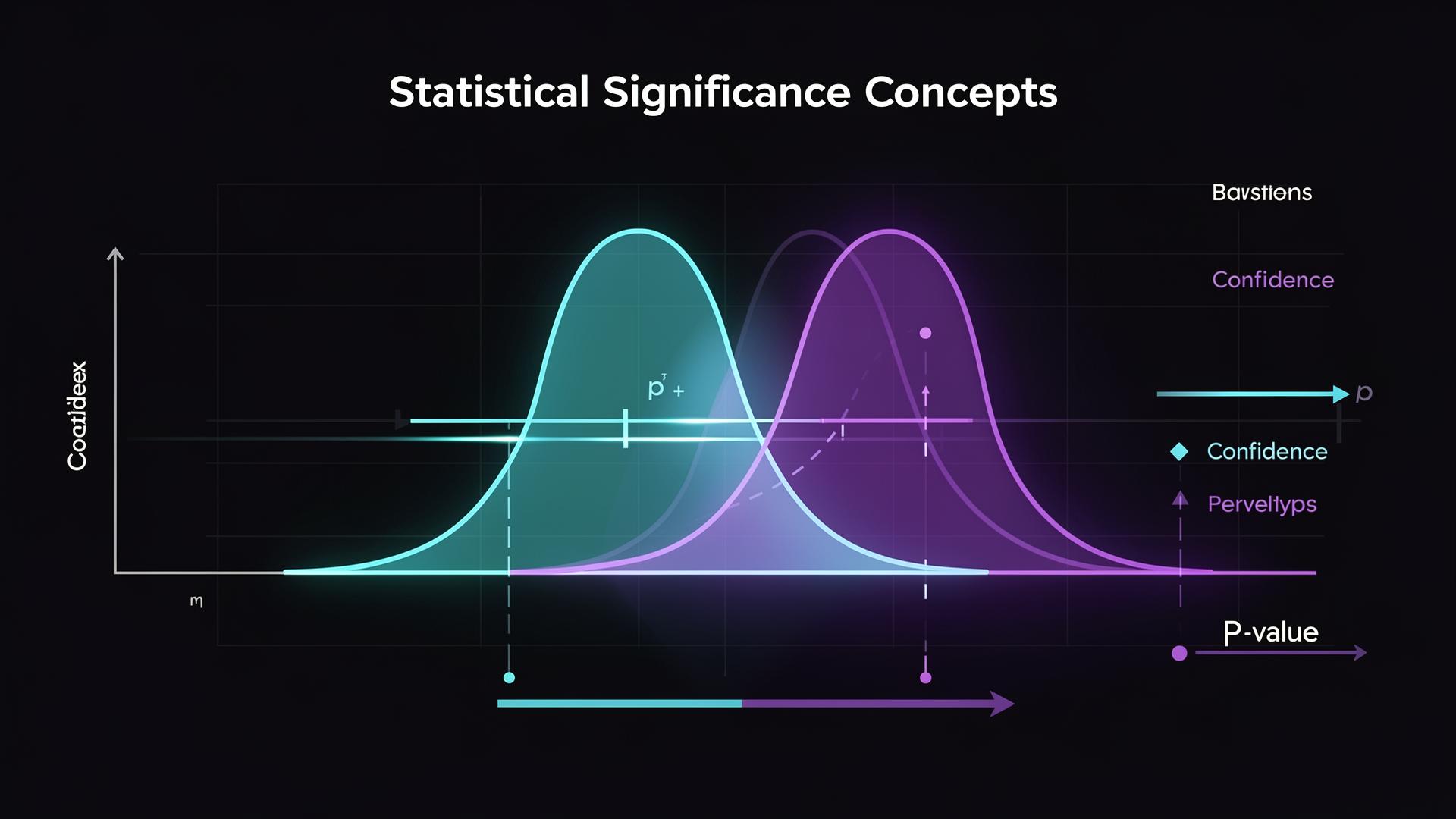
Okay, let's talk about the scary part, statistics. But I promise to make this painless. Statistical significance basically answers one question: "Is this result real, or did I just get lucky?" When you see a result is "statistically significant at 95%," it means there's only a 5% chance the difference between your variants is just random noise. That's pretty solid.
Think of it like this: you flip a coin 10 times and get 7 heads. Is the coin rigged? Eh, probably not. 7 out of 10 isn't that unusual. But flip it 10,000 times and get 7,000 heads? Yeah, something's definitely up with that coin. A/B testing works the same way. With a small number of visitors, weird things happen all the time. With thousands of visitors, the patterns become trustworthy. Statistical significance tells you exactly when you have enough data to believe what you're seeing.
And here's where most people screw up: they check results way too early. Your test's been running for 3 days, Variant B looks 20% better, and you think "that's good enough, let's ship it!" Nope. Those early numbers are the most unreliable thing in the world. There's even a name for this. "regression to the mean." Early leads tend to shrink (or even reverse!) as more data comes in. Studies show that peeking at results daily can push your false positive rate from 5% to over 30%. That means roughly 1 in 3 of your "winners" aren't actually better. They just got lucky.
p-value (Don't Panic)
This number tells you the odds that your result is just random noise. You want it below 0.05, meaning less than 5% chance it's a fluke. The lower the p-value, the more confident you can be. Most tools calculate this for you automatically, so don't sweat the math.
Confidence Level
The flip side of p-value. If your p-value is 0.05, your confidence is 95%. Basically: "we're 95% sure this result is legit." The industry standard is 95%. Some people use 90% for early-stage tests, but I wouldn't go lower than that.
Sample Size (How Many People?)
This is how many visitors you need per variant. It depends on your current conversion rate and how small a change you want to detect. There are free calculators everywhere, just Google "A/B test sample size calculator." Please use one. Seriously.
Statistical Power
This is your test's ability to actually catch a real winner when there is one. The standard is 80%. If your power is too low, you might have a winning variant right in front of you and miss it because your test wasn't set up to detect it. More power = more visitors needed.
Bayesian vs Frequentist (The Great Debate)
Frequentist (Old School)
- You decide sample size before starting
- Uses p-values, you've seen these in school
- NO peeking allowed (really, don't)
- Just tells you yes or no, no nuance
Bayesian (The Cool Kid)
- You CAN peek, the math handles it
- Tells you "B has 94% chance of winning"
- Way more intuitive for non-stats people
- Needs prior assumptions (sounds scarier than it is)
What Should You Actually Test?
Enough theory, here are concrete test ideas you can steal and run today.
| Element | Test Example | Impact | Metric |
|---|---|---|---|
| Product Page Headlines | "Premium Running Shoes" vs "Run Faster, Feel Better" | High | Conversion Rate |
| Add-to-Cart Button | Green vs Orange, "Add to Cart" vs "Buy Now" | High | Add-to-cart rate |
| Price Display | "€99" vs "€99 (Save 40%)" vs "3 payments of €33" | Very High | Revenue per visitor |
| Product Images | Studio photos vs lifestyle photos vs 360° views | High | Conversion Rate |
| Social Proof | Star ratings vs written reviews vs "X people bought today" | Medium-High | Conversion Rate |
| Checkout Flow | Single page vs multi-step, guest checkout vs forced registration | Very High | Checkout completion rate |
| Shipping Info | "Free shipping" badge placement, delivery date vs speed | High | Cart abandonment rate |
| Urgency Elements | Countdown timer, "Only 3 left", "Sale ends tonight" | Medium | Conversion Rate |
12 Mistakes That'll Ruin Your Tests
I've seen all of these. Multiple times. Learn from other people's pain.
#1Pulling the plug too early
You check after 2 days, see Variant B winning by 20%, and stop the test. Big mistake. Those early numbers are lying to you, random fluctuations, day-of-week effects, you name it. Wait for statistical significance. Always.
#2Sneaking peeks at results
Every time you check your results before the test is done, you're essentially running a new significance test. Do that 10 times and your false positive rate shoots from 5% to over 30%. Translation? One in three of your "winners" isn't actually better. Ouch.
#3Changing everything at once
You changed the headline, swapped the image, rewrote the CTA, AND moved the form. Congrats, it worked! But... which change actually made the difference? You have no idea. Test one thing at a time. That's the whole point.
#4Ignoring segments
Your test shows "no difference" overall. But wait, did you check mobile vs desktop? New visitors vs returning? Sometimes Variant B crushes it on mobile but tanks on desktop, and the overall average hides everything. Always segment your results.
#5Tracking the wrong metric
You optimized for clicks and got tons more clicks. Awesome, right? Except... none of those clickers actually bought anything. Make sure you're measuring what actually matters to your business, revenue, qualified leads, real conversions. Not vanity numbers.
#6Testing without a hypothesis
"Let's try a green button instead of blue." Cool, but why? If you can't explain why a change might work, you won't learn anything even if it wins. Always start with a "because." Your future self will thank you.
#7Way too small a sample
50 visitors per variant and you're declaring a winner? That's like asking 3 friends if your restaurant idea is good. You need real numbers. For a 5% baseline conversion rate and 20% improvement target, plan for at least 1,500 visitors per variant. Use a calculator, don't guess.
#8Falling for Simpson's Paradox
This one's sneaky. Your data shows Variant B wins overall. But when you break it down by segment, it actually loses in EVERY single one. How? The traffic mix was skewed. More high-converting mobile users happened to see Variant B. Always look at segment-level data, not just the total.
#9Ignoring seasonality
You ran a test during Black Friday and got amazing results. Great! But those results don't apply to a regular Tuesday in March. Seasonal patterns, promotions, and even the news cycle can all mess with your data. Keep the context in mind.
#10Sweating the small stuff
You've spent 3 months testing button colors. Meanwhile, your value proposition is a mess and nobody knows what you're selling. Test the big things first: headlines, offers, page layout, pricing. Those are where the real money is. Button colors can wait.
#11Letting the boss override data
HiPPO = Highest Paid Person's Opinion. The CEO "feels" the other version is better? Cool, but the data says otherwise. This happens ALL the time and it kills testing cultures. If you're going to test, you have to commit to following the data, even when it's uncomfortable.
#12Not writing down what you learned
You ran 50 tests this year and can't remember what most of them taught you. Sound familiar? Keep a simple log: what you tested, what happened, and what you learned. Otherwise, you'll end up running the same tests twice, and your team won't benefit from past insights.
Tools. Honest Reviews (No Sponsored BS)
What's actually worth your money.
Google Optimize (Sunset → GA4)
Free (discontinued)It was free and plugged right into Google Analytics. Now it's been replaced by GA4 experiments, which are... basic, to put it nicely.
It's dead, Jim. GA4 experiments are very limited.
Basic tests if you're already on GA4
VWO
From $199/moThe Swiss Army knife of CRO. Visual editor, heatmaps, surveys, session recordings, it's got everything. Teams love it because you don't need to juggle 5 different tools.
Not cheap for small businesses. Advanced features have a learning curve.
Mid-size to enterprise businesses serious about CRO
Optimizely
Custom pricing ($$$$)The Ferrari of A/B testing. Enterprise-grade with feature flags, server-side testing, and a stats engine that statisticians drool over. If you need the best of the best, this is it.
Expensive. Overkill if you're just starting out. Setup can be complex.
Enterprise with high traffic and engineering resources
AB Tasty
From $299/moSuper user-friendly visual editor. AI-powered personalization that actually works. Plus, it's a European company, so GDPR compliance is baked in, no headaches.
No free tier. Some good features locked behind expensive plans.
European companies that need GDPR + CRO in one place
Convert.com
From $99/moThe privacy-first option. They don't store personal data at all. Flicker-free testing (your visitors won't see the page "flash" during loading). And their support team is genuinely helpful, like, actually responds.
Smaller community. Not as well-known as VWO or Optimizely.
Privacy-conscious companies, agencies
Kameleoon
Custom pricingAI-driven personalization that's seriously impressive. Both server-side and client-side testing, plus feature management. Their predictive targeting is probably the best in the market.
Enterprise pricing, not for the faint of wallet. Complex for beginners.
Enterprise with personalization needs
Real Stories, Real Numbers
These aren't made up. These are actual results from companies you know.
Booking.com
"Only 2 rooms left!". that little message you see everywhere on Booking? It works. Scarcity drives decisions. And here's the kicker: they run over 25,000 experiments per year. It's not luck, it's a system.
HubSpot
They did something ridiculously simple: removed the navigation menu from landing pages. Fewer links = fewer distractions = more signups. Sometimes the best tests are the ones that take things away.
Amazon
"Customers who bought this also bought...". you know that section? It generates 35% of Amazon's total revenue. Thirty-five percent! That's the power of personalized recommendations backed by continuous testing.
Obama 2008 Campaign
They tested different hero images and CTA buttons on the donation page. The winning combination? It brought in an extra $60 million in donations. Sixty. Million. Dollars. From one A/B test.
AI + Testing = The Future (and It's Already Here)
Here's the frustrating truth about traditional A/B testing: most tests fail. Like, a LOT of them. Industry data says only about 1 in 7 tests produces a statistically significant winner. That means 85% of the time, you're sending traffic to losing variants. That's a lot of wasted visitors, wasted time, and wasted opportunity. It's like going on 7 job interviews and only getting 1 callback.
This is where AI comes in and changes the game. Tools like EyeCaptain use machine learning trained on millions of eye-tracking sessions to predict where people will look on your page, before you send a single visitor. Imagine being able to see your design through your customers' eyes before launching the test. You can weed out the obvious losers and only test the variants that actually have a shot. It's not replacing testing, it's making every test count.
And it goes way beyond pre-screening. AI can analyze your analytics, heatmaps, and user behavior to automatically suggest test ideas you might never have thought of. It can predict how long a test needs to run. And the really exciting stuff? Real-time personalization, where AI doesn't just pick a winner, but shows different versions to different users based on their behavior, all automatically. The future of testing isn't just faster, it's smarter.
See Through Your Customers' Eyes
AI attention prediction shows you exactly where people will look on your page. Is your CTA getting noticed? Is your hero image distracting from the form? Know before you launch.
Let AI Find the Opportunities
Instead of brainstorming test ideas in a meeting, let AI crunch your data and spot patterns you missed. It's like having a tireless analyst who's looked at millions of websites.
Test Smarter, Not Harder
Why test 10 ideas when AI can tell you 7 of them are duds? Pre-screen everything, test only the top 2-3, and get results in half the time. More wins, less waste.
The Smarter Workflow
Questions You're Probably Asking
Be the first to learn CRO secrets
Actionable tips, case studies & early access to new AI tools. Weekly in your inbox.
1,200+ marketers trust us