Generative Engine Optimization for Product and Service Pages
EyeCaptain

Generative Engine Optimization for Product and Service Pages

Generative engine optimization for product and service pages: write direct answers, specs in text, structured data and FAQs that AI assistants can cite.

Dimitris Andreadakis

8 min read
412 views
generative engine optimizationoptimize product pages for AI searchhow to get cited by ChatGPTGoogle AI Overviews optimizationstructured data for AI search

Generative engine optimization for product and service pages means making each page easy for AI assistants to read, verify and quote. In practice: answer the buyer's main question in the first lines, put specs and prices in plain text, add accurate structured data, include a real FAQ, and keep the same facts everywhere your business appears online.

ChatGPT, Perplexity and Google AI Overviews do not publish ranking formulas, and anyone who claims to know the exact weighting is guessing. What we do know: these systems can only cite what they can find, parse and trust. The same changes also help human buyers, so the work pays off either way.

What is generative engine optimization, and how is it different from SEO?

Generative engine optimization (GEO) is the practice of structuring content so AI systems that write answers can understand it and cite it as a source. Classic SEO aims at a ranked list of links. GEO aims at being one of the few sources an assistant draws from when it composes a single answer.

The two overlap heavily. Google's Search Central guidance on AI features says the same fundamentals apply: crawlable pages, helpful content and indexable text. The difference is emphasis. GEO rewards pages where each fact stands on its own as a clean sentence, because an assistant lifts sentences, not whole layouts.

How do AI assistants decide which pages to cite?

Nobody outside these companies knows the exact rules. Public documentation points to a few requirements you can control:

  • Access. The page must be reachable by the crawler the tool uses. OpenAI documents OAI-SearchBot for ChatGPT search and Perplexity documents PerplexityBot. If your robots.txt or firewall blocks them, you cannot be cited from a fresh crawl.
  • Readable text. Facts in HTML text are easy to extract. Facts baked into images, PDFs or JavaScript widgets that load after interaction are harder or impossible.
  • A clear match to the question. If someone asks "does this blender crush ice", a page that says "Crushes ice in under a minute with the pulse setting" answers it. A page that says "Power you can feel" does not.
  • Corroboration. When your site, marketplace listings and review sites state the same price and specs, the fact looks reliable.
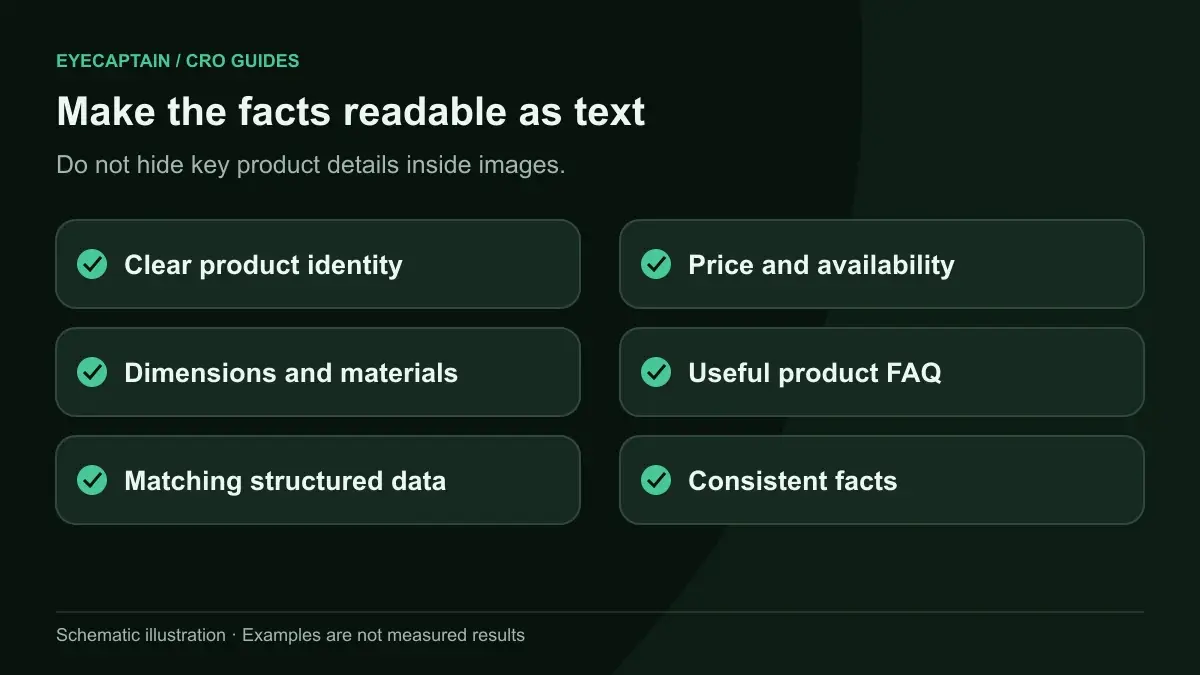
Make the facts readable as text. Do not hide key product details inside images.EyeCaptain

What should go in the first lines of a product or service page?

The first lines should state what the thing is, who it is for, and the one or two facts a buyer needs to decide. Write it as a plain sentence a stranger could quote without context.

Compare two openings for the same product. Weak: "Meet the future of hydration." Strong: "The Trail 750 is a 750 ml insulated steel bottle that keeps drinks cold for 24 hours, fits standard car cup holders and costs $34." The second answers four questions at once and helps the shopper who scans for five seconds too. If you want a broader view of what buyers look for on these pages, our product page best practices guide covers the layout side.

For service pages, state scope, location, price model and turnaround.

Why should specs and prices be in text, not images?

Specs in text can be read by every crawler, screen reader and translation tool. Specs inside an image or PDF depend on recognition that may not happen at all. Keep the graphic if you like it, but add the same specs as an HTML table or list.

Watch for these common hiding places:

  • Size charts uploaded as JPGs.
  • Ingredients or materials shown only in a product photo of the label.
  • Prices that appear only after selecting a variant.
  • Key details inside accordions that load their content by script after a click. Collapsed content that is already in the HTML is fine; content fetched on click may not be.

Which structured data matters for AI search?

Structured data in schema.org format tells machines exactly which value is the price, which is the brand and which is the rating. For product pages, use Product with a nested Offer (price, currency, availability) and, if you collect genuine reviews, AggregateRating. For service businesses, use Organization or LocalBusiness and Service. Use BreadcrumbList on both.

Two rules keep structured data useful. It must match the visible page, as Google's structured data guidelines require. And it must stay current: a JSON-LD price that lags behind the page price is a conflict that makes the fact look unreliable.

Page typeSchema types to useFacts to state in visible text too
Product pageProduct, Offer, AggregateRating, BreadcrumbListPrice, currency, stock, dimensions, materials, warranty, shipping time
Service pageService, LocalBusiness or Organization, BreadcrumbListService area, price model, turnaround, credentials, what is included
SaaS pricing pageSoftwareApplication, Offer, OrganizationPlan names, monthly price, limits, free trial terms, cancellation terms
FAQ section on any pageFAQPage (optional)Each question and full answer in HTML

Note that Google limited FAQ rich results in 2023 to authoritative government and health sites, so do not expect snippets from FAQPage. The visible questions and answers still matter.
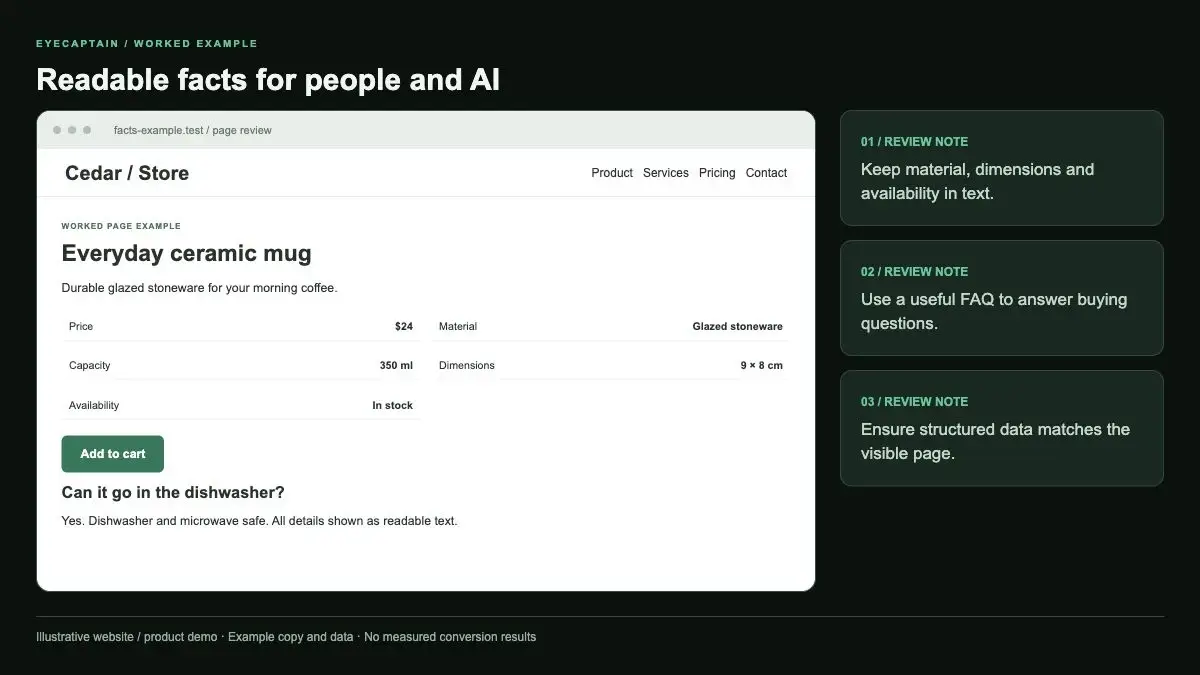
Readable facts for people and AI. Keep material, dimensions and availability in text. Use a useful FAQ to answer buying…EyeCaptain

How do you write an FAQ that AI assistants can use?

Write questions in the words buyers use, and answer each in two to four sentences that make sense without the question. Pull questions from support tickets, chat logs and the "People also ask" box.

Good FAQ answers start with the answer. "Yes, the Trail 750 is dishwasher safe on the top rack. Hand washing keeps the powder coat looking new for longer." Bad answers start with filler: "Great question! At Trail, we care deeply about..." Keep each answer specific to this product. Clear answers also reduce anxiety at the point of decision, the same principle behind good form microcopy.

EyeCaptainEyeCaptain
Conversions Booster

Your visitors leave without converting

Most websites lose 97% of their traffic without a single conversion. Our AI scans 200+ CRO elements to find exactly where visitors drop off.

Hero CTA missing

Why do consistent facts across the web matter?

AI assistants often draw on several sources for one answer. If your site says the warranty is two years and your Amazon listing says one year, the system has to pick one or hedge. Fix the sources you own.

Audit these places for the same core facts: your product or service page, Google Business Profile, marketplace listings, comparison and review sites where you have a profile, your social bios, and press pages. If you renamed a product, say so: "Previously sold as the Trail Pro."

How do you run a GEO check on one page?

Audit one page in under an hour:

  1. Ask the assistants. Type three buyer questions about your product into ChatGPT, Perplexity and Google. Note whether you appear and whether the facts are right.
  2. Check access. Open robots.txt and your CDN or firewall rules. Confirm you are not blocking the crawlers of the tools you care about.
  3. View the page without scripts. Disable JavaScript or view the page source. Can you still find the price, specs and main claim?
  4. Rewrite the opening. Make the first two sentences a quotable answer: what it is, who it is for, the deciding facts.
  5. Move specs into text. Add an HTML table for anything that only lives in images or PDFs.
  6. Validate structured data. Run Google's Rich Results Test and confirm every value matches the visible page.
  7. Add or fix the FAQ. Four to eight real questions with direct answers.
  8. Align external facts. Update your top three external listings to match.
  9. Recheck in a few weeks. Ask the same questions again.
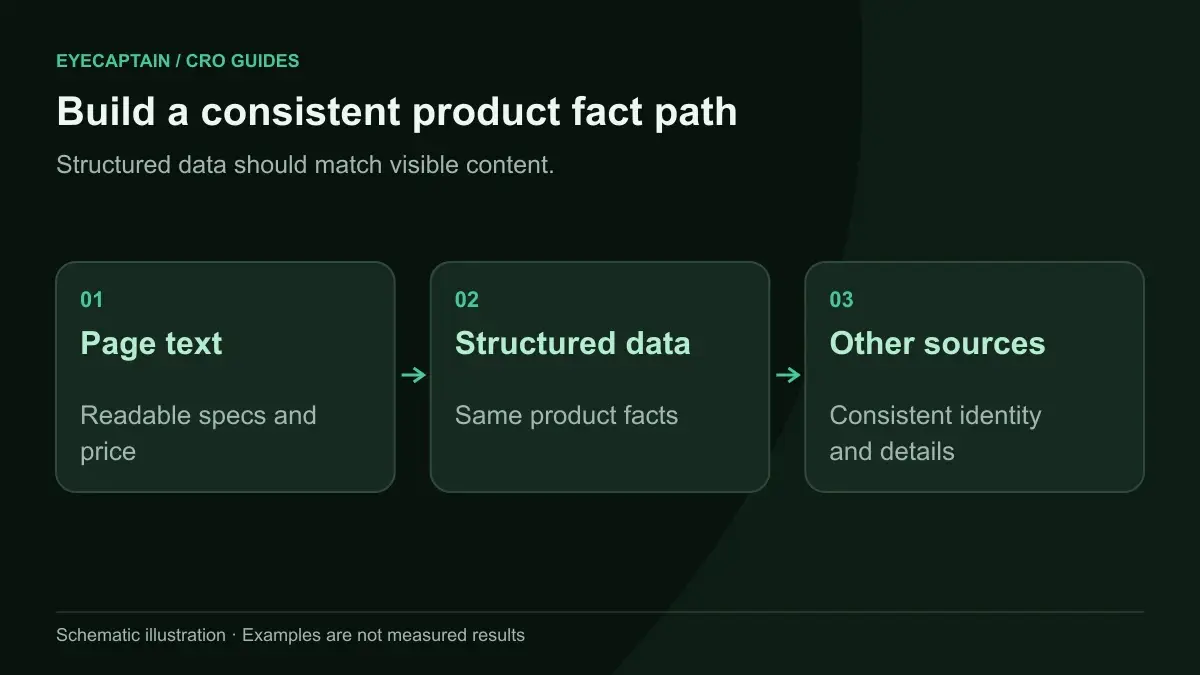
Build a consistent product fact path. Structured data should match visible content.EyeCaptain

What does this look like on a real-world page?

Take a hypothetical online store selling a ceramic pour-over coffee set. Its current page opens with a lifestyle photo and the line "Slow mornings, perfected." Capacity and materials live in an image carousel, the JSON-LD shows last season's price, and its marketplace listing says "porcelain" while the site says "ceramic".

The fixes: open with "A ceramic pour-over set for one to two cups: dripper, 600 ml glass server and 40 paper filters, $48." Add a short spec table. Update the Offer price. Pick one material term and use it everywhere. Add an FAQ answering "Which filters fit?", "Is it dishwasher safe?" and "Does it work on a mug?" The design does not need to change.

Key takeaways

  • No one outside the AI companies knows exact citation rules, so focus on what you control: access, clear text, accurate markup and consistent facts.
  • Open every product and service page with a quotable sentence that states what it is, who it is for and the deciding facts.
  • Put specs, prices and terms in HTML text, and make structured data match the visible page.
  • Write FAQ answers that start with the answer and stand alone.
  • Most GEO fixes also make the page clearer for human buyers, which helps conversion directly.

Clarity problems show up in conversion data long before they show up in AI answers. A free CRO audit on EyeCaptain checks one page for unclear messaging, buried facts and weak calls to action. For a wider review, see the CRO checklist.

Keep product facts consistent. Visible content and structured data must describe the same item.EyeCaptain

Frequently asked questions

Is GEO replacing SEO?

No. GEO builds on SEO rather than replacing it. AI assistants that search the web still rely on pages being crawlable, indexable and relevant, which is classic SEO work. GEO adds emphasis on clear, self-contained statements, consistent facts and structured data. A site with weak technical SEO will usually struggle with AI citations too, so fix crawl and indexing issues first.

Should I block AI crawlers in robots.txt?

It depends on your goal. Blocking a search crawler such as OAI-SearchBot or PerplexityBot can stop those tools from citing fresh versions of your pages. Some publishers block training crawlers but allow search crawlers. Check each company's documentation, because training and search bots often use different user agents. For most stores and service businesses, being citable is worth more than blocking.

How can I tell if ChatGPT or Perplexity sends me traffic?

Check referral traffic in your analytics for domains such as chatgpt.com and perplexity.ai. Some visits arrive without a referrer, so the numbers undercount. You can also add a "How did you hear about us?" field to checkout or lead forms. Manually asking the assistants your buyers' questions each month gives you a simple qualitative check.

Does schema markup guarantee my product appears in AI answers?

No. Structured data helps machines read your price, availability and ratings accurately, but no provider promises that markup leads to citation. Treat schema as a way to remove ambiguity, not a ranking switch. Its value depends on the visible page being clear and the markup matching it exactly.

How long does GEO take to show results?

There is no fixed timeline. Changes appear only after the relevant crawlers revisit your page, and each system refreshes on its own schedule. Expect weeks rather than days. Track a fixed set of buyer questions over time instead of judging after one check, and keep improving the page for human visitors in the meantime.

Enjoyed this article?

One short email a week with practical CRO and UX tips

No spam. Unsubscribe anytime.

Find what stops your visitors from converting

EyeCaptain is an AI-powered CRO & UX audit tool that automatically scans your pages, identifies UX issues, and gives you actionable optimization suggestions to increase conversions. Try it for free, no card, no commitment.

Free Website Audit
Share this article
LinkedIn X

About the author

Founder of EyeCaptain. Writes about conversion rate optimization, UX analysis and the neuromarketing behind pages that actually sell.

More articles by Dimitris Andreadakis